
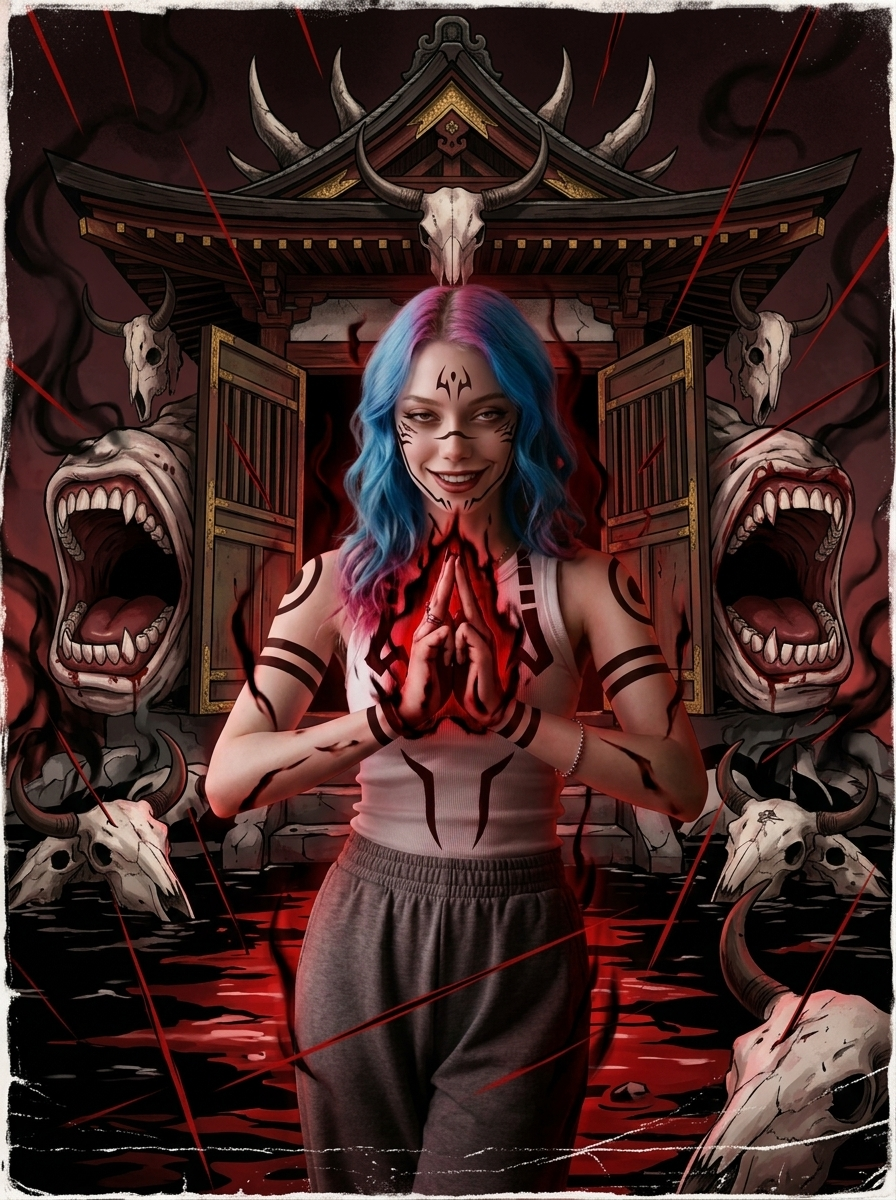
What Makes This Sukuna Domain Expansion Portrait So Unsettling?
The Malevolent Shrine edit works because it transplants the viewer's face into a visual language built entirely around contempt. Sukuna's signature expression — the half-lidded eyes, the predatory grin — is not decorative. It is a power statement. When that expression is placed on a familiar face, the result reads as both personal and cosmic in scale.
The environmental layering amplifies this. The warped zushi cabinet, the gaping-mouthed shrine entrances, the bull skulls on ink-black reflective water — these are not background elements. They are proof that the domain has already opened. The slash marks cutting through the frame's edges reinforce that the violence is not contained; it is already happening.
Color discipline is what locks it together. The restricted palette — blood crimson, bone white, pitch-black water, oxidized gold — gives the composition the feel of a ceremonial woodblock print elevated to threat level. Nothing is decorative. Everything signals malice.
Key Insight: A domain expansion portrait succeeds not by adding horror elements, but by making the subject's expression the most dangerous thing in the frame — the environment exists only to confirm it.
How to Customize Your Sukuna Domain Expansion Prompt
Tip 1: Shift the hand seal to change the curse implication
The Enmaten mudra is tied specifically to Sukuna's "cooking" domain metaphor. Swap it for a different seal — such as the Tora (Tiger) or Kai (Ocean) hand sign — and the generated image will carry a different mythological weight while keeping the JJK visual aesthetic intact.
Change: [HAND SIGN] mudra name and its symbolic association
Tip 2: Adjust the expression intensity on a spectrum
The current expression is calibrated to maximum sadistic amusement. For a more subdued result, replace "predatory grin" with "cold, unreadable calm" and "half-lidded contemptuous confidence" with "flat, absolute certainty." This produces a different register of Sukuna — less theatrical, more ancient.
Change: [EXPRESSION] — smirk descriptor and eye-lid description
Tip 3: Replace shrine type to shift domain mythology
The zushi (miniature shrine cabinet) is specific to Malevolent Shrine. Replacing it with a torii gate emerging from black water, or a collapsed altar overgrown with curse markings, will generate a domain that reads as a different JJK technique — same visual grammar, different mythological claim.
Change: [ENVIRONMENT] — shrine description block and ground material
Common Pitfall: Removing the slash mark signature effect strips the most recognizable Malevolent Shrine identifier from the frame. Without the thin red lines cutting through the image border, the result looks like a dark anime portrait — not a domain expansion. Keep [SIGNATURE EFFECT] even when changing other elements.
Frequently Asked Questions
Can I use a group photo or does this only work with solo portraits?
Solo portraits produce the most consistent results because the expression and hand seal require a single focal subject. Group photos can work, but the model will typically apply the Sukuna transformation to only one figure or produce inconsistent cursed aura placement across multiple faces.
Why does the expression specification include such detailed eye and brow direction?
Because micro-expression language determines whether the result reads as threatening or merely dramatic. Sukuna's look is built on a specific combination — slight downward gaze, one raised brow, half-lidded contempt — that communicates hierarchy. Without those specifics, the model defaults to a generic villain smirk that loses the sadistic amusement register entirely.
What aspect ratio works best for this domain expansion portrait?
2:3 portrait orientation works best because it gives enough vertical space to show the hand seal at chest level while keeping the shrine architecture visible behind the subject. Square crops lose either the mudra detail or the shrine's upper horn protrusions.