
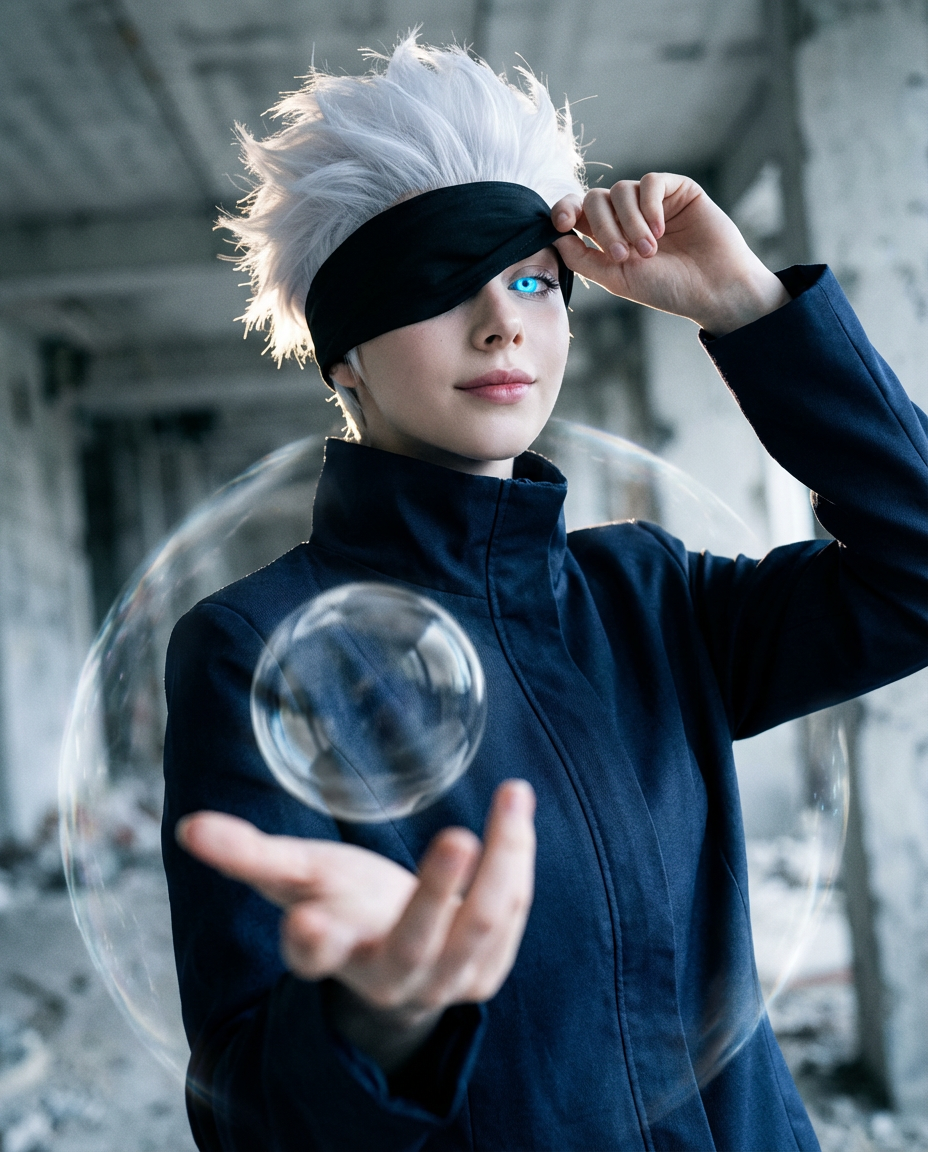
What Makes the Satoru Gojo Cosplay Portrait Work?
The result hits the "I am the strongest" nerve with precision. Gojo's signature gesture — blindfold raised with two fingers, one eye uncovered — is the anime's most iconic still frame, and transposing a real face into that exact moment creates a recognition jolt that stops scrolling. This is not a costume photo; it is a power fantasy portrait.
The cinematography amplifies this: a low-angle shot looking up from below the chin is specifically a dominance composition. Combined with the ice-blue eye being the most saturated point in an otherwise desaturated steel-blue frame, the viewer's gaze is pulled to that single eye before anything else registers. This is selective color saturation as an editorial tool, not a filter effect.
The infinity void — a translucent sphere of distorted air above the palm — is handled with restraint. It does not overwhelm the face. Light bends around it like a gravitational lens, making it visible without competing with the eye highlight. The result reads as a scene from a film rather than a generated image.
Key Insight: The desaturated palette is not an aesthetic choice — it is a containment strategy. By draining color from everything except the ice-blue eye, the composition forces a single focal hierarchy on a half-body shot that might otherwise compete with the background and the palm effect.
How to Customize Your Satoru Gojo Cosplay Portrait
Tip 1: Shift the Emotional Register
The current result defaults to Gojo's "quiet superiority" mode — calm smirk, no anger. For a battle-mode variant, replace the expression directive with something more intense: "focused stare, jaw set, zero expression." The ice-blue eye reading changes entirely depending on expression.
Change: Expression section — "calm, confident smirk — not anger, just quiet superiority"
Tip 2: Adjust the Background Intensity
The demolished concrete interior pushes the portrait into a post-battle context. For a cleaner editorial look, replace it with "plain white cyclorama, soft shadowless light." This removes the narrative frame and makes the cosplay read as a studio portrait shoot rather than a scene.
Change: Background descriptor — "Demolished concrete interior background, out of focus"
Common Pitfall: Requesting a full-body shot breaks the low-angle dominance composition. This prompt is calibrated for a half-body view — the hand-to-eye proportion and the upward angle only work at that framing. Changing to full-body produces a different character read.
Frequently Asked Questions
Can I use this with my own photo if I don't look like a Satoru Gojo cosplayer?
Yes — the prompt preserves your exact facial features from the uploaded photo regardless of resemblance to Gojo. The cosplay elements (white hair, blindfold, dark jacket) are added by the model, not derived from your reference. Upload any face and the transformation applies on top.
Why is everything desaturated except the ice-blue eye?
Selective saturation creates a single focal hierarchy — when one element is the only saturated point in the frame, the viewer has no choice but to look there first. This is a standard technique in editorial photography and movie poster design to direct gaze without cropping. The eye becomes the narrative center.
Can I adjust the lighting style while keeping the Gojo character read?
Yes, but carefully. The strong backlight rimming the white hair is load-bearing for the character recognition — removing it turns the hair from "glowing white" to "flat gray." If you adjust lighting, keep the rim light directive and only change the quality, for example replacing "strong backlight" with "soft backlight."