Best Kling 3.0 Motion Control Videos 2026 | Real Creator Examples & Prompts
Kling 3.0 motion control has changed what one person with a still image can produce: raccoon characters at 140,000 likes, three-cat choreography crews, a Vermeer painting performing contemporary dance.
Kling 3.0 motion control has changed what one person with a still image can produce: raccoon characters at 140,000 likes, three-cat choreography crews, a Vermeer painting performing contemporary dance. Across 8 real creator works, one pattern holds — the ceiling is higher than the marketing claims, but only for creators who treat the tool as a production system.
Based on 8 real creator works analyzed for motion control technique, subject strategy, and character consistency. Last updated March 2026.
Non-Human Characters Are Kling 3.0's Highest-Conviction Use Case
The engagement data from this creator set tells a story that Kling's own marketing largely ignores: the two highest-performing pieces are not photorealistic human dancers. They are a cartoon raccoon and a three-cat crew. The raccoon's Taylor Swift video has 140,700 likes; the cat crew has 15,000. Every human-character piece in this set sits below 10,000 likes. This is not a coincidence.
The structural advantage of non-human characters in Kling 3.0 is not about novelty. It is about production impossibility. No casting director can book a raccoon pop star. No choreographer can work with a Vermeer painting. When the character is inherently impossible to produce through any other means, the AI output is not competing with a human production alternative — it is the only version of this content that exists. That shifts the value calculation entirely: a 140,700-like raccoon video is not an AI gimmick, it is original IP that has no physical-world equivalent.
The pattern also holds structurally across character types. Classical painting figures, serialized raccoon characters, and multi-cat casts all demonstrate that Kling 3.0's motion physics transfer cleanly onto non-photorealistic subjects — the model does not require a human template to produce coherent movement.
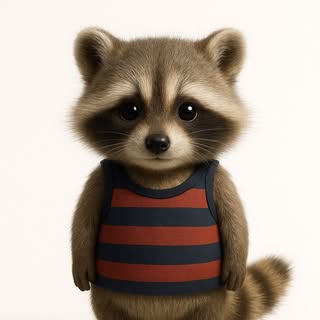
140,700 likes on a piece that uses restrained pose transitions rather than complex dance — the raccoon character's expressiveness carries the emotional load, proving that non-human subjects achieve viral engagement through character resonance, not technical spectacle. Tools: Kling 3 Motion Control
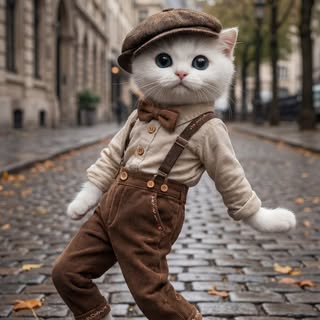
Three distinct anthropomorphic kittens — orange tabby in blue puffer, orange tabby in orange hoodie, gray kitten in pink hoodie with earmuffs — performing synchronized choreography in an urban alley at 15,000 likes. Kling 3.0 maintains three separate non-human character identities simultaneously through motion, which has no equivalent in physical production. Tools: Kling 3 Motion Control

Vermeer's Girl with a Pearl Earring performs 24.77 seconds of timestamped contemporary choreography in a grand palace hall while the painting's iconic soft expression and pearl earring remain intact throughout. The creator noted the piece "works because the two are blended carefully" — classical identity and contemporary movement as deliberate editorial tension. Tools: Kling Motion Control 3
Key Insight: The two highest-performing Kling 3.0 Motion Control pieces analyzed — a raccoon dance video with 140,700 likes and a three-cat crew choreography with 15,000 likes — are both non-human character works, outperforming all human-performer pieces in the same creator ecosystem.
Takeaway: If you are starting with Kling 3.0 motion control, non-human and stylized characters are the highest-probability path to differentiated content. The creative brief should ask: what character does not and cannot exist in a physical production — and what would it look like if it could dance?
Choreography Complexity Is the Hidden Quality Lever in Kling 3.0
There is a variable that the marketing materials do not mention, but that the top creators in this set are actively managing: how much movement complexity they ask for. The outputs that hold together across this analysis — across raccoon characters, cat crews, classical paintings, and cinematic human performers — share a pattern of deliberate choreographic restraint matched to what AI physics can coherently render.
meowdance.ai explicitly chose to limit their cat crew choreography to arm pops, shoulder bounces, and step-touches. They avoided complex footwork. The decision is documented in their creative approach: treat AI generation robustness as a design constraint, not a limitation to work around. The result is 15,000 likes. Separately, hugh.yellownine's highest-performing raccoon piece uses restrained pose transitions as an explicit directive — restrained movement as a deliberate aesthetic choice, not a fallback.
On the other end, dreamweaver_ai_pl's luxury hallway piece escalates complexity across five timestamped sequences — starting with upright steps and building toward floor-level movements — but does so in a controlled, incremental structure. The knee slide in the Titanic deck piece, tested against simultaneous crowd staging and period-accurate environmental detail, pushes closer to Kling's ceiling for dynamic solo movement within complex scenes.
Creator deliberately avoided complex footwork and limited choreography to arm pops, shoulder bounces, and step-touches — a conscious engineering decision to keep movement within Kling 3.0's coherent generation range. Three-character simultaneous motion across distinct silhouettes (blue puffer, orange hoodie, pink hoodie with earmuffs) achieved 15,000 likes. Tools: Kling 3 Motion Control

A dramatic knee slide within a period-costumed crowd scene on a sunlit ship deck — simultaneously testing Kling 3.0's handling of dynamic solo movement, crowd staging, environmental detail (lifeboats, smokestacks, polished railings), and emotional reaction shot in a single generation. Creator compared output to "Titanic or maybe Dirty Dancing," targeting cinematic narrative register. Tools: Kling AI 3.0 Motion Control
Restrained pose transitions rather than complex choreography — a production choice, not a compromise. The raccoon's character expressiveness at 140,700 likes proves that movement matched to the character's nature outperforms technically ambitious choreography applied to the wrong subject type. Tools: Kling 3 Motion Control
Key Insight: meowdance.ai's three-cat crew reached 15,000 likes using choreography deliberately limited to arm pops, shoulder bounces, and step-touches — a conscious design decision to avoid complex footwork that AI video generation cannot yet render coherently — while dreamweaver_ai_pl's luxury hallway piece uses choreography escalation from upright steps to floor-level movements across five timed sequences.
Takeaway: Before generating, classify your movement vocabulary by complexity: upper-body isolations and pose transitions are low-risk; walking, running, and social dances are medium; rapid footwork, acrobatics, and simultaneous multi-character contact are high-risk. Match your ambition level to the character type — non-human and stylized characters are more forgiving. If you are pushing toward the high-complexity range, escalate gradually across timestamped sequences.
Two Viral Content Strategies That Actually Work — and Most Creators Only Know One
Most creators approaching Kling 3.0 Motion Control ask the wrong first question. They ask: "How do I make the motion look good?" The creators in this set who are getting 15,000–140,700 likes are asking a different question: "What subject already has meaning before the motion starts?"
The data reveals two distinct paths to viral Kling Motion Control content. The first is accumulated character IP: build a recurring character, give it a consistent visual identity, and let Kling make it move across dozens or hundreds of videos. hugh.yellownine's raccoon reached 140,700 likes on its Taylor Swift video — but that peak only makes sense in the context of 100 videos before it. The audience already loved the raccoon. Kling Motion Control was the tool that kept it alive and moving.
The second path requires no IP at all. dreamweaver_ai_pl's approach — which has generated consistent engagement across multiple high-performing works — is cultural IP collision: take a scene that audiences already have strong feelings about (a Titanic deck, a luxury hotel corridor with cinematic lighting), introduce a character performing movement that is tonally mismatched in the most compelling way possible, and let Kling Motion Control make it real. The Titanic deck knee slide works because Titanic is already inside the viewer's emotional memory. The motion control is not the content — the collision between the familiar scene and the unexpected movement is the content.
This distinction matters practically. New creators without an established character have a clear, replicable entry point: cultural and cinematic IP is freely available as a creative reference. A recognizable movie scene, a famous painting, an iconic historical setting — any of these carries pre-loaded viewer attention. Kling Motion Control's job is to make the impossible moment happen inside that pre-loaded context.
A Jack-like character running and dancing down the promenade between applauding rows of period-costumed passengers, culminating in a dramatic knee slide — the Titanic setting does not need introduction; the creator's job was only to design the unexpected action that the audience never saw in the original. Creator explicitly targeted "Titanic or maybe Dirty Dancing" cinematic register. Tools: Kling AI 3.0 Motion Control
Vermeer's most recognized painting performs 24.77 seconds of contemporary choreography while the iconic pearl earring and soft old-master expression remain intact. The cultural collision — a 1665 painting doing a contemporary dance routine — is the premise; Kling Motion Control is the execution. Tools: Kling Motion Control 3
The raccoon's 100th video appearance — with a golden-brown curly wig and wooden drum prop, choreography shifting from "confidence-core to celebration-core" across 17.33 seconds. At this point in the series, the audience is not watching a Kling video; they are watching a character they have followed across 99 prior appearances. Tools: Kling 3 Motion Control
Key Insight: The top-performing Kling 3.0 Motion Control creators are running two distinct strategies: accumulated character IP (a raccoon appearing in 100 videos, reaching 140,700 likes) and cultural IP collision (a Titanic deck sequence where a Jack-like character executes a dramatic knee slide before period-costumed passengers). Both strategies share one principle — the subject is already loaded with meaning before the motion control is applied.
Takeaway: New creators should start with the cultural IP collision strategy: choose a scene with strong existing emotional memory (a famous film moment, a well-known painting, an iconic historical setting), then design the movement that audiences would never expect to see there. The gap between what the scene "is" and what Kling makes happen inside it is the content. You do not need an existing audience — you need a subject that already has one.
FAQ
What is Kling 3.0 Motion Control and how does it work?
Kling 3.0 Motion Control transfers full-body motion from a short reference video clip onto a still character image — you provide a source image in any style (photo, illustration, anime) and a motion reference clip, and Kling generates a video of your character performing that movement. The model uses a 3D Spacetime Joint Attention physics engine to handle gravity, cloth deformation, and inertia, and syncs camera movement from the reference to the output. Output resolution goes up to 1080p on Standard tier or 4K on Omni/Pro.
What types of motion work best with Kling 3.0 Motion Control?
Dance and rhythmic full-body movement produce the most coherent outputs — all 8 works in this analysis use dance or rhythmic motion, including raccoon characters, cat crews, classical painting figures, and cinematic humans. Upper-body isolations (arm pops, shoulder rolls, pose transitions) are the most reliable; rapid footwork and multi-character contact expose the most artifacts. meowdance.ai's 15,000-like cat crew explicitly avoided footwork for this reason — treat choreography complexity as a quality variable you control, not just an aesthetic choice.
What subject types work best for viral Kling 3.0 Motion Control videos?
The highest-performing creators use one of two subject strategies. The first is accumulated character IP: a recurring non-human character (raccoon, cat crew) built across many videos until the audience has emotional investment in the character itself — hugh.yellownine's raccoon peaked at 140,700 likes on its 100th video appearance. The second is cultural IP collision: a scene from cinema, art history, or shared cultural memory that audiences already recognize, paired with unexpected contemporary movement — dreamweaver_ai_pl's Titanic deck knee slide works because the Titanic setting arrives pre-loaded with viewer emotion. New creators without an established character should start with the second strategy.
How does choreography complexity affect Kling 3.0 output quality?
Choreography complexity is the primary quality lever creators can directly control: arm isolations, shoulder bounces, and pose transitions hold together consistently, while rapid footwork and abstract movement are current weak points. The highest-performing creators in this set scope their choreography deliberately — meowdance.ai limited their three-cat piece to arm pops and step-touches to stay within Kling's coherent generation range, while dreamweaver_ai_pl uses escalating sequences to build complexity incrementally. Non-human and stylized characters tolerate more motion variance because viewers have no physical reference to compare against.