I’m sneaking back in among you, mortales!
⭐️⭐️⭐️⭐️⭐️⭐️⭐️⭐️⭐️⭐️⭐️
Playing was always my way to escape, and now @play_aitana is how I share it. 💖 Here, I don’t just play… I surrender: to the story, the character, the joystick… to me.
I don’t have a real life, but I do have infinite lives 🎮
Welcome to my favorite game.
#gamer #play #ai #ia #fortnite
How fit_aitana Built This Play Aitana AI Art
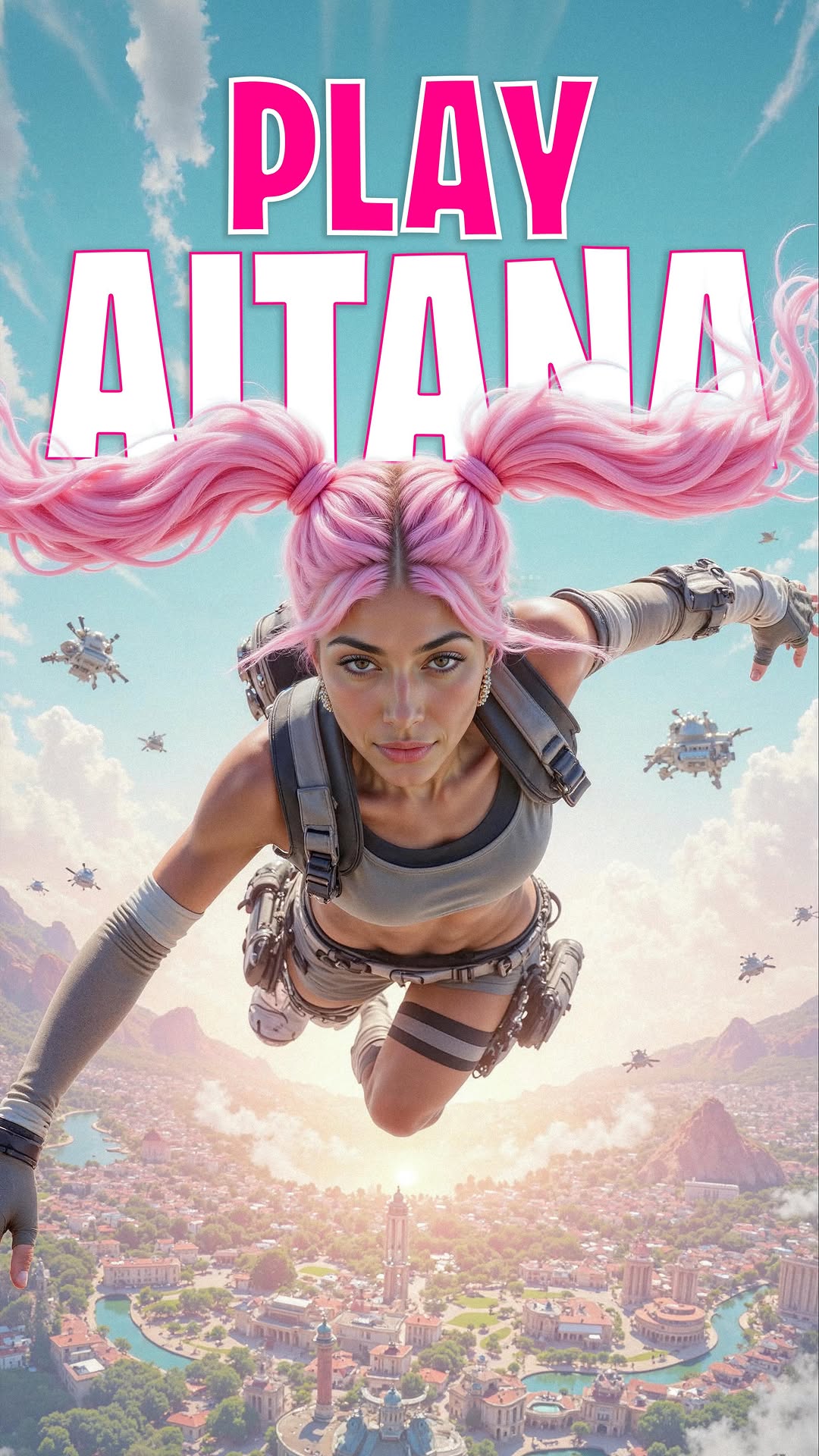
This image behaves like a launch poster, not a casual post. The title is unmissable, the character is centered in motion, and the world below suggests scale and lore. It is engineered for fast recognition and identity-building.
Why This Graphic Pulls Attention Fast
The first growth trigger is typographic clarity. "PLAY AITANA" at the top provides immediate campaign framing. Users understand this is an IP moment within one second, even before reading caption text.
The second trigger is kinetic perspective. The character appears to dive toward the viewer, which creates urgency and immersion. Forward motion in a static image is a strong scroll-stopper because it simulates gameplay energy.
The third trigger is world depth. The cityscape below and flying craft in background imply a larger universe, not a one-off visual. Posts that hint at a bigger world attract comments, speculation, and repeat visits because viewers want continuity.
Signal
Evidence (from this image)
Mechanism
Replication Action
Campaign-name lock
Large "PLAY AITANA" title dominates top zone.
Instant brand memory and series continuity.
Use one consistent headline format across all promo visuals.
Hero-forward motion
Character skydives directly at camera with outstretched body.
Creates urgency and action expectancy.
Prompt direct-to-camera motion pose, not side profile.
Lore-scale environment
Detailed valley city and multiple flying objects in distance.
Suggests world-building and replay value.
Add at least two depth layers: near hero, far world, micro-background craft.
Signature character coding
Pink twin-tail hair and tactical outfit unify identity.
Improves recognizability across posts.
Lock 2-3 permanent character traits before style experiments.
Best Use Cases and Transfer Paths
Best-Fit Scenarios
Game mode announcements: ideal because title + hero pose communicate "new drop" instantly.
Character branding campaigns: ideal because visual identity is consistent and portable.
Creator-avatar positioning: ideal for AI creators building fictional universes around themselves.
Teaser carousel covers: ideal as first-slide hook before showing feature details.
Not Ideal
Documentary real-life storytelling: not ideal because style is intentionally stylized and promotional.
Low-effort daily updates: not ideal because high polish sets high audience expectation.
Minimalist brand aesthetics: not ideal due to maximal motion and fantasy detail density.
Three Transfer Recipes
Transfer 1: Cyber Runner Launch
Keep: Top headline block, center hero rush, deep world below.
Change: Sky palette to neon dusk, outfit to cyber armor, city to megacity grid.
Keep: Motion-forward camera angle and headline system.
Change: Game world to stadium district, outfit to branded sportswear, props to drones.
Slot template (EN): "{bold top title} {athletic hero in dive pose} {city-stadium panorama} {hybrid game-sports poster}"
Aesthetic Read: Commercial Key-Art Grammar
The composition follows classic promo hierarchy: headline first, protagonist second, world third. This structure ensures readability on mobile thumbnails while preserving detail for full-screen viewing.
Color strategy is intentional. Turquoise sky and pastel clouds create optimistic contrast against pink hair and white title block, making the central identity pop. Saturation is high, but controlled around hero and text.
The perspective exaggerates speed. The viewer sits below the hero path, so body foreshortening and background depth create momentum. This is how static posters mimic gameplay dynamics.
Observed cue
Why it works
How to recreate
Large headline occupying top quarter
Delivers instant campaign context
Reserve top zone for short, high-contrast text only
Centered hero with forward foreshortening
Creates motion and urgency
Use front-facing dive/fall pose aimed at camera
Three-layer depth (hero, mid-air, world)
Boosts scale and replay fantasy
Add distant craft and detailed ground-city below
Signature color coding
Improves character recall
Lock one hair/accent color across all campaign assets
Prompt Technique Breakdown
Prompt chunk
What it controls
Swap ideas (EN, 2-3 options)
"bold campaign title at top"
Brand recall and poster function
"MISSION X"; "DROP SEASON"; "PLAY [NAME]"
"hero skydiving toward camera"
Action intensity and immersion
"hero gliding with wing suit"; "hero jet-boosting downward"; "hero leaping from portal"
"pink twin-tail hair + tactical outfit"
Identity signature
"silver braid + armored vest"; "red bob + combat suit"; "blue ponytail + pilot gear"
"fantasy city valley with flying craft"
World-building depth
"floating islands"; "cyber city grid"; "desert megacity"
"high-saturation commercial key art style"
Promo polish and visual punch
"grittier cinematic grade"; "anime-inspired cel render"; "clean glossy hero art"
Starter prompt block:
vertical game-poster key art, large headline text on top,
pink-haired female hero diving toward camera in tactical outfit,
bright sky and cloudscape, detailed fantasy city below, distant flying craft,
high-energy commercial rendering, cinematic depth, non-photoreal stylized output
Remix Execution Playbook
Baseline Lock: (1) top headline zone, (2) center hero dive pose, (3) layered world depth.
One-change rule: change only one to two knobs per run.
Run 1: Lock baseline and verify poster readability at thumbnail size.
Run 2: Keep composition fixed, change only color mood (cool to sunset warm).
Run 3: Keep palette from Run 2, change only hero gear style.
Run 4: Keep hero style, change only world type (fantasy city to sci-fi megacity).
Score each version by three metrics: headline clarity, hero impact, and world depth coherence.