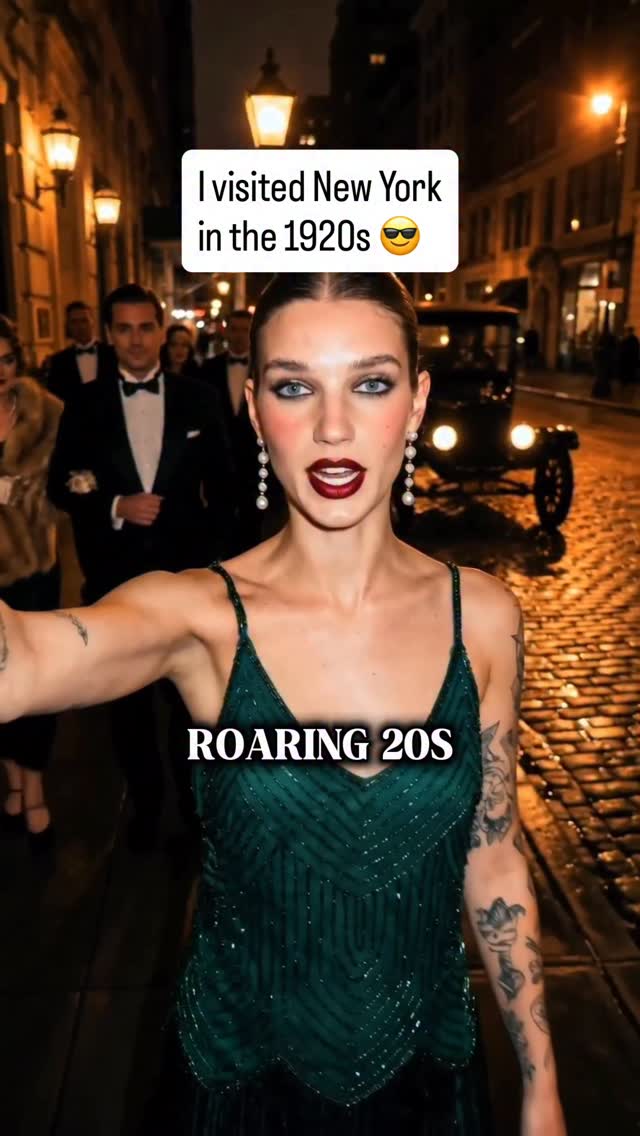
How chloe.vs.history Made This Roaring Twenties New York Selfie — and How to Recreate It
This image works because it fuses two visual systems that usually do not belong together. The background is coded like a period drama: wet cobblestones, vintage headlights, eveningwear, amber streetlamps, and a narrow New York street that feels locked in another century. The foreground is coded like a present-day post: arm-out selfie framing, direct eye contact, beauty-forward styling, and a cheeky text bubble that turns the whole scene into a joke you can instantly repeat in your own head.
The Real Hook
The strong move here is not just “1920s aesthetic.” It is time-travel through social grammar. The image borrows the familiar language of modern phone culture and drops it into a Roaring Twenties fantasy. That mismatch is what makes it sticky. Viewers do not need to study the image for ten seconds to understand it. They get the bit immediately, and the period styling adds just enough richness to reward a longer look.
The emerald beaded dress is also doing more work than it first appears. It acts as the color anchor, the glamour signal, and the texture contrast against the dark wet street. Without it, the image would read like a costume photo. With it, the image becomes fashion content with a historical fantasy wrapper.
Signal Table
| Signal | Evidence (from this image) | Mechanism | Replication Action |
|---|---|---|---|
| Instant meme readability | The selfie framing and chat-bubble copy communicate the joke immediately | Fast comprehension improves shareability and repost potential | Use a familiar posting format first, then place it inside an unexpected world |
| Period immersion | Vintage car, evening crowd, amber lamps, and glossy cobblestones sell the era | Background specificity makes the fantasy believable | Choose 3-4 historically coded props and lock them hard in the prompt |
| Fashion focal point | The green beaded dress catches light and separates the subject from the street | Texture and color give the eye a clean center of gravity | Pick one garment with high reflective value and make it the only rich color accent |
| Modern intimacy | The arm-out perspective feels personal instead of cinematic-from-a-distance | Selfie grammar creates immediacy and social closeness | Make sure the phone viewpoint feels physically plausible and close to the face |
| Nightlife glamour | Warm light, lipstick contrast, and wet pavement create an upscale nocturnal mood | Beauty styling plus reflective surfaces increases visual richness | Use warm practical light and reflective ground rather than adding random effects |
Aesthetic Read
The image lands in a very useful zone between cosplay, editorial portrait, and internet humor. It is glamorous, but not stiff. It is funny, but not sloppy. The tattoos and bold makeup keep the main figure from feeling like a museum-perfect reconstruction. That slight anachronism helps the image feel like a post made by a person, not a costume study built for accuracy points.
The lighting is also well judged. The streetlamps and headlights create the romance, but the face is still readable. That balance matters. If the scene became too dark or too realistic, the shareable charm would collapse. This kind of content depends on visual clarity as much as mood.
Where This Format Transfers Best
This prompt logic can travel into many adjacent niches: Paris in the 1890s, disco-era club exits, old Hollywood arrivals, medieval market selfies, or futuristic city-phone diaries. The reusable principle is simple: take a highly familiar posting behavior and transplant it into a strongly coded world. That gives you both novelty and readability.
For creators building repeatable formats, this is stronger than chasing “pretty vintage image” after “pretty vintage image.” The post becomes a format viewers can recognize and anticipate. That is a much better engine for retention.
Prompt Technique Breakdown
| Prompt chunk | What it controls | Swap ideas (EN, 2–3 options) |
|---|---|---|
| front-facing selfie at arm's length | Locks the modern social-camera grammar | mirror selfie in a palace; over-shoulder vlog frame; photo-booth close crop |
| 1920s New York night street | Defines the era and environmental story | Belle Epoque Paris boulevard; 1970s disco back alley; 1940s Hollywood premiere curb |
| emerald beaded flapper dress | Gives the image its glamour texture and color anchor | silver fringe gown; burgundy satin slip; black sequined column dress |
| wet cobblestones and vintage headlights | Adds cinematic light reflection and mood depth | rain-slick marble arcade; foggy tram lights; moonlit carriage street |
| text-bubble-ready composition | Supports meme formatting and repost culture | headline strip at top; handwritten caption area; postcard title band |
Remix Playbook
Start with four baseline locks: selfie perspective, one glamorous outfit, one strongly coded historical street, and one readable lighting source. If those four stay stable, you can remix almost everything else without losing the post format.
Then apply a one-change rule. Change only one category at a time: era, outfit color, weather surface, or social caption tone. For example, keep the same arm-out framing and wet street, but move from Roaring Twenties New York to 1960s Rome. Or keep the city and the pose, but swap the green beads for silver fringe and cold moonlight. Controlled variation creates a stronger series than rewriting the whole visual language from zero each time.
If the output starts to feel too costume-heavy, reduce the historical props and strengthen the beauty editorial cues. If it starts to feel too generic-modern, do the opposite: push the vehicle, street texture, and crowd styling harder. The best version lives in the tension between those two worlds.