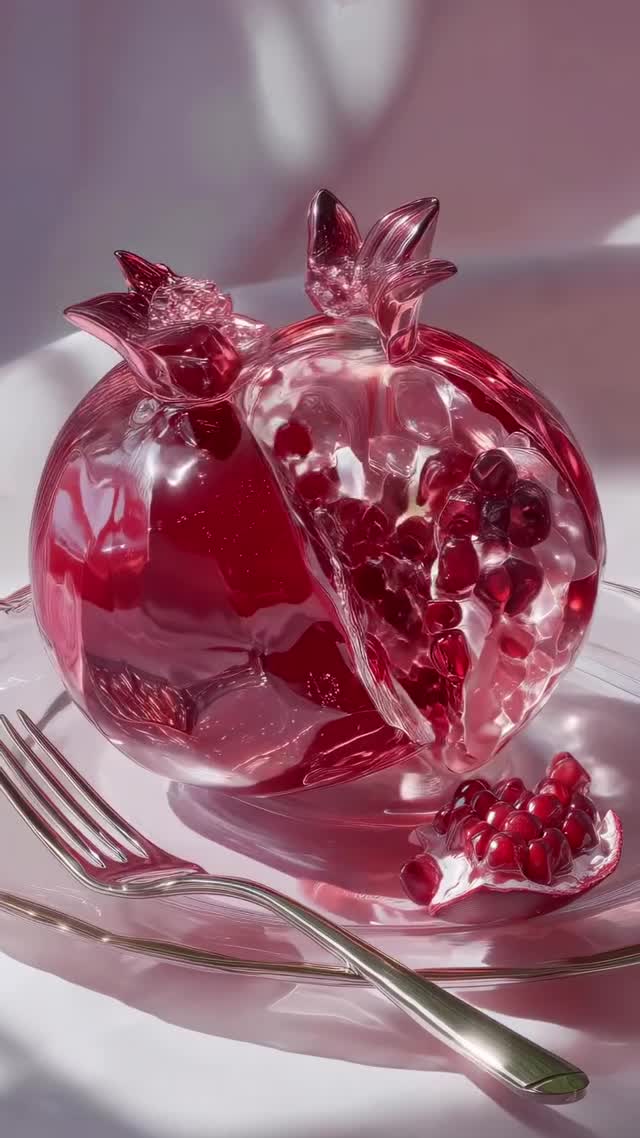
Glass fruits🍐
Animated with @klingai_official
Are you serious about learning how to create AI visuals at a professional level? In my course, I teach everything I use in my own process:
• How I build concepts and visual storytelling
• The exact tools, prompts, and workflows I use
• How to refine, edit, and create a portfolio that gets noticed
This is the full system I used to grow Dreamfall Art and work with brands.
If you want access —
Comment “COURSE” below and I’ll send you the link directly.
#ai #aiartwork #aidesign
The Glass Pomegranate: How dreamfall.art Built This AI Art
This image transforms a familiar object into a luxury visual event. A pomegranate is already symbol-rich, but rendering it as translucent glass changes the meaning from “food” to “artifact.” That shift is what creates scroll interruption. Viewers pause because their brain recognizes the shape but questions the material.
The frame is minimal, but not empty. Every element has a role: fork for scale and direction, plate for grounding, detached seeds for narrative detail. This is a strong lesson for creators: virality in still life often comes from material tension, not quantity of objects.
Why it goes viral: material surprise + controlled composition
The first mechanism is contradiction. Pomegranate implies softness and juice, but glass implies hardness and polish. Contradictory cues trigger curiosity. The second mechanism is simplicity with precision: one hero object, one directional prop, one clean color world. This reduces cognitive load and increases dwell time.
The lighting is equally important. Specular highlights and refractions communicate craftsmanship. Without those optical details, the image would look like generic 3D art. With them, it feels collectible and editorial.
Signal
Evidence (from this image)
Mechanism
Replication Action
Material contradiction
Fruit shape rendered as transparent glass
Novelty through category collision (organic form + synthetic material)
Choose one familiar object and rewrite its material identity
Single-object focus
One central pomegranate dominates frame
Fast visual decoding increases hold on first glance
Limit scene to one hero object + one supporting prop
Optical richness
Strong highlights, refraction, and internal reflections
Perceived craftsmanship raises share-worthiness
Prompt for transparent material behavior, not just “shiny” adjectives
Palette discipline
Rose-pink environment with silver accent
Cohesive color language improves premium feel
Lock two dominant hues and one accent metal tone
Best-fit scenarios and transfer strategy
Beauty packaging campaigns: perfect for ingredient storytelling with luxury texture.
Jewelry and accessory promos: works when you want “sculptural premium” mood.
Moodboard accounts: high-save visual due to collectible aesthetic.
Creative studios: ideal as visual proof of rendering and art-direction ability.
Not ideal for
Utility-focused tutorials where object realism must remain literal.
Fast meme formats that depend on text-heavy punchlines.
Catalog shots that require plain product documentation.
Three transfer recipes
Glass citrus recipe
Keep: single-object hero, transparent material behavior, high-key pink stage.
Change: pomegranate to sliced blood orange form.
Slot template:{familiar_object_shape} made of {transparent_material}, on {monochrome_surface}, with {single_support_prop}
Metal-flower recipe
Keep: central sculptural composition and controlled negative space.
Change: glass to chrome with reflective environment map.
Slot template:{botanical_form} in {reflective_material}, studio minimal set, directional soft light
Gem-candy recipe
Keep: clean background and one diagonal prop line.
Change: fruit object to candy geometry with gemstone translucency.
Slot template:{object} with {refraction_quality}, {accent_prop} in foreground, high-end editorial still life
Aesthetic Read: observed → recreate evidence
The elegance here comes from engineered restraint. There is no busy scene design, only optical intent. The frame proves that still images can feel dynamic when highlights, curves, and direction lines are choreographed.
Observed
Why it matters
How to recreate
Transparent red-pink glass body
Defines the concept at first glance
Specify translucency, refraction, and inner reflections explicitly
Opened section with visible seed cluster
Adds narrative detail and realism anchor
Prompt a split-open segment plus seed geometry
Fork diagonal in lower-left
Creates movement in a static composition
Add one metallic prop with directional placement
Pink background and soft window-like shadow pattern
Keeps scene cohesive and editorial
Use monochrome background with one directional light source
High micro-contrast at glass edges
Improves perceived rendering quality
Increase edge clarity and highlight control in render settings
Prompt Technique Breakdown
Prompt chunk
What it controls
Swap ideas (EN, 2-3 options)
single glass pomegranate, split-open with seed interior
Change only object shape (pomegranate to orange), keep all lighting and palette fixed.
Reset baseline, change only prop type (fork to spoon).
Reset baseline, change only light hardness to compare editorial softness vs dramatic gloss.
Publishing tip
Pair this visual with a short caption that asks a material question (“What is this made of?”). Curiosity prompts usually outperform descriptive captions for this style.