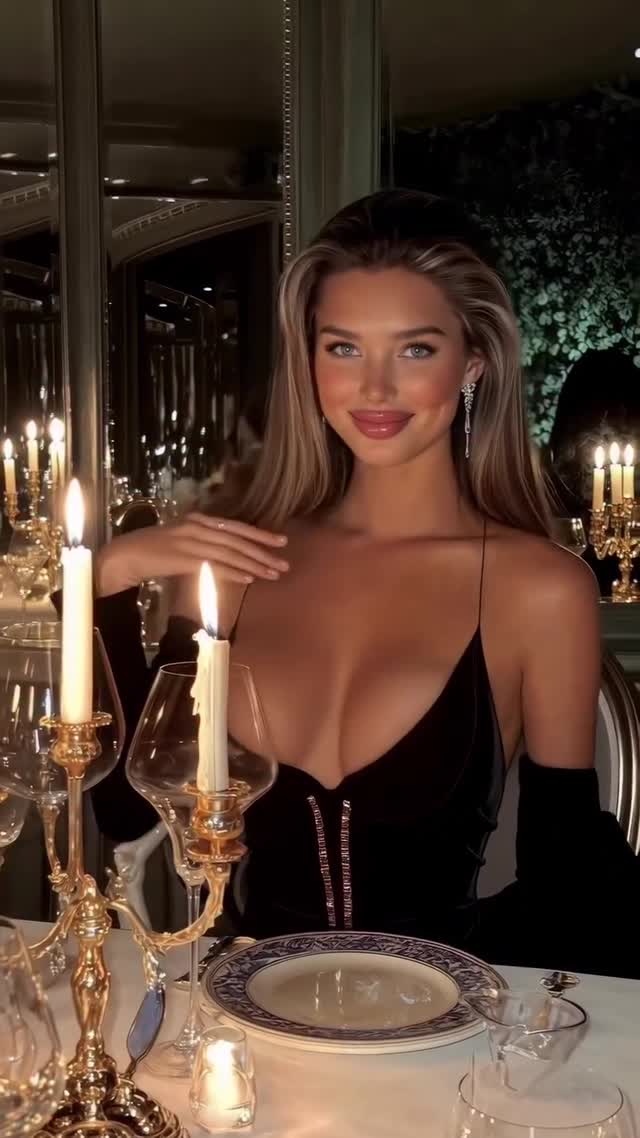
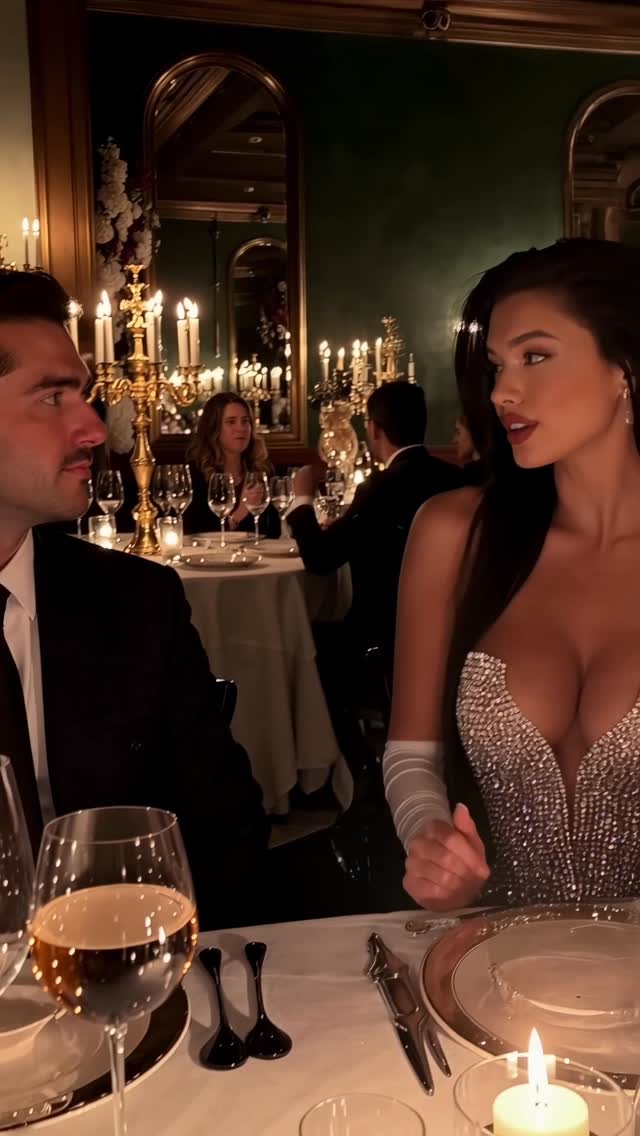
Restaurant collection✨
Animated with @klingai_official
Are you serious about learning how to create AI visuals at a professional level? In my course, I teach everything I use in my own process:
• How I build concepts and visual storytelling
• The exact tools, prompts, and workflows I use
• How to refine, edit, and create a portfolio that gets noticed
• Personal feedback, guidance, and access to my private community
This is the full system I used to grow Dreamfall Art and work with brands.
If you want access —
Comment “COURSE” below and I’ll send you the link directly.
#ai #midjourney #aiart #aiartcommunity #aiartwork #fashion #model #midjourneyart
Case Snapshot
This 14.1-second vertical “restaurant collection” montage is a luxury moodboard in motion: candlelit fine-dining tables, gold candelabras, mirrored walls, green-toned interiors, and multiple glamorous models in evening gowns (black satin, champagne sequins, silver sequins), including one shot with a man in a tux. The visual trick is that it feels expensive even though it’s structurally simple: short 2-3 second shots, shallow depth of field, warm tungsten lighting, and consistent table-setting anchors (white tablecloths, wine glasses, taper candles). It’s the kind of content that pulls both mainstream viewers (aspiration, romance, “rich life” fantasy) and creators (lighting recipe, composition layers, outfit prompts). Keywords it naturally fits: “luxury restaurant AI video prompt,” “candlelit dinner cinematic reel,” “editorial fashion nightlife montage,” plus Chinese long-tail like “烛光餐厅 质感短视频” and “高级感 夜景 AI 视频提示词.”
What You're Seeing
1) The Environment Anchor: Candlelight + Glass
Nearly every shot includes the same luxury cues: taper candles, gold candelabra arms, wine glasses, white tablecloth, and warm reflections. These anchors create continuity even when the subject changes.
2) Editorial Casting (Multiple Subjects, One Aesthetic)
The montage cycles through different models and looks, but all stay within the same “evening glamour” band: deep necklines, sequins/satin, statement earrings, and clean makeup. That’s why it reads as a collection, not random clips.
3) Depth Layering
Foreground glassware and candle flames, midground subject, and background diners/chandeliers create a 3-layer image. This depth is the anti-“flat AI” move.
4) Color and Lighting Logic
The palette is warm tungsten (gold/amber), with dark green walls and dark wood/mirrors adding richness. Highlights bloom gently on sequins and jewelry, which sells a high-end camera vibe.
5) Motion Choreography
Movement is controlled: small head turns, a hand gesture, a look-back over the shoulder. The montage avoids chaotic action so it stays believable.
6) Shot-by-Shot Breakdown (estimated)
Time range
Visual content
Shot language (framing / focal-length feel / movement)
Lighting & color tone
Viewer intent
00:00-00:01.8 (estimated)
Blonde in black satin dress at candlelit table, gold candelabra foreground
Portrait close-up, shallow DOF, stable
Warm amber, reflective highlights
Hook: instant luxury cues
00:01.8-00:04.4 (estimated)
Brunette in strapless sparkling gown with white gloves, hand gesture
Medium portrait, slight reframe
Warm key, green wall depth
Variation while keeping setting consistent
00:04.4-00:06.8 (estimated)
Side profile sequin gown at long table, lace glove
Side portrait, slow drift
Candle clusters, chandelier glow
Save-worthy fashion frame
00:06.8-00:09.3 (estimated)
Blonde + man in tux at bar/banquette table
Two-shot profile, stable
Dense warm bokeh points
Social proof: “real” upscale crowd vibe
00:09.3-00:11.7 (estimated)
Close portrait of brunette in silver halter dress + diamond choker
Beauty close-up, shallow DOF
Soft side light, clean skin tone
Detail shot for elegance
00:11.7-00:14.1 (estimated)
Look-back over shoulder at window table with skyline outside
Medium portrait, ending hold
Candles + city lights contrast
Final beat: cinematic payoff
7) Text, Subtitles, and Music Layer
No in-frame text is visible in the sampled frames and the source file has no audio stream. The visuals carry the whole story, which is why each shot needs clear “luxury evidence” (candles, glass, sequins, mirrors).
8) The “Collection” Pattern You Can Reuse
Instead of one story, it’s a curated set of similar scenes. That makes it easy to scale: keep the restaurant template, swap outfits and angles, and publish as a series.
Why It Went Viral
Topic Selection Analysis (250-300 words)
The topic is luxury nightlife fantasy, and it’s a universal attention magnet because it is instantly legible: candles, champagne glasses, sequins, and a beautiful restaurant interior communicate “high status” in under one second. This format also has built-in audience overlap. Fashion followers watch for styling (sparkle gowns, gloves, jewelry), travel and lifestyle audiences watch for restaurant atmosphere, and AI creators watch because the visuals are clearly “crafted.” Psychologically, it triggers aspiration and curiosity: viewers want to know where the place is, what the night feels like, and how to recreate the look. The montage structure adds variety without requiring plot. Every 2-3 seconds you get a new face, new pose, or new angle, but the environment anchors (candelabras, white tablecloth, mirrors) keep it cohesive.
From a platform perspective, the clip is optimized for completion: short shots, minimal confusion, high visual clarity, and a final “look-back” window shot that feels like an ending. It’s also extremely saveable as a reference board: creators and viewers can screenshot frames for lighting, wardrobe, and composition. That save rate is often a stronger signal than likes for long-term distribution.
Platform-Signal View (about 100 words)
Watch time likely comes from rapid shot variety within a consistent setting and the absence of messy motion that would look fake. Shares/saves likely come from reference utility: each frame is a usable wallpaper-style image. The clip avoids controversial hooks and still drives comments because viewers ask “where is this” and “how is this made.” The ending window skyline adds contrast and a clean finish, which boosts completion and rewatch.
5 Testable Viral Hypotheses
Observed evidence: candles + glass appear in almost every shot. Mechanism: continuity + perceived luxury. Replication: enforce 2-3 recurring props across all shots.
Observed evidence: 2-3 second shot rhythm. Mechanism: novelty cadence prevents drop-off. Replication: cut every 2-3 seconds while keeping the same environment.
Observed evidence: background diners are blurred but present. Mechanism: social proof and “real place” feeling. Replication: add soft background silhouettes, not detailed faces.
Observed evidence: final look-back by window with skyline. Mechanism: ending beat increases completion. Replication: reserve one contrast shot (window/city lights) for the last 15-20%.
How to Recreate (0 to 1)
Step 1: Choose a “Collection” Theme
Pick one theme you can repeat: restaurant glamour, hotel lobby elegance, rooftop bar nights. Collections scale better than one-off stories.
Step 2: Lock the Environment Template
Write a global lock: candlelit fine dining, white tablecloths, gold candelabras, mirrors, chandeliers, warm tungsten grade, shallow DOF.
Step 3: Build 6 Shot Prompts
Storyboard 6 shots with different angles: close portrait, profile, two-shot, booth close-up, look-back by window. Keep each shot short.
Step 4: Define Wardrobe Swaps
Use 3 wardrobe variants: black satin, champagne sequins, silver sequins. Add gloves and jewelry for “expensive detail.”
Step 5: Generate Keyframes
Generate 2-3 keyframes per shot and reject any with broken glassware or warped candles. Architecture and props must stay rigid.
Step 6: Render Per Shot and Stitch
Render each shot separately to control identity and props, then stitch with simple cuts. This reduces temporal jitter.
Step 7: Troubleshoot Failures
If candles flicker unnaturally, simplify flame detail and reduce exposure changes. If background faces deform, blur them more and reduce crowd density.
Step 8: Packaging
Thumbnail: pick the clearest candle + face + gown sparkle frame. Title angle: “Restaurant Collection” + one concrete cue (candles, mirrors, sequins).
Step 9: Publish as a Series
Post “Restaurant Collection #1/#2/#3” with small variations and keep the same visual signature so your feed builds a recognizable aesthetic.
Growth Playbook (Distribution & Scaling)
3 Opening Hook Lines
"I’m building a luxury restaurant collection with AI. Here’s the template."
"If your AI videos look cheap, steal this candlelight recipe."
Template B: Hook: "Candlelight is the cheat code." Value: "Recurring props create continuity." Question: "Black satin or silver sequins next?" CTA: "Vote below."
Template C: Hook: "How I make AI feel expensive." Value: "Mirrors + glass + highlight bloom." Question: "Want the negative prompt?" CTA: "Save this."
Template D: Hook: "One setting, many looks." Value: "Swap wardrobe and angles, keep the restaurant locked." Question: "Which frame should be the cover?" CTA: "Pick 1-6."