How Goblin Network Made This Emo Band Tee Friends Car Night Photo and How to Recreate It
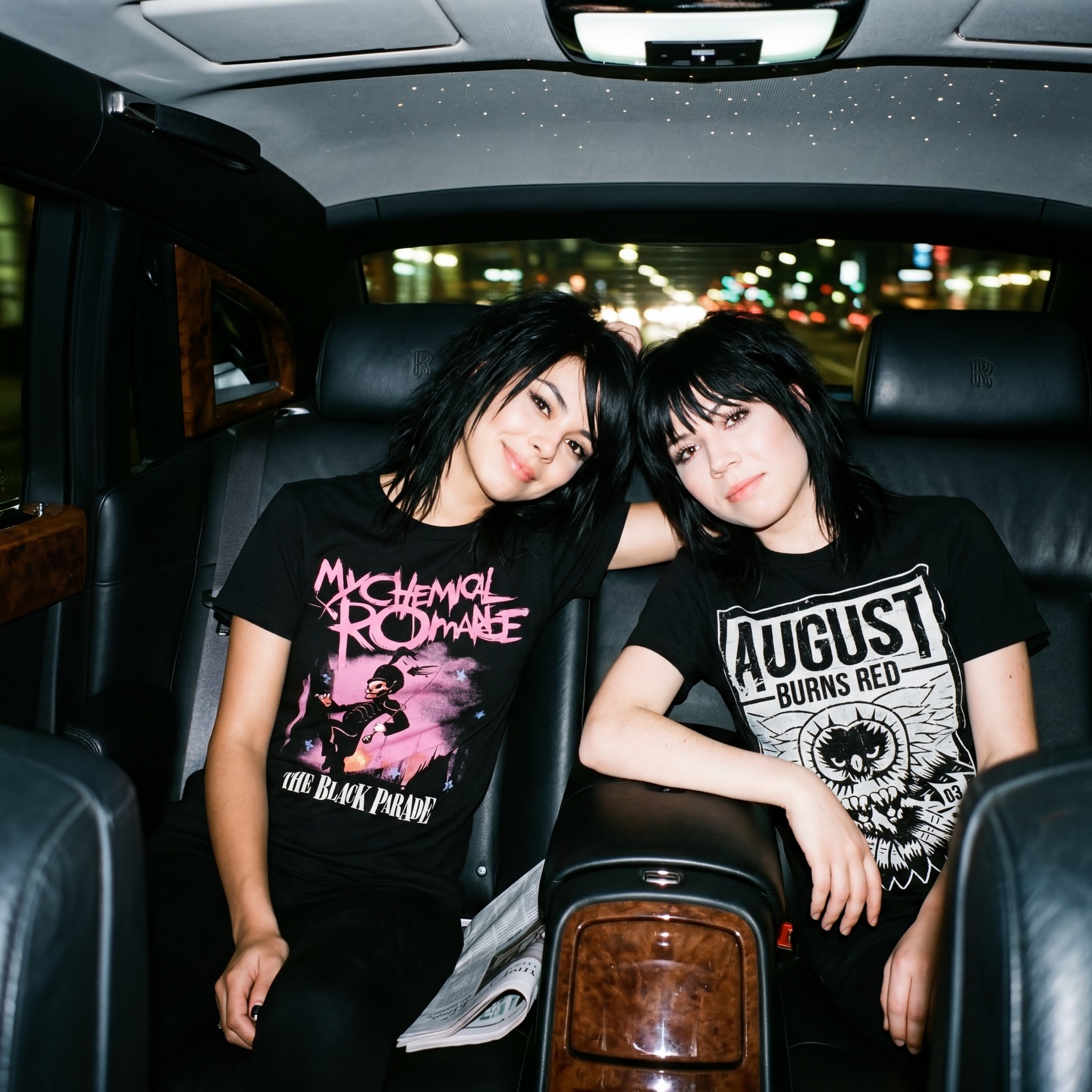
This image works because it captures subculture through context instead of costume overload. Nothing here feels overbuilt. Two friends sit in the back of a car at night, both in black band shirts, both with similar shaggy dark hair, both relaxed enough that the image feels lived-in rather than staged. That lack of effort is exactly what gives the photo credibility. It looks like a real moment first and an aesthetic artifact second.
The strongest thing in the frame is not the car, and it is not even the shirts by themselves. It is the social proof created by the pairing. One person in an alt band tee can read as styling. Two people sharing the same visual language inside a late-night setting reads as belonging. That difference matters for creators. Community-coded images often travel further than individual look shots because they imply a scene, not just a person.
The flash is also doing important work. A softer light would have made the image prettier, but probably less memorable. The direct flash gives it honesty. You can see the shirts clearly, the leather seats clearly, and the faces clearly, while the city lights outside stay blurred and distant. That tension between sharp foreground and soft nightlife background is what makes the photo feel like a real memory instead of a polished campaign.
| Signal | Evidence (from this image) | Mechanism | Replication Action |
|---|---|---|---|
| Scene-coded belonging | Both subjects wear black band tees and share a similar alternative hairstyle language | Matching cultural signals create a sense of friendship and subcultural authenticity | Use 2 people with aligned visual cues instead of styling one person in isolation |
| Flash honesty | Faces and shirt graphics are brightly lit while the night environment remains secondary | Direct flash makes the image feel candid, immediate, and documentary | Choose frontal flash when the goal is memory texture rather than beauty softness |
| Contained nightlife setting | The car backseat frames the pair while city lights blur beyond the rear window | A private interior plus public-night exterior gives the image emotional depth | Place subjects in a contained space with a distant nightlife backdrop instead of a fully open street scene |
Why this image feels real instead of manufactured
The answer is imperfection control. The posture is casual, the smiles are slight, and the center armrest awkwardly divides the frame rather than being hidden. Those details help. Too many lifestyle recreations fail because they remove the friction that makes a candid believable. Here, the photo keeps just enough awkwardness to feel trustworthy.
The band shirts matter in a very practical way too. They are not generic black tops. They carry readable identity markers. That means the image is doing cultural storytelling through typography and graphics without needing captions or extra props. For small creators, this is a strong lesson: wardrobe that carries actual references is often more powerful than wardrobe that only looks fashionable.
| Observed | Why it matters for the look |
|---|---|
| Two-subject balance across the backseat | Makes the image feel social and increases emotional relatability |
| Readable band graphics on both shirts | Provides instant scene identity and subculture specificity |
| Direct frontal flash | Creates the snapshot realism that gives the photo its authenticity |
| Black leather interior with wood trim | Adds a believable environment without distracting from the people |
| Blurred city lights outside the rear window | Signals nighttime movement and expands the feeling of the moment beyond the car |
Best use cases and transfer ideas
- Subculture moodboards: Great fit because the image documents a shared alt identity instead of a solo outfit. Keep the paired styling language.
- Band or music-community editorial references: Strong fit when you want fan culture energy without a concert setting. Preserve the shirt readability and candid flash.
- Friendship campaign inspiration: Useful for creators who want closeness and credibility rather than polished luxury. Keep the interior setting intimate.
- Night-out documentary portrait series: Works well because the image feels like a memory captured between destinations. Hold onto the city bokeh and car framing.
This approach is less ideal for beauty campaigns, luxury fashion editorials, or sleek influencer branding. The image is strongest when it stays subcultural and unvarnished. Over-styling would remove the thing that makes it believable.
Three transfer recipes work especially well here. Keep the dual-subject setup, the flash lighting, and the contained vehicle interior. Change the music references, hair styling, or seat setting. Template one: two friends in a car at night, direct flash, readable subculture wardrobe, blurred street lights outside. Template two: candid alt-community portrait, matching dark styling language, private interior plus nightlife background. Template three: {shared scene identity} documented as a casual backseat snapshot, clear wardrobe references, honest flash photography.
Prompt technique breakdown
To recreate this image well, write it like documentary nightlife photography, not like fashion branding. The energy comes from social context, not from polish. If the styling becomes too intentional, the photo stops feeling like a memory.
| Prompt chunk | What it controls | Swap ideas (EN, 2–3 options) |
|---|---|---|
| two alt friends in a car backseat at night | Core scene setup and relationship energy | two punk friends in a diner booth; two indie friends on a train; two goth friends in a taxi |
| readable black band T-shirts | Subculture specificity and visual identity | hardcore band merch; vintage tour shirts; local zine tees |
| direct frontal flash photography | Authenticity and snapshot mood | compact-camera flash; disposable-camera flash; digital point-and-shoot flash |
| black leather interior with city bokeh outside | Contained environment and nighttime context | taxi interior; van bench seat; train compartment at night |
| shaggy layered black hair on both subjects | Shared styling language and silhouette cohesion | bleached punk cuts; dyed red emo hair; dark mullet shapes |
| realistic candid nightlife photo | Medium identity and anti-glam finish | documentary snapshot; 2000s scene photo; point-and-shoot nightlife portrait |
Execution playbook for remixing it well
Lock three things first: the two-person dynamic, the direct flash, and the car-at-night setting. Those are the structural controls. Then only adjust one or two variables per run so the candid credibility stays intact.
- Run 1: Establish the seating and relationship posture. Make sure the image feels like two friends sharing a real space.
- Run 2: Make the shirt graphics readable enough to carry scene identity without overwhelming the faces.
- Run 3: Refine the outside bokeh and interior details so the car setting is clear but not dominant.
- Run 4: Test a transfer, such as swapping music references or moving to a taxi or van, while keeping the same flash-driven honesty.
The practical takeaway is that authentic social portraits spread best when they preserve evidence of a real scene. Keep the styling culturally specific, keep the light honest, and let the environment frame the people instead of performing for them.