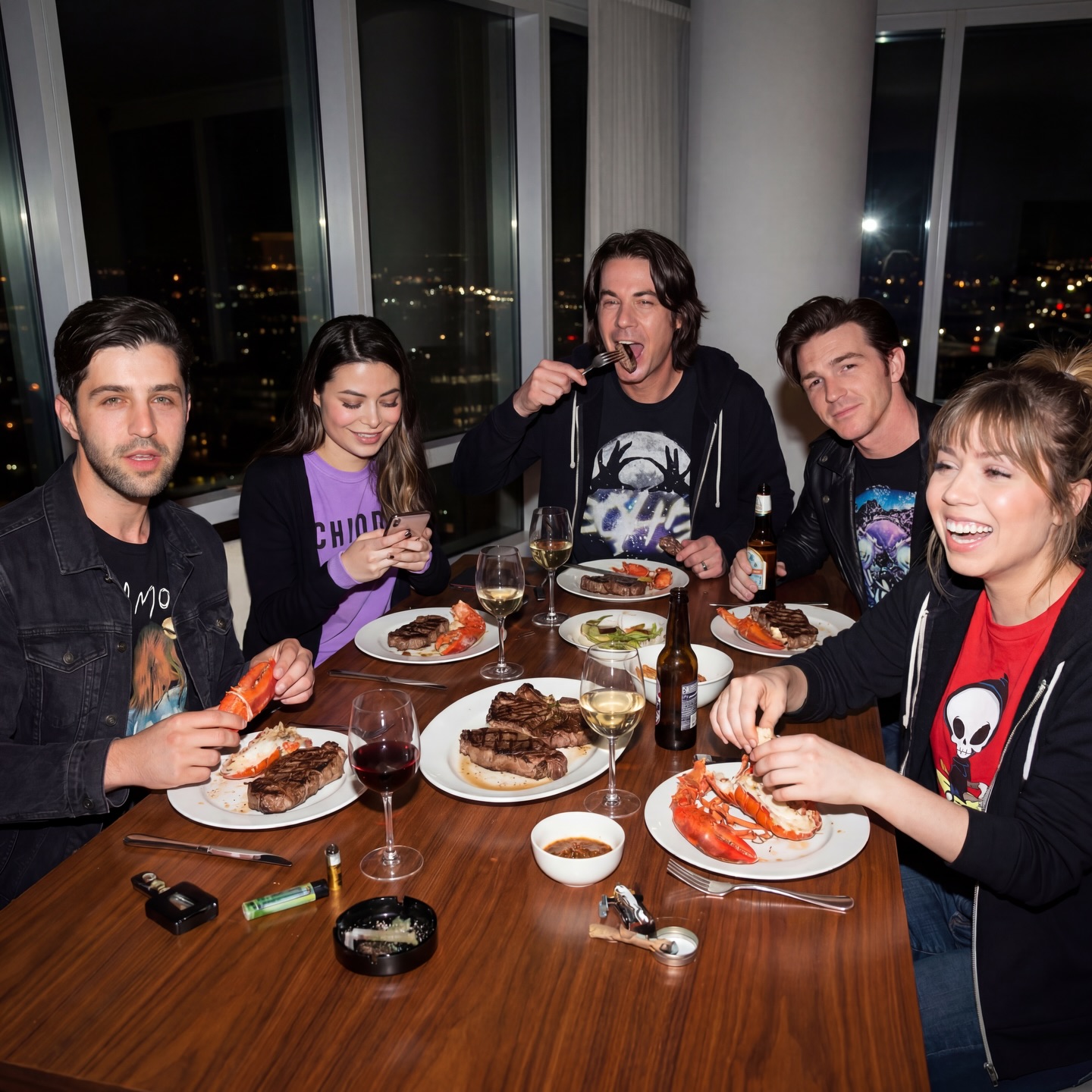
How Goblin Network Made This Flash-Lit Friends Dinner Apartment Photo and How to Recreate It
This image works because it captures the exact kind of social mess that polished lifestyle photography usually edits out. People are not performing the same emotion. One person is checking a phone, another is mid-bite, another is smiling toward the camera, and the table is full of half-eaten food, glasses, and random objects. That unevenness is the point. It makes the image feel like evidence of a real night instead of content manufactured for a brand feed.
For creators, this is a useful reminder that authenticity often lives in split attention. Nobody here is fully arranged for the lens, and that is why the photo has energy. Group images become more believable when not every face is optimized at the same time. A real gathering usually contains several micro-scenes at once, and this frame preserves that overlap instead of flattening it.
The direct flash is also critical. A more flattering light would have turned the image into a cleaner dinner editorial, but probably a less memorable one. The flash keeps skin, food, glass, and tabletop textures crisp while letting the room behind fall away. That creates the familiar "someone actually took this during the night" feeling. It is not glamorous, but it is sticky.
| Signal | Evidence (from this image) | Mechanism | Replication Action |
|---|---|---|---|
| Split-attention realism | One person is on a phone, one is mid-bite, others look at the camera or the table | Multiple simultaneous actions make the scene feel socially alive and unstaged | Direct subjects toward different micro-behaviors instead of forcing one shared pose |
| Meal-in-progress texture | Steak, lobster, sauces, bottles, glasses, and small table clutter remain visible | Used objects create narrative residue and make the image feel lived in | Keep evidence of the gathering on the table instead of styling everything perfectly |
| Flash-documentary tone | The group and food are brightly lit while the apartment and city beyond stay darker | Harsh honest light makes the scene feel immediate and memory-like | Use direct flash when the goal is social documentation rather than hospitality elegance |
Why the image feels intimate
The apartment setting does a lot of work. If this same group were photographed in a restaurant, the scene would feel more public and less personal. Here, the windows, the column, and the table arrangement signal a private night inside someone’s space. That privacy changes the emotional temperature. The image becomes less about dining and more about belonging.
The food choices matter too. Steak and lobster read as indulgent, but because the setting is casual, that indulgence feels slightly chaotic rather than luxurious. It suggests a special night among friends, not a staged fine-dining campaign. That distinction is useful for creators. Social warmth often comes from the tension between nice things and unfiltered behavior.
| Observed | Why it matters for the look |
|---|---|
| Five people engaged in different actions at once | Creates believable group dynamics and prevents the image from feeling posed |
| Flash-lit food and tabletop clutter | Builds sensory realism and documents the meal as an active event |
| Night skyline through large windows | Adds time and place without distracting from the social core of the frame |
| Casual graphic shirts and hoodies | Keeps the scene grounded in friendship rather than formal hosting |
| Warm wood table as the visual center | Acts as the shared stage connecting every subject in the frame |
Best use cases and transfer ideas
- Friendship documentary moodboards: Great fit because the image preserves natural social fragmentation instead of idealizing it. Keep the split-attention setup.
- Nightlife-at-home visual references: Strong fit for creators who want apartment-party realism rather than club imagery. Preserve the flash and the window context.
- Editorial studies of group dynamics: Useful when exploring how people share a frame without one dominant hero subject. Keep the table as the organizing center.
- Candid dinner-series concepts: Works well because the format can transfer across different friend groups and meals while keeping the same social truthfulness.
This approach is less ideal for hospitality advertising, polished food campaigns, or elevated luxury branding. The image wins because it feels private, messy, and slightly unguarded. Cleaning it up too much would remove the thing that makes it emotionally readable.
Three transfer recipes are especially useful. Keep the apartment-at-night setting, the direct flash, and the active meal evidence. Change the friend group, cuisine, or mood. Template one: {friend group size} around a table at night, direct flash, in-progress meal, mixed attention states, city lights outside. Template two: private apartment dinner snapshot, documentary flash lighting, casual clothes, real table clutter, no staged smiles. Template three: {social gathering} photographed mid-moment, with one shared table, one private room, and several simultaneous behaviors.
Prompt technique breakdown
To recreate this image well, think like a social documentary photographer rather than a food stylist. The power comes from the overlapping human actions first, then the food and setting as evidence around them.
| Prompt chunk | What it controls | Swap ideas (EN, 2–3 options) |
|---|---|---|
| five friends around a dinner table at night | Core social energy and subject count | four roommates on a couch with takeout; six friends in a kitchen; small afterparty around a coffee table |
| direct flash apartment snapshot | Authenticity, time-of-day feel, and visual harshness | point-and-shoot flash; disposable-camera style; compact digital party flash |
| steak, lobster, wine, and bottles on the table | Meal richness and narrative residue | pizza and beer; sushi takeout spread; birthday leftovers and cake |
| city lights visible through windows | Night setting and urban context | suburban backyard lights; rainy street view; skyline balcony glow |
| mixed attention and imperfect expressions | Believability of group behavior | one laughing, one texting, one reaching for food; split conversation states; distracted candid reactions |
| realistic candid social photography | Medium identity and anti-glam tone | documentary party photo; lived-in apartment snapshot; 2000s digital flash dinner capture |
Execution playbook for remixing it well
Lock three things first: the group size, the direct flash, and the meal-in-progress table. Those are the structural controls. After that, change only one or two variables per run so the candid realism stays intact.
- Run 1: Build the room and table first. Make sure the image already feels like a believable apartment dinner.
- Run 2: Distribute attention states across the group so not everyone performs for the camera.
- Run 3: Refine table clutter and food so the meal feels active, not plated for display.
- Run 4: Test a cuisine or room transfer while keeping the same flash-driven honesty and group dynamics.
The practical takeaway is simple: social images feel real when they preserve overlap, residue, and imperfection. Keep the room private, the light honest, and the table busy enough to prove the night is already happening without the camera.