How Goblin Network Made This Surreal Low-Poly Strawberry Object Render and How to Recreate It
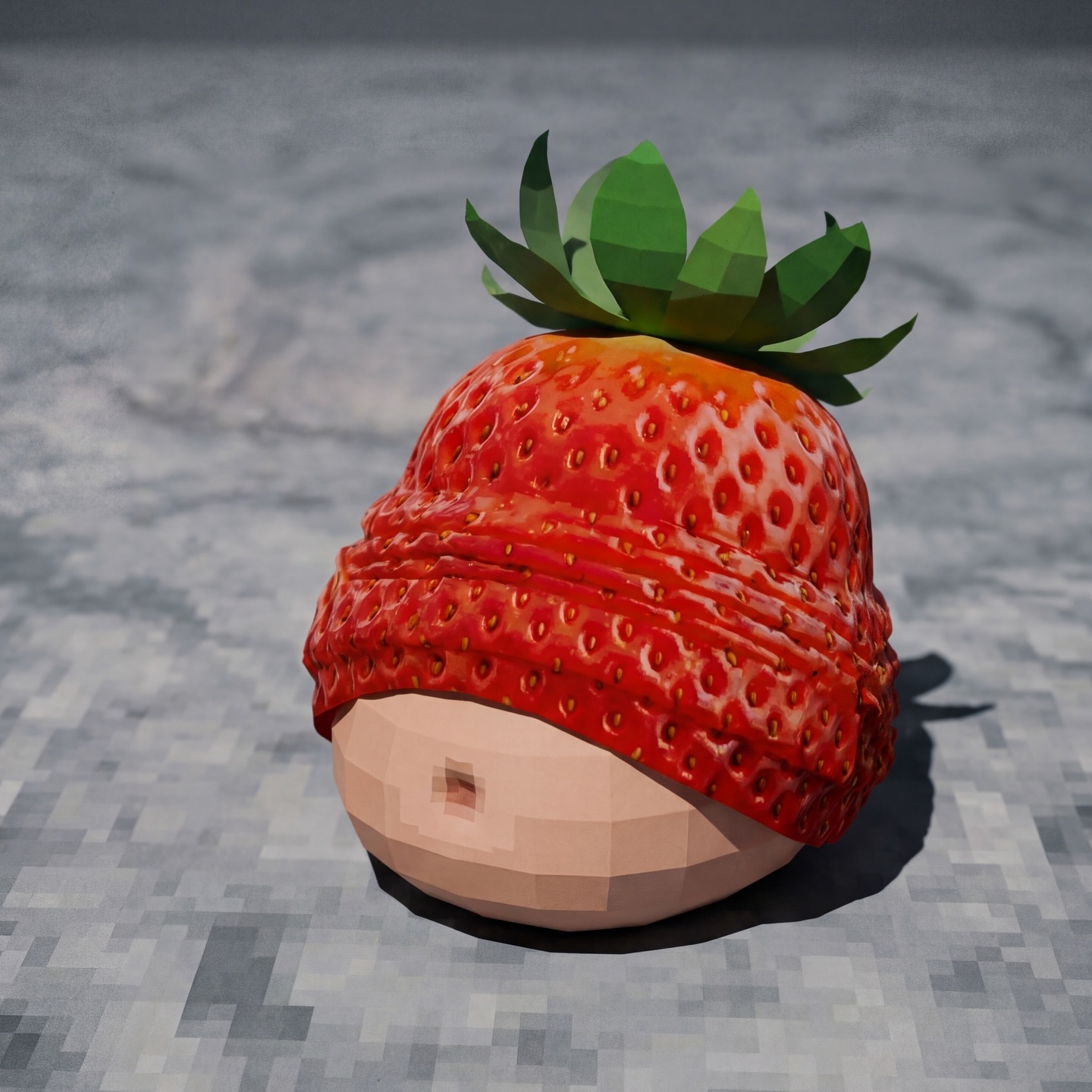
This image works because it behaves like a joke with product-shot discipline. At first glance you see a strawberry. Then you notice the faceted peach-toned base, the strange wrapping shape, and the slightly uncanny object logic. That delayed recognition is exactly what gives the image replay value. Viewers look once to identify it, then again to understand why it feels funny.
For creators, the useful lesson is that novelty travels further when it is presented seriously. If this same concept were drawn as a loud cartoon, it would become a one-note gag. Here, the lighting, the shadow, and the centered still-life composition all treat the object as if it belongs in a premium product render. That seriousness is what upgrades the absurdity into something more shareable.
The hybrid surface treatment is the strongest choice in the frame. The strawberry shell is glossy and detailed, while the lower base is intentionally low-poly and simplified. Those two languages should not naturally belong together, which is exactly why they create tension. This is a reliable visual strategy for surreal object design: combine one hyper-familiar texture with one obviously artificial geometry.
| Signal | Evidence (from this image) | Mechanism | Replication Action |
|---|---|---|---|
| Recognition delay | The object looks like a strawberry at first, then reveals an unexpected faceted base and wrapping structure | The viewer spends longer with the image because the brain needs a second pass to decode it | Build an object that starts familiar but breaks one core expectation on closer inspection |
| Texture contrast | The top shell is glossy and realistic while the lower form is flat-shaded and polygonal | Mixed rendering languages create novelty without needing a complex scene | Combine one realistic material with one obviously stylized geometric form |
| Product-shot framing | The object is centered on a neutral textured ground with clean directional light | Professional presentation makes the surreal concept feel intentional and collectible | Use simple still-life lighting and avoid background clutter when the object idea is already strong |
Why the image feels sharper than a simple meme
The answer is restraint. There are no eyes, no face, no caption, and no extra prop trying to explain the joke. The image trusts form and material to do the work. That restraint matters because once surreal design becomes overexplained, it stops being elegant. Here, the object is strange enough on its own, and the clean composition lets the viewer enjoy the ambiguity.
The gray pixel-like ground is also smarter than it first appears. It gives the object a neutral stage without competing with the red and green color story. If the background were bright or busy, the image would lose the crispness that makes the object feel sculptural. Small creators should remember this: when the subject idea is weird, the environment usually needs to become more boring, not more exciting.
| Observed | Why it matters for the look |
|---|---|
| Realistic strawberry seed texture and gloss | Anchors the object in something immediately recognizable |
| Low-poly peach-colored base | Introduces artificiality and gives the concept its surreal break point |
| Single-object centered composition | Keeps attention on form rather than on scene context |
| Directional daylight with cast shadow | Makes the object feel physically present and intentionally rendered |
| Muted gray ground plane | Supports the object without stealing any chromatic attention |
Best use cases and transfer ideas
- Surreal object moodboards: Excellent fit because the concept depends on one strong visual twist rather than narrative context. Keep the single-object presentation.
- 3D experiment showcases: Strong fit for creators blending realistic materials with stylized forms. Preserve the lighting discipline and neutral set.
- Poster or cover art for playful design brands: Works well when the goal is smart absurdity instead of overt comedy. Keep the background restrained.
- Concept series built around hybrid food objects: Useful because the object logic is easy to extend into a collectible set. Repeat the same render language across variations.
This approach is less ideal for busy illustration scenes, brand ads with multiple messages, or heavily narrative fantasy work. Its power comes from the clean still-life format. The more scene information you add, the less interesting the object itself becomes.
Three transfer recipes are especially effective. Keep the single-object framing, the realistic texture plus low-poly geometry pairing, and the neutral ground plane. Change the fruit family, wrap structure, or color base. Template one: {familiar fruit skin} wrapping around {unexpected geometric base}, centered on a neutral surface, daylight product lighting. Template two: surreal hybrid object render, one realistic material, one stylized low-poly form, clean still-life composition. Template three: {food object} reimagined as a sculptural design piece, shallow depth of field, minimal environment, premium render.
Prompt technique breakdown
To recreate this image well, start by locking the object logic before anything else. Many surreal prompts fail because they describe mood first and structure second. Here, structure is everything. The object has to be both readable and wrong in a very specific way.
| Prompt chunk | What it controls | Swap ideas (EN, 2–3 options) |
|---|---|---|
| glossy realistic strawberry shell | Recognition anchor and organic texture detail | orange peel skin; kiwi fuzz texture; cherry gloss surface |
| peach-toned low-poly rounded base | Artificial geometry and surreal disruption | faceted cube core; smooth matte egg form; low-poly pear base |
| single centered still-life product shot | Presentation discipline and visual clarity | museum pedestal crop; tabletop macro framing; studio hero object setup |
| gray textured ground plane | Neutral staging and chromatic separation | cement slab; matte stone surface; soft studio floor gradient |
| bright daylight with cast shadow | Physical presence and object realism | window light product shot; noon sun shadow; soft studio key with hard edge shadow |
| clean surreal 3D render | Overall medium identity and finish quality | premium design render; experimental CGI still life; gallery-style 3D object study |
Execution playbook for remixing it well
Lock three things first: the hybrid fruit logic, the realistic-versus-low-poly contrast, and the centered still-life framing. Those are the structural controls. After that, change only one or two variables per pass so the concept stays sharp.
- Run 1: Solve the silhouette first. Make sure the object is immediately readable as fruit before the surreal twist appears.
- Run 2: Refine the material contrast. Push seed detail and gloss on the shell while keeping the base faceted and simplified.
- Run 3: Adjust lighting and shadow so the object feels grounded in physical space.
- Run 4: Test a transfer, such as swapping strawberry for pear or orange, while preserving the same serious product-shot presentation.
The practical takeaway is that absurd object design spreads best when it is rendered with confidence. Treat the strange idea like a premium object, keep the set quiet, and let the viewer discover the mismatch on their own.