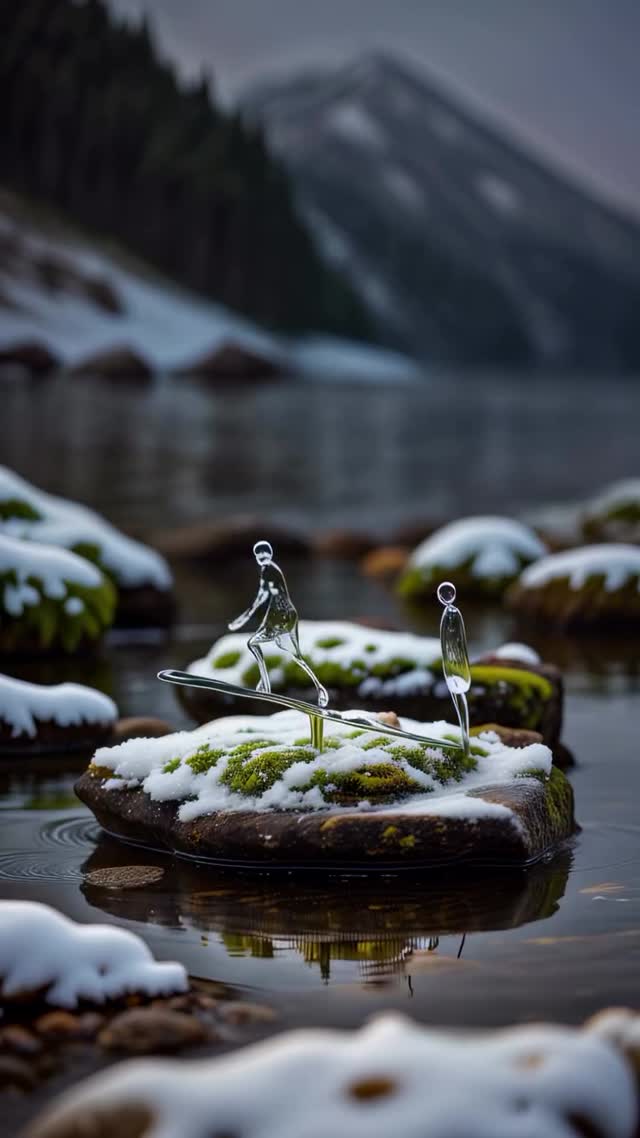
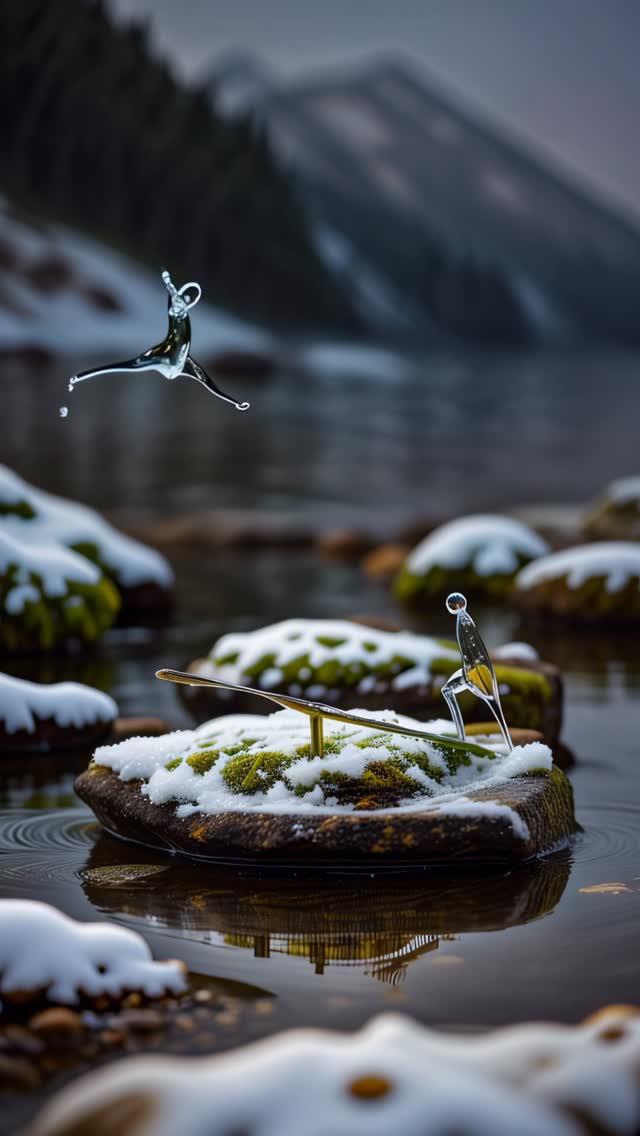
Let’s play in the snow ❄️ . Based on a video by @deryckandreas and @aaron_hakala . #aiart #generativeart #midjourney #discodiffusion #ai
Let’s play in the snow ❄️ . Based on a video by @deryckandreas and @aaron_hakala . #aiart #generativeart #midjourney #discodiffusion #ai
This image feels magical because it’s built like a miniature film scene. Two tiny glass-like figures “play” on a snowy moss rock while a mountain valley fades into soft bokeh behind them. The scale contrast does the emotional work: small subjects, big world, quiet weather.
For creators, this is a strong reminder that you don’t need complex characters to tell a story. You need a readable action (snowboarding), a believable surface (snow on moss), and a background that suggests a world without stealing attention.
The hook is the material: transparent “water people.” The second hook is the action: a snowboard stance. That combination is both surprising and easy to understand. Viewers stop because it’s odd, then stay because it’s coherent.
The scene is also designed for looping attention. People zoom in to inspect the glass highlights and the snow texture, then zoom out to feel the landscape mood. That back-and-forth viewing behavior is the kind of engagement that pushes distribution.
| Signal | Evidence (from this image) | Mechanism | Replication Action |
|---|---|---|---|
| Miniature story | Two tiny figures on one rock | Clear subject hierarchy, easy to read | Keep the scene to 1–2 subjects and one “stage” surface |
| Surreal material | Transparent glass/water bodies | Second-look hook | Use one “impossible material” and render it cleanly |
| Real-world texture | Snow patches on green moss | Believability anchors the surreal element | Pair surreal subjects with realistic surfaces (snow, moss, water ripples) |
| Cinematic depth | Mountain and forest blurred into bokeh | Feels like a film still | Push shallow DOF and keep background far away |
Recipe 1: Activity swap
Recipe 2: Material swap
Recipe 3: Season swap
Surreal subjects feel better when the world around them behaves correctly. Here, the snow looks like snow, moss looks wet, and water has ripples and reflections. Those “mundane” physics cues let the viewer accept the glass figures without resistance.
If your version looks fake, fix the environment first: snow texture, moss detail, and water reflections. Then refine the glass highlights.
| Prompt chunk | What it controls | Swap ideas (EN) |
|---|---|---|
| “two tiny glass-like human figures” | Surreal hook | “ice crystal figures”, “wireframe figures”, “paper-cut silhouettes” |
| “snow-dusted moss rock stage” | Believable surface detail | “wet leaf”, “stone step”, “tree stump” |
| “macro low waterline perspective” | Miniature scale illusion | “top-down macro”, “side profile macro”, “wider shot” |
| “winter valley background, heavy bokeh” | Cinematic atmosphere | “foggy forest”, “city night bokeh”, “desert haze” |
| “cool overcast grade” | Seasonal mood | “warm sunrise”, “blue hour”, “snowstorm whiteout” |
Hyperreal macro cinematic winter river scene: a small moss-covered rock emerging from shallow water, topped with patches of fresh snow. Two tiny transparent glass-like water-sculpture human figures stand on the rock; one balances on a small snowboard-like board while the other stands nearby. Gentle ripples and reflections in the water. Background is a cold mountain valley with dark evergreen forest and a distant snowy mountain, all heavily blurred into dreamy bokeh. Low waterline macro perspective, vertical framing, soft overcast daylight, cool desaturated grade, crisp snow and moss texture, clean specular highlights on the glass figures, high resolution.