My girlfriend's bestie hates me 😵💫
My girlfriend's bestie hates me 😵💫
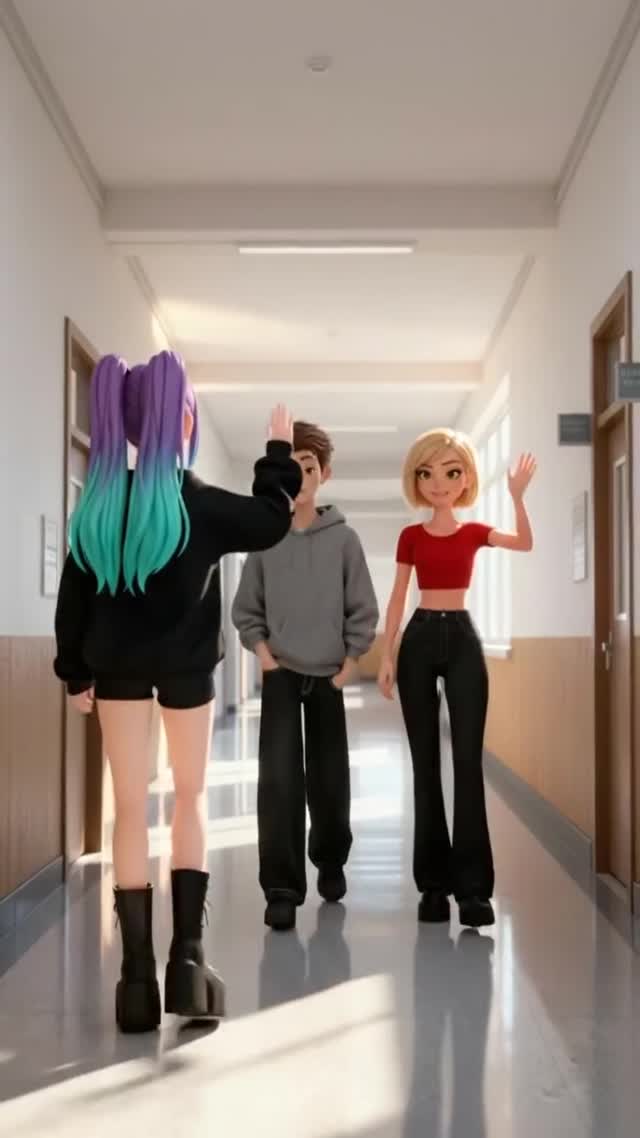
This image is a simple comedic story engine: three characters, one corridor, and one relationship tension implied by spacing and gestures. For short-form creators, that is gold. You do not need dialogue to set up a situation; you need a readable blocking pattern that viewers can decode instantly.
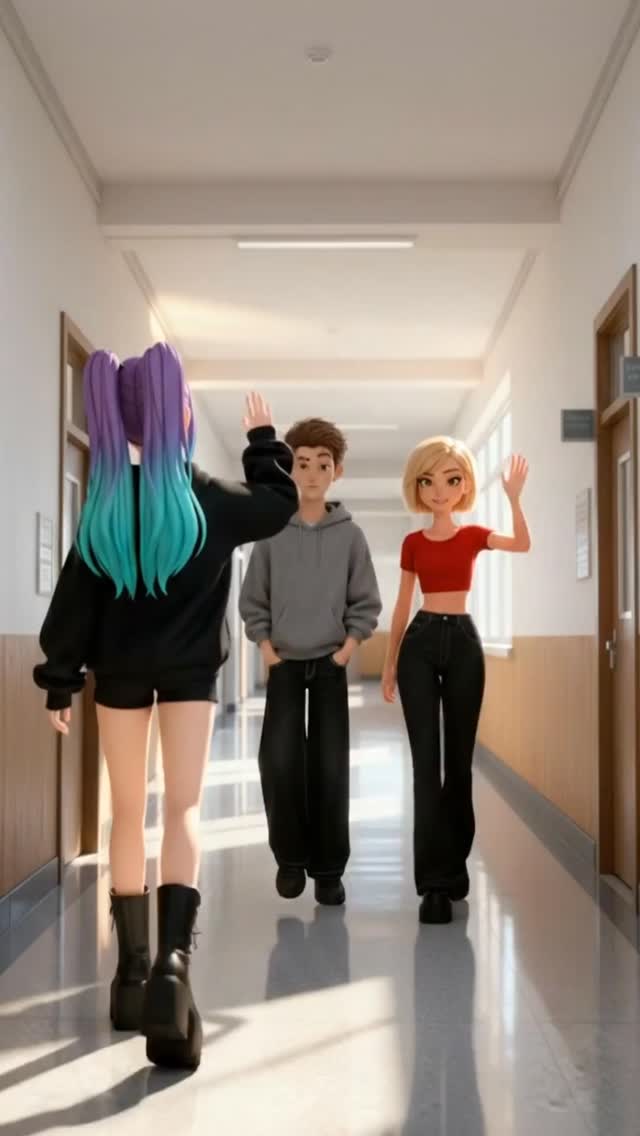
The scene reads in half a second. A girl in the foreground waves, the boyfriend stands in the middle, and another girl waves back. The corridor’s leading lines pull your eye directly into the triangle. Even without text, you understand there is a social dynamic happening.
It also looks like a “series world.” The 3D animated style is consistent, the hallway is a repeatable set, and the characters have strong color signatures (purple-teal hair, gray hoodie, red top). Series worlds are easy to binge and easy to remix.
| Signal | Evidence (from this image) | Mechanism | Replication Action |
|---|---|---|---|
| Instant blocking | Three-character triangle with clear spacing | Viewers decode relationships immediately | Design scenes with 3 roles: “me / partner / third person” |
| Leading lines | Hallway perspective points to the center character | Guides attention without needing edits | Use corridors, doorways, aisles for built-in composition |
| Series-ready style | Consistent 3D animated look | Creates a recognizable universe | Lock one render style and reuse it for 20 episodes |
| Color-coded characters | Purple/teal hair and red top stand out | Improves thumbnail recognition | Assign each main character one dominant accent color |
The corridor is doing two important things: it creates depth and it removes noise. Because the background is clean, the viewer reads gesture and distance first. That is exactly what you want in short-form storytelling: clarity before detail.
The reflective floor and sun streaks add production value without adding props. This is a good reminder: you can make a scene feel “real” by improving light and surfaces, not by piling on objects.
| Observed | Recreate | Why it matters |
|---|---|---|
| Three-character blocking | Lock character count and positions early | Prevents story confusion |
| Clean corridor set | Use simple environments with strong perspective | Makes the hook readable |
| Accent colors | Assign each character a signature color | Builds recognition |
| Soft daylight | Use bright neutral lighting and one strong directional cue | Keeps the render friendly and shareable |
| Prompt chunk | What it controls | Swap ideas (EN, 2–3 options) |
|---|---|---|
| blocking / positions | Relationship readability | foreground/back; left/center/right; distance gap |
| environment | Leading lines and mood | school hallway; office corridor; hotel hallway |
| character signatures | Recognition | hair color; outfit color; accessory |
| lighting | Production value | sun streaks; soft skylight; warm interior light |
| render style | Series consistency | Pixar-like; claymation; glossy 3D |
Baseline Lock: (1) hallway set, (2) three-character positions, (3) signature colors.
One-change rule: change only 1–2 knobs per run. Example sequence: