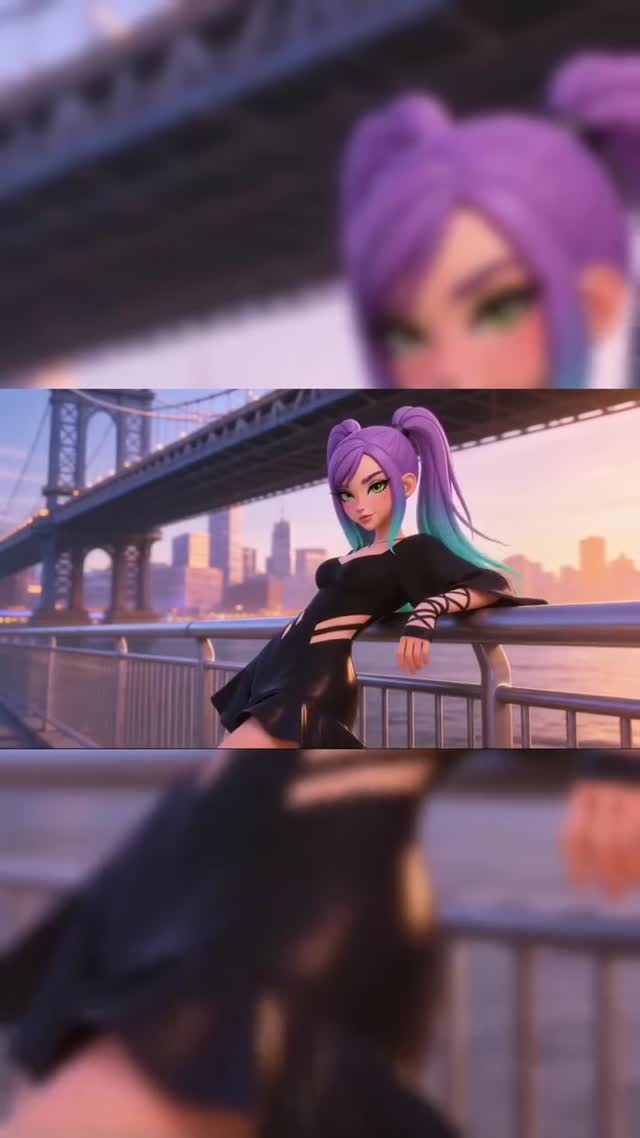

Trouble looks like me 🖤
Trouble looks like me 🖤
This frame uses the same structural language as high-performing lyric hooks: segmented strips, a strong character pose, and a high-recognition location. Even without text overlay, the image communicates attitude immediately through posture and scene choice.
For avatar-based music creators, this is a practical way to keep visual identity consistent while changing environments between posts.
The top and bottom blur bands create kinetic tension, while the middle band delivers the hero pose clearly. That contrast keeps the viewer’s eye anchored where you want it. The bridge backdrop adds cinematic scale and urban mood, making the frame feel like a music-video still rather than a static character render.
The dark outfit against warm sunset tones also reinforces the caption theme (“Trouble looks like me”) by pairing mood with visual styling.
| Signal | Evidence (from this image) | Mechanism | Replication Action |
|---|---|---|---|
| Segmented hook pacing | Top/middle/bottom strip split with center clarity | Creates immediate visual rhythm | Keep one strip sharp and two strips blurred for hook frames |
| Pose-led attitude | Avatar leans casually on railing with confident gaze | Conveys personality without caption dependence | Design one signature “attitude pose” for recurring character posts |
| Location storytelling | Bridge and skyline at sunset | Adds scale and cinematic context | Use recognizable urban landmarks as mood amplifiers |
| Color contrast mood | Black outfit vs warm pastel sky and cool water tones | Strengthens dramatic tone while preserving readability | Pair dark wardrobe with warm-cool environmental split |
Not ideal: information-heavy educational content, detailed product showcases, or emotionally soft ballad visuals requiring close facial nuance.
top blur face / center pose at {landmark} / bottom blur motion strip{avatar_pose} with {short_lyric_hook}, segmented reels layout{same_avatar_identity} in {new_scene}, fixed split-frame edit grammarThe image uses social-native editing language rather than traditional photography grammar. Segmenting the frame mirrors fast-cut reel timing, which helps the still feel part of motion content culture. The confident center pose then gives a stable narrative center.
Because scene and color are controlled, the visual looks intentional instead of random “AI style.”
| Prompt chunk | What it controls | Swap ideas (EN, 2-3 options) |
|---|---|---|
| tri-strip vertical reel layout | Hook structure and pacing | "2-strip split" / "4-strip micro montage" / "single-frame cinematic" |
| single avatar lounging on rail | Character attitude and pose identity | "walking pose" / "seated pose" / "lean-against-wall pose" |
| sunset bridge skyline backdrop | Urban cinematic context | "night neon bridge" / "sunrise riverfront" / "industrial dock" |
| purple-teal hair + black outfit | Brand palette consistency | "pink-cyan hair" / "silver-blue hair" / "all-black monochrome" |
| top/bottom blur with center sharpness | Attention control | "all sharp" / "heavy center blur" / "directional motion blur" |
Baseline lock: lock strip grammar, lock avatar identity colors, lock center-pose dominance.
One-change rule: one visual variable per version.
This sequence helps maintain consistent brand language while improving hook performance.