
▶
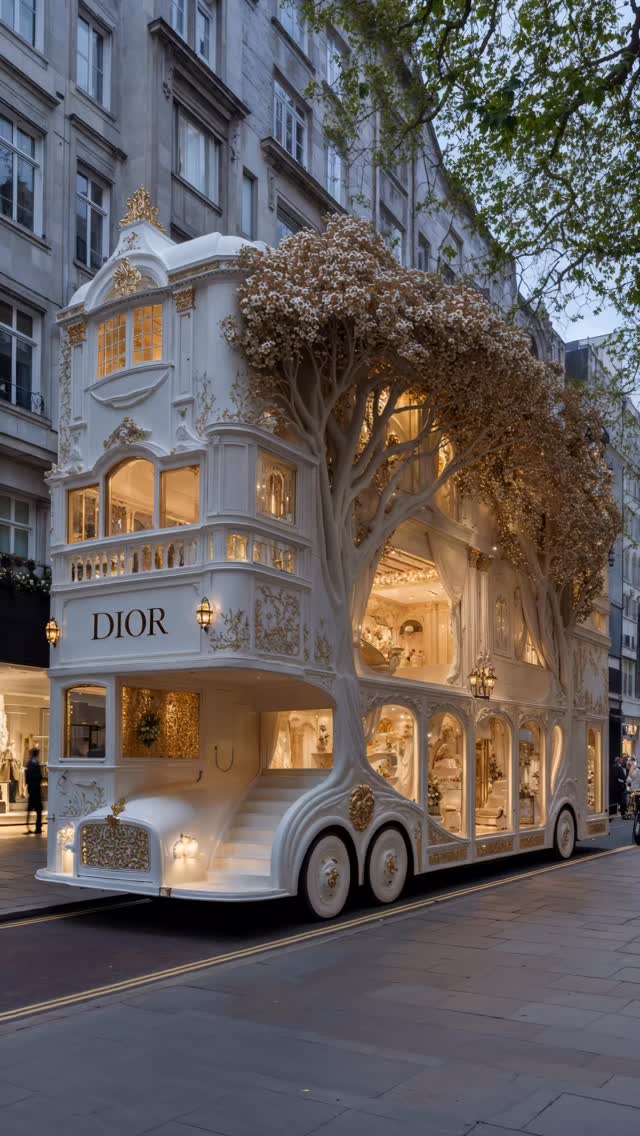
If only luxury brands did their own grand bus parade through Paris. Art/Prompts by @ifonly.ai AI-generated (@midjourney • @higgsfield.ai • @klingai_official • @topazlabs)
If only luxury brands did their own grand bus parade through Paris. Art/Prompts by @ifonly.ai AI-generated (@midjourney • @higgsfield.ai • @klingai_official • @topazlabs)
If only luxury brands did their own grand bus parade through Paris: this short, AI-generated Instagram video turns iconic fashion houses (DIOR, VERSACE, GUCCI, CHANEL, and a Louis Vuitton-style LV finale) into moving “flagship boutiques on wheels,” cruising through a rainy Haussmann boulevard at dusk. The hook is instant: a multi-axle, double-to-multi-story bus that looks like a baroque townhouse façade (white stone + gilded trim, warm boutique windows, even a full tree integrated into the architecture) glides past wet pavement reflections. Each cut reveals a new brand-specific architectural fantasy: a VERSACE palace-bus crowned with a monumental Medusa face; a GUCCI bus wrapped in plush, quilted deep-red velvet with glowing windows; a CHANEL hybrid that fuses ornate white masonry with a modern black glass tower; and a warm bronze/brown LV townhouse-bus with stacked balconies and amber-lit windows.
It’s “cinematic editorial portrait” energy applied to product design + city mood: cool blue-gray sky, warm tungsten interiors, smooth gimbal tracking, and hyper-believable materials. No dialogue needed. The concept is instantly shareable because it’s both a luxury reference flex and a clean, copyable creative recipe for indie creators: pick a recognizable brand identity, translate it into a single bold visual object, then present it in a consistent Paris-at-dusk film grammar.
Every shot centers on one “brand bus” that is basically a mobile building: multiple floors, oversized windows, boutique interiors, and architectural ornament. The wheels and chassis are real enough to sell motion, but the scale is intentionally absurd (it reads like a townhouse driving down the street).
Gray stone façades, mansard roofs, classic balconies, and a wet roadway that catches amber reflections. This matters because it gives the fantasy a believable, premium context. The sky stays cool and flat; interiors stay warm and inviting.
The camera consistently tracks at street height with gentle parallax and a slight upward tilt (to emphasize height). The motion feels like a stabilized gimbal/dolly pass, not handheld UGC. That “luxury ad” smoothness is doing a lot of work here.
Outside is blue-gray and overcast; inside glows tungsten. This contrast makes windows feel like little “mini-scenes,” adding depth without needing characters or dialogue.
Stone carvings, gilded rails, velvet quilting, glossy glass reflections—these textures are the reason viewers don’t instantly file it under “cheap AI.” The surfaces look expensive.
The structure is simple: reveal → admire → cut → new reveal. Each cut is a “brand surprise.” It’s basically a carousel in video form.
| Time range | Visual content | Shot language (framing / movement) | Lighting & color tone | Viewer intent |
|---|---|---|---|---|
| 00:00–00:03.5 | DIOR baroque townhouse-bus, white+gold, warm boutique windows, integrated tree canopy, “DIOR” wordmark | Street-level 3/4 tracking, slight upward tilt, slow glide | Cool dusk exterior + warm interior glow, wet reflections | Instant hook: scale + luxury detail |
| 00:03.5–00:06.5 | VERSACE palace-bus with gold balconies and a monumental Medusa face front, “VERSACE” wordmark | 3/4 front-left track, mild push-in as it approaches | Neutral/cool sky, warm windows, glossy road | Escalation: iconic symbol surprise |
| 00:06.5–00:10.5 | GUCCI plush quilted deep-red velvet bus with glowing warm windows and “GUCCI” signage | Wider framing, side-to-3/4 tracking, steady pace | Warm pink/orange interior against cool city | Texture porn: velvet + glow |
| 00:10.5–00:13.5 | CHANEL hybrid: ornate white stone façade fused with modern black glass tower, subtle double-C | 3/4 tracking, slightly higher viewpoint, glass reflections | Cool exterior, warm interior silhouettes | Contrast: heritage vs modern |
| 00:13.5–00:16.5 | LV-style bronze/brown townhouse-bus with many warm windows, “LV” on grille, a few pedestrians | Slightly elevated sidewalk track, end beat | Amber reflections, warm window grid, cool sky | Finale: density + city life |
This is a perfect “reference-value” concept: luxury brands are instantly recognizable, Paris is instantly legible, and the object is instantly impossible. That triangle makes the video self-explanatory in 0–1 seconds—no narration needed.
Viewers get to enjoy the status signaling of luxury branding, but the absurdity (a literal building-bus) keeps it playful instead of braggy. It’s aspirational and meme-able at the same time.
Each cut is a new reward. People naturally wait to see “what’s next” (DIOR → VERSACE → GUCCI → CHANEL → LV), and many rewatch to catch details (Medusa face, velvet quilting, the tree, the glass tower).
Creators and AI hobbyists can immediately copy the format: pick a brand, translate brand codes into materials + architecture, keep one city + one camera grammar, cut every ~3 seconds. That’s why it’s “save-worthy.”
Instagram rewards fast comprehension + consistent aesthetic. This video delivers a clear hook in the first frame (a DIOR building-bus), then maintains stable lighting, stable camera motion, and stable color grade across every cut, which reduces cognitive load and increases completion rate. The edits are frequent enough to prevent scrolling, but not so fast that details become unreadable. The concept also triggers shares because it’s a “luxury design idea” and a “what-if” worldbuilding moment—both are high share-intent categories.
Use this as your base prompt in your video generator. Replace the bracket variables.
GLOBAL: Vertical 9:16, 24fps, photoreal cinematic, Paris Haussmann boulevard at overcast dusk, wet street reflections, cool blue-gray sky, warm tungsten interior lighting, smooth gimbal tracking, slight depth of field, soft film grain.

SHOT: A gigantic multi-axle bus designed as a moving [BRAND] flagship boutique / townhouse façade. Materials: [MATERIALS]. Brand motif: [MOTIF]. Readable signage: [BRAND_WORDMARK]. The bus glides forward slowly; camera tracks at street level 3/4 angle, stable reflections, no flicker.

NEGATIVE: misspelled text, warped architecture, jitter, cartoon look, watermarks, subtitles.
Use a video model that can keep consistent camera motion and readable textures, and start from strong keyframes (one per shot).
“Paris dusk wet” (environment + lighting) plus “readable wordmark” (credibility).
Your motion is too fast—slow the camera, keep the bus farther away, and lock “rigid chassis, consistent wheels.”
Prioritize realistic materials (stone, gold, velvet, glass), stable exposure, and subtle grain over extreme stylization.
Instagram favors cohesive aesthetics and saves; TikTok favors strong hooks and rapid novelty—test both with the same cut rhythm.
Be transparent in the caption (e.g., “AI-generated”) and avoid implying the scene was filmed in real life.