If only I became Mayor of Paris. Art/Prompts by @ifonly.ai AI-generated (@higgsfield.ai • @klingai_official)
If only I became Mayor of Paris. Art/Prompts by @ifonly.ai AI-generated (@higgsfield.ai • @klingai_official)
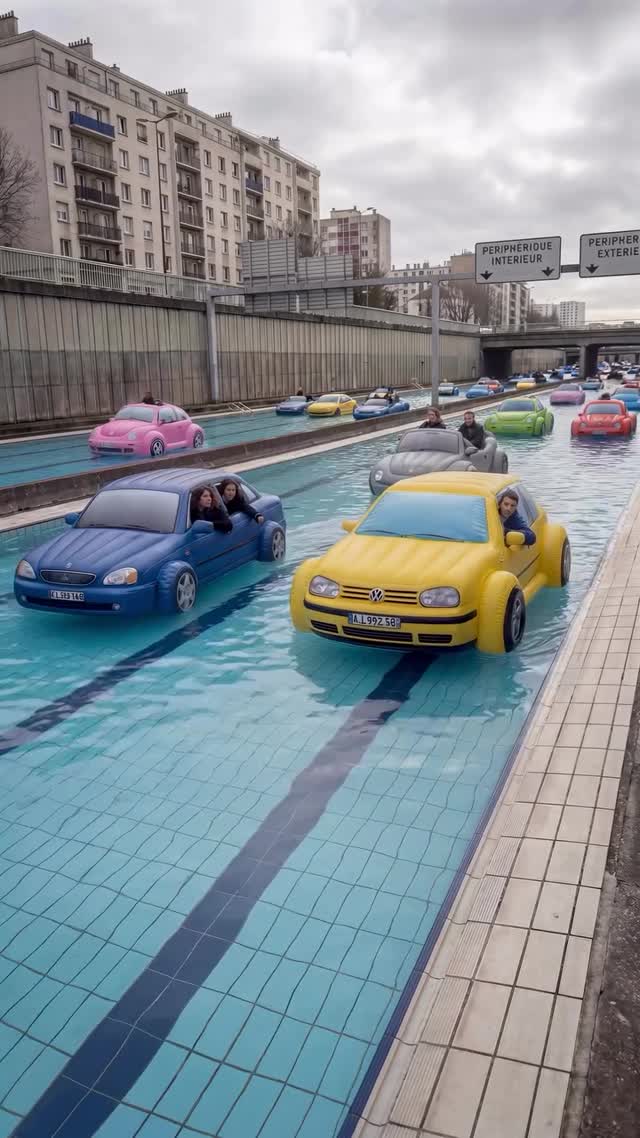
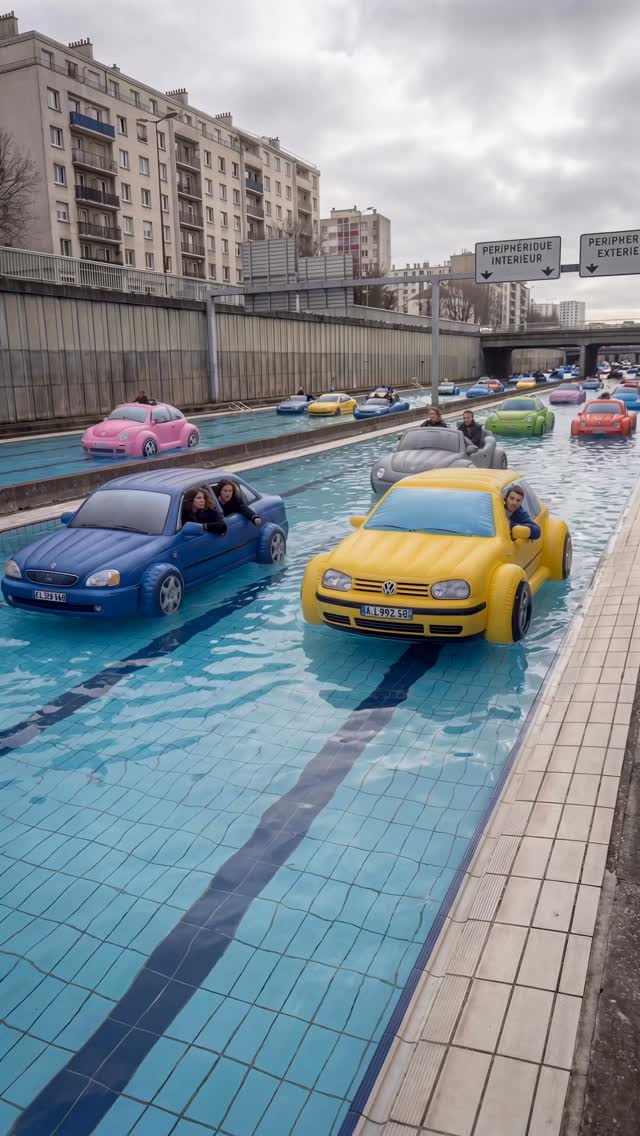
This image takes a familiar anxiety trigger (city traffic) and flips it into something playful: compact cars gliding through bright turquoise water as if the ring road became a public pool. The visual tension is immediate, but it never feels random. Every element supports the same story: ordinary infrastructure, extraordinary condition, and just enough human presence to make it feel real.
If you are a small creator trying to build repeatable reach, this is a strong template. It proves you do not always need celebrity faces or expensive production. You need one clear visual contradiction, clean framing, and a color decision that can be recognized in half a second while scrolling.
The first hook is contradiction. Roads are expected to be dry, gray, and fast. Here they are watery, pastel, and calm. That expectation break buys attention without requiring context. Then the image adds a second hook: recognizability. The signs, bridge, lane geometry, and apartment blocks feel like a real place, so the surreal twist feels like “this could be true for one strange day.”
Another key mechanism is emotional safety. The scene is odd, but not scary. There is no crash, no chaos, no panic. People in cars look relaxed. That makes viewers more likely to share it with a caption like “what is happening here?” instead of avoiding it. This matters for creators because low-friction emotions travel better in mixed audiences.
Finally, the palette does heavy lifting. Cyan water plus candy-like car colors forms a simple color memory. Even after users scroll away, they remember “the flooded road with pastel cars.” That memory compression is a practical growth asset.
| Signal | Evidence (from this image) | Mechanism | Replication Action |
|---|---|---|---|
| Expectation break | Urban highway lanes are filled with shallow clear water | Pattern interrupt increases dwell time in first 1-2 seconds | Lock one everyday environment, then replace one physical rule (dry road -> water lane) |
| Reality anchors | French road signs, bridge, retaining walls, apartment blocks | Concrete details make surreal premise believable | Keep 3-4 documentary anchors (signage, architecture, lane markings, weather) |
| Color memorability | Turquoise base with yellow/blue/pink/green/red cars | High recall and easy repost captioning | Use a 2+1 palette rule: one dominant environment color + 2 accent object colors |
| Human micro-story | Passengers leaning from windows, small gestures | Adds life without stealing frame structure | Include people as secondary scale cues, not hero portraits |
Not ideal: highly technical product demos (too abstract), legal/news reporting (can be misread as documentary fact), and minimalist luxury ads that require clean neutral backgrounds.
Keep: diagonal wide composition, overcast softness, one dominant environmental color. Change: scene type and vehicle type. Slot template (EN): {city_infrastructure} + {unexpected_surface} + {compact_vehicle_set} + {calm_public_mood}.
Keep: documentary anchors (signs, lane lines, architecture). Change: weather and object palette. Slot template (EN): {real_world_signage} + {architectural_context} + {accent_color_system} + {human_micro_gestures}.
Keep: foreground duo + mid cluster + deep background queue depth structure. Change: subject category (cars -> bikes/boats/trolleys). Slot template (EN): {foreground_pair} + {midground_cluster} + {distance_queue} + {single_physics_twist}.
The strongest choice is geometric control. Tile lines and lane stripes pull the eye inward, so even a surreal concept feels engineered. This prevents the frame from looking like a chaotic collage and gives it the confidence of editorial photography.
Color hierarchy is also precise. The water is the dominant field color, while each car becomes a deliberate accent chip. Because the sky is neutral gray, those accents pop without clipping into neon. That balance makes the image shareable across audiences who like either design, fashion, or urban content.
Human scale is handled carefully. People are present but small, mostly framed by windows, which keeps the “system-level” story intact. You read the scene first, then discover faces. That sequence is valuable: broad hook first, detail reward second.
| Observed | Why it matters | How to recreate |
|---|---|---|
| Elevated right-edge camera angle | Creates depth and city-document feel | Place camera slightly above car roof height near sidewalk edge |
| Soft overcast daylight | Maintains realism and avoids dramatic distraction | Use cloud-diffused key with low contrast and mild cool balance |
| 2-3 level depth stacking | Improves narrative readability | Design foreground hero pair, mid cluster, distant queue |
| Single dominant environment color | Builds instant visual memory | Lock one large-area hue (cyan) and avoid competing background colors |
| Prompt chunk | What it controls | Swap ideas (EN, 2-3 options) |
|---|---|---|
| Subject count + vehicle class | Scene density and believability | “14 compact hatchbacks”; “10 retro sedans”; “16 mixed micro-EVs” |
| Physics twist | Core surreal hook | “shallow tiled water lanes”; “foam-covered road”; “glassy reflective asphalt” |
| Reality anchors | Documentary credibility | “French road signs”; “subway exit labels”; “bus route markers” |
| Camera geometry | Flow and visual hierarchy | “elevated diagonal wide shot”; “median-center symmetry”; “bridge-top overlook” |
| Lighting direction + softness | Mood stability across reruns | “overcast diffuse”; “late-afternoon side soft”; “fog-filtered morning light” |
| Palette constraints | Memorability and brand alignment | “cyan + pastel cars”; “warm beige + rust accents”; “charcoal + safety orange” |
Baseline lock (first runs): lock composition angle, lock water-lane physics, lock palette hierarchy.
Keep this rule strict: one to two knobs per iteration. If four things change at once, you lose attribution and cannot learn what truly improved retention.