How imma.gram Made This Virtual Influencer AI Portrait — and How to Recreate It
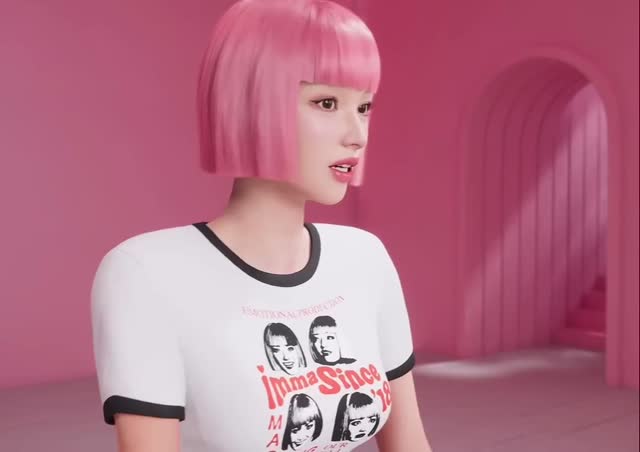
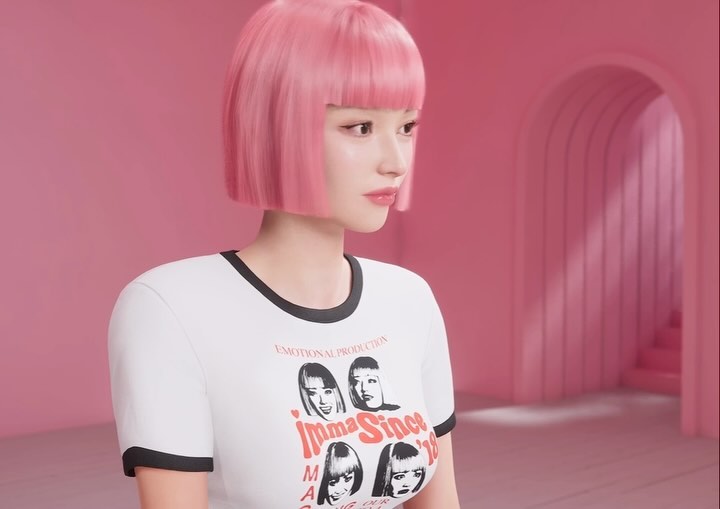
This image is doing something subtle: it looks like a scene from a minimalist film, but it’s really a conversation starter. A virtual human in a single-color world feels instantly recognizable, and the side-profile “mid-sentence” mouth makes the post feel like a moment you caught—not a posed selfie. That’s exactly the vibe you want when your caption is emotional and personal.
The pink set is not just aesthetic. It’s a control system. When everything is one color, the audience stops scanning the background and starts reading the face. The graphic ringer tee adds a touch of everyday realism, which keeps the character from feeling like a fashion render. You get futurism (CG person) with familiarity (casual shirt), and that blend is what makes people lean in.
Why it spreads (signals you can copy without copying the character)
| Signal |
Evidence (from this image) |
Mechanism |
Replication Action |
| Controlled world |
All-pink room with a single archway, no clutter |
Less visual noise = more attention on expression and message |
Lock a monochrome set (one hue) and explicitly forbid furniture/props |
| “Caught mid-thought” energy |
Side profile, mouth slightly open like speaking |
Reads as candid, which pairs well with vulnerable captions |
Prompt “mid-speech, mouth slightly open, soft nervous expression” |
| Iconic hair silhouette |
Blunt pink bob + straight bangs |
Memorability: the audience recognizes the post in a scroll |
Give your character one unmistakable silhouette (hair/hat) and keep it constant |
| Everyday grounding detail |
White ringer tee with black trim and a bold graphic |
Balances the “CG” feel with streetwear familiarity |
Add one casual wardrobe cue (ringer tee, hoodie) to reduce “sterile render” vibes |
Best-fit scenarios
- Channel launches: announcements feel more human when the image looks like a moment, not a poster.
- Vulnerability posts: nervous/excited updates land better with soft lighting and a calm set.
- Virtual persona building: consistent palette + hair silhouette becomes your signature.
- Creator community invites: “come talk to me” posts perform when the visual tone is approachable.
Not ideal
- High-info education: this frame is mood-first; it won’t carry dense text overlays.
- Product detail shots: a character-led composition will steal attention from the product.
- Hard comedy: the minimal art direction can read too serious unless you add a deliberate twist.
Transfers (exactly 3)
-
Recipe 1: New persona, same art direction
- Keep: monochrome room, side-profile mid-speech pose, soft studio light
- Change: character identity, hair color, shirt graphic theme
- Slot template: “{virtual_persona} in a monochrome {color} room, side-profile mid-speech, wearing {casual_top_with_graphic}”
-
Recipe 2: Color-series system
- Keep: same camera angle and set geometry (archway), same wardrobe silhouette
- Change: room color per emotion (pink = nervous, blue = calm, red = bold)
- Slot template: “same scene layout, monochrome {emotion_color} set, expression: {emotion}, caption tone: {announcement}”
-
Recipe 3: Swap the ‘mid-sentence’ beat
- Keep: minimal set, negative space, soft lighting
- Change: micro-expression (surprised, shy smile, thoughtful) and mouth position
- Slot template: “{persona} in monochrome room, {micro_expression}, {mouth_position}, side-profile composition”
Aesthetic read: what makes it feel premium instead of ‘random 3D’
The trick is that the environment is designed like a brand identity: one hue, one architectural motif, and nothing else. That archway creates depth without adding objects. The lighting is gentle, so the face reads first. And the shirt is intentionally ordinary—if everything looked futuristic, the audience would keep their distance.
If you’re building a virtual creator format, consistency beats novelty. Use one camera angle, one room geometry, one palette, and one hairstyle silhouette as your “signature.” Then let the caption carry the story changes.
| Observed |
Evidence in the image |
Recreate instruction (prompt knob) |
| Monochrome set discipline |
Walls + floor are the same pink; no decor |
“empty monochrome {color} room, no furniture, matte surfaces” |
| Depth via architecture |
Rounded archway and curved corridor |
“arched doorway, curved corridor, minimal geometry” |
| Signature silhouette |
Blunt bob + straight bangs is instantly recognizable |
“iconic blunt bob haircut with straight bangs, glossy hair specular” |
| Soft lighting, low contrast |
No harsh shadows; skin reads smooth |
“soft studio key light, low contrast, gentle shadow falloff” |
| Grounding wardrobe cue |
Ringer tee with a bold print breaks the pink field |
“white ringer tee with black trim, bold graphic print, cotton jersey” |
Prompt technique breakdown (treat it like a controllable scene)
| Prompt chunk |
What it controls |
Swap ideas (EN, 2–3 options) |
| Character realism level |
Whether it reads as premium CG vs uncanny |
“semi-realistic CG human”, “stylized 3D doll look”, “hyper-real virtual model” |
| Hair silhouette |
Recognizability and brand memory |
“blunt bob with bangs”, “high ponytail”, “short pixie cut” |
| Set palette |
Brand identity and noise control |
“monochrome pink room”, “monochrome blue room”, “monochrome cream room” |
| Set geometry |
Depth without props |
“arched doorway”, “curved hallway”, “rounded window cutout” |
| Pose micro-beat |
Candid vs posed energy |
“mid-speech mouth slightly open”, “half-smile”, “thoughtful pause” |
| Wardrobe anchor |
Relatability and contrast |
“ringer tee”, “oversized hoodie”, “simple tank top” |
A prompt skeleton to start from
premium 3D render of {virtual persona}, {iconic hair}, side-profile mid-speech,
wearing {casual top}, empty monochrome {color} room with an arched doorway,
soft studio lighting, low contrast, clean cinematic look
Remix steps (converge fast)
Baseline lock
- Palette: commit to one set color and keep every surface inside it.
- Camera: keep the same side-profile angle and framing.
- Signature feature: lock the hairstyle silhouette before you experiment with anything else.
One-change rule
Change one knob per run: expression OR set color OR wardrobe. You’ll keep the “system” intact while learning what actually moves engagement.
Example 4-step iteration sequence
- Run 1: match the pink-room template with a ringer tee and mid-speech pose.
- Run 2: change only the set color to blue and keep everything else identical.
- Run 3: change only the expression (shy smile) and keep the set locked.
- Run 4: change only the wardrobe silhouette (hoodie) while preserving the camera angle.