How invideo.io Made This Cinematic Eye Closeup AI Art
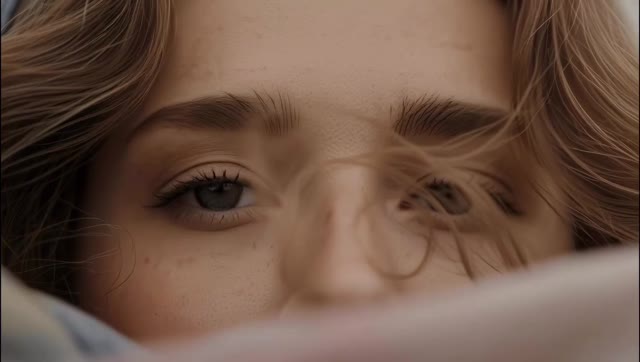
When people talk about “cinematic,” they often mean one thing: intentional focus. This frame is nothing but eyes, skin texture, and a few hair strands, yet it feels like a whole story. For creators working with AI video or hybrid workflows, this is one of the highest‑leverage shots you can learn to build.
Why this kind of frame spreads
The feed rewards clarity. An extreme close-up is clarity by design: the viewer has exactly one place to look. Eyes are the most magnetic subject on screen, and when the background is completely soft, attention cannot leak away.
There is also a “craft signal.” Fine skin texture, natural hair strands, and gentle lighting read as film language, not filter language. That makes people stop and think, “How was this made?” Curiosity plus perceived craft is a reliable share driver in creator circles.
| Signal |
Evidence (from this image) |
Mechanism |
Replication Action |
| Attention lock |
Extreme close-up on eyes, minimal distractions |
Forces a single reading path on mobile |
Storyboard one “eye close-up” beat in every short film sequence |
| Cinematic focus language |
Very shallow DOF, background fully soft |
Signals film craft and increases perceived production value |
Lock “macro close-up + shallow DOF” as a repeatable prompt block |
| Natural imperfection |
Hair strands crossing the face, realistic skin texture |
Prevents the frame from feeling like sterile CGI |
Add 1–2 controlled imperfections (loose hair, micro freckles, subtle grain) |
| Soft lighting |
Gentle shadow falloff, no flash look |
Feels intimate and believable |
Use a single soft key source; avoid multiple hard lights |
Use cases and transfers
Best-fit scenarios
- Short film teasers: an eye close-up is a universal hook for mood and intrigue.
- Music video visuals: close-ups match intimate lyrics and build emotional rhythm.
- Brand story ads: close-up “human truth” frames raise trust before product reveal.
- Transition beats: use it to cut from wide scene to inner emotion.
- AI filmmaking demos: close-ups are where viewers judge realism hardest.
Not ideal
- Explain-first content where the viewer needs context immediately.
- Action-heavy sequences where motion readability is the main value.
- Product detail shots where the object must be fully visible.
Transfers (3 remix recipes)
- Keep: eye framing + shallow DOF. Change: emotion. Template: "extreme close-up on eyes, {emotion} expression, soft natural light, film still".
- Keep: lighting softness. Change: foreground obstruction. Template: "eyes in focus with soft blurred foreground ({foreground}), hair strands, cinematic grade".
- Keep: macro lens language. Change: environment color temperature. Template: "macro eye close-up, shallow DOF, {warm/cool} film grading".
Aesthetic read: what makes it feel expensive
Expensive is not about sharpness everywhere. It is about choosing what to sharpen. Here, the eyes and brows carry all the detail, while everything else melts away. That selective focus is a storytelling tool and a quality signal.
The other “expensive” detail is restraint in grading. Skin stays natural, highlights are not blown out, and saturation is controlled. If your close-ups look plastic, you lose trust instantly. If they look human, the audience forgives everything else.
| Observed |
Recreate |
Why it matters |
| Eyes are the sharpest plane |
Explicitly prompt “focus on irises and eyebrows” |
Defines where attention should land |
| Background is fully soft |
Demand creamy bokeh and no background detail |
Prevents attention leakage |
| Real skin texture |
Add “subtle pores/freckles” and avoid beauty smoothing |
Stops the uncanny valley |
| One natural imperfection |
Loose hair strands crossing the face |
Adds life and realism |
Prompt technique breakdown
| Prompt chunk |
What it controls |
Swap ideas (EN, 2–3 options) |
| shot scale |
How cinematic and intimate the frame feels |
extreme close-up; close-up; medium close-up |
| focus target |
What becomes the emotional center |
focus on eyes; focus on lips; focus on tear line |
| imperfection cue |
Whether it reads human or synthetic |
loose hair strands; subtle freckles; faint film grain |
| lighting softness |
Flattery and realism |
soft window light; soft key + fill; overcast daylight |
| grading restraint |
Premium finish |
muted filmic; warm neutral; cool desaturated |
Remix steps (iteration strategy)
Baseline Lock: (1) extreme close-up framing, (2) eyes in focus, (3) background fully out of focus.
One-change rule: change only 1–2 knobs per run. Example sequence:
- Run 1: Lock the crop and ensure the eyes are tack sharp.
- Run 2: Lock DOF and remove background detail until it becomes pure bokeh.
- Run 3: Add one imperfection (hair strands) and keep it subtle.
- Run 4: Adjust grading slightly (warm vs cool) while keeping everything else constant.