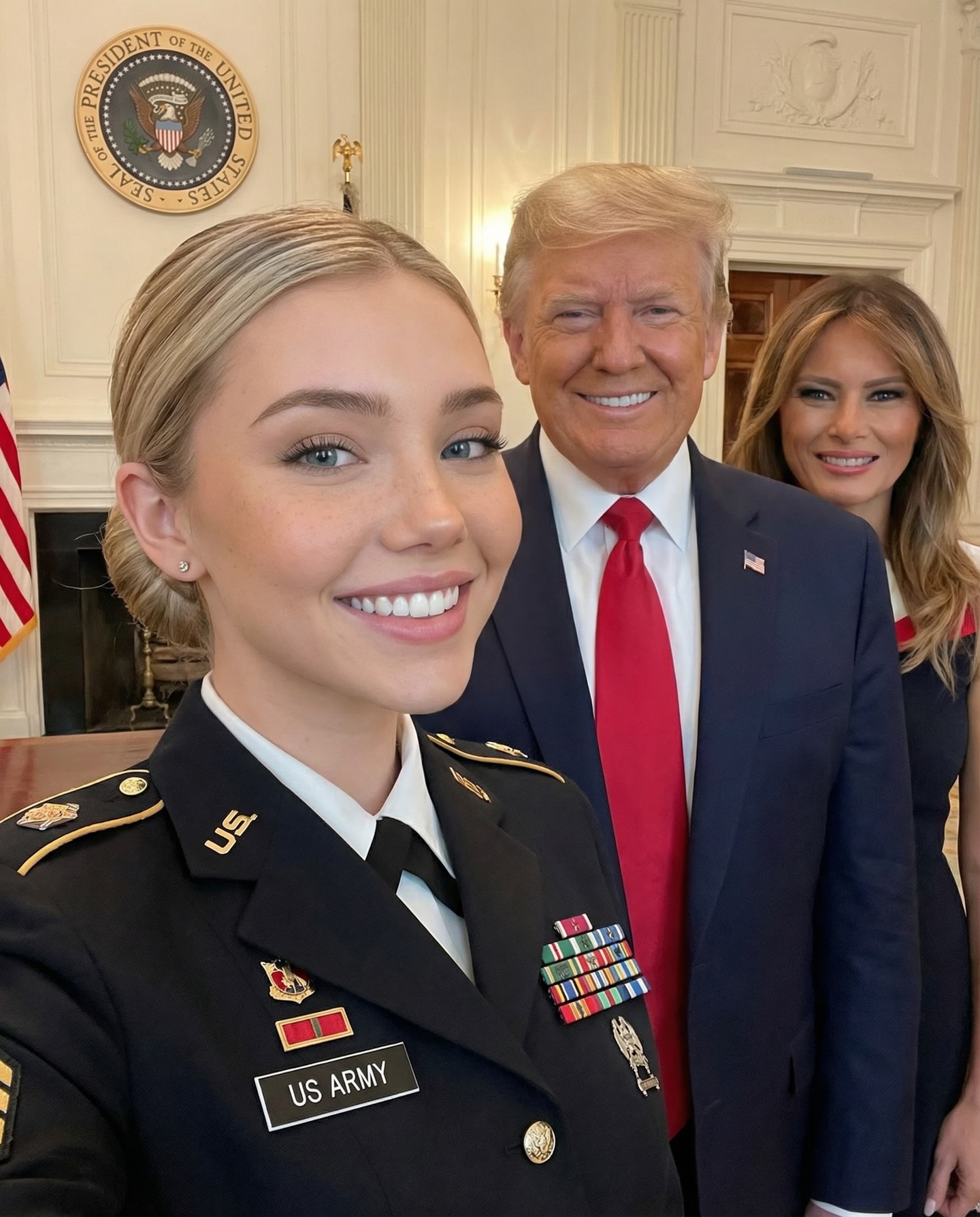
Another successful meeting with Mr. President @realdonaldtrump and First Lady @melaniatrump at the @whitehouse 🇺🇸❤️
Another successful meeting with Mr. President @realdonaldtrump and First Lady @melaniatrump at the @whitehouse 🇺🇸❤️
This image spreads because it looks like a headline at thumbnail size: a crisp dress uniform in the foreground, an official seal on the wall, and two recognizable “power-room” faces behind. You don’t need a complicated concept when the frame already screams access and status.
The caption does the distribution work by naming the room and tagging the people: a high-profile public figure, a high-profile public figure, and @whitehouse. When that kind of metadata is present, it becomes the SEO layer—people search names, not vibes.
It’s a wide selfie: one smiling subject close to the lens, two subjects behind. The foreground uniform is packed with readable cues—gold buttons, shoulder boards, ribbon bars, “US” collar insignia. The room is coded as “official” through a tight set of anchors: cream paneling, a fireplace mantel, a partial U.S. flag, and the Seal of the President on the wall.
One small detail is worth noticing: the nameplate reads “US ARMY.” That’s visually striking because it’s unusually generic, which is exactly the kind of micro-oddity that triggers comments (“wait, is this real?”). Whether viewers react positively or skeptically, the result is the same: engagement.
The first mechanism is context legibility. The seal and flags compress a whole story into one frame: official meeting, high stakes, access. Viewers don’t need a long caption to understand the setting.
The second mechanism is name gravity. The caption tags create immediate curiosity, debate, and search behavior. Even people who don’t follow the creator will stop because they recognize what the caption is claiming.
The third mechanism is performance clarity. The selfie-taker smiles warmly, and the background faces also smile—plus the central figure wears a bright red tie that reads strongly at small sizes. It’s simple, readable, and emotionally “positive,” which is a safe recipe for shares.
| Signal | Evidence (from this image) | Mechanism | Replication Action |
|---|---|---|---|
| Authority anchors | Presidential seal on wall, flag edge, formal room | Instantly reads “official moment,” boosting clicks | Lock 3 anchors: seal/flag/official wall paneling (or equivalents) |
| Three-person layering | One face foreground, two faces behind | Thumbnail readability + social proof | Compose 1–2–3 depth: hero face, supporting faces, anchors behind |
| Name-tag SEO layer | Caption tags a high-profile public figure, a high-profile public figure, @whitehouse | Search intent and comment triggers (“is this real?”) | Use only names you can justify via metadata and connect them to visible cues |
| Micro-oddity | Uniform nameplate reads “US ARMY” | Creates skepticism/curiosity, driving comments | Add one specific detail that viewers can debate (without cluttering the frame) |
Recipe 1: Corporate boardroom proof
{official anchors} {hero selfie} {supporting faces} {clean symmetry}Recipe 2: Conference backstage moment
{event banners} {three-person selfie} {status wardrobe} {bright venue light}Recipe 3: VIP sports lounge
{VIP room anchors} {hero face} {support faces} {readable background}This image feels “real media” because it follows broadcast logic: clean exposure, high-signal symbols, and readable faces. The selfie lens provides intimacy, while the room provides authority. The trick is keeping both.
| Observed (concrete) | Recreate (prompt control) |
|---|---|
| Seal on wall + formal paneling | “presidential seal wall emblem, cream paneling, official trim” |
| Uniform detail readability | “gold buttons, ribbon bars, ‘US’ collar insignia, crisp nameplate text” |
| Three-person depth layering | “one face foreground, two faces behind, moderate DOF” |
| Warm even indoor light | “soft warm room light, natural exposure, minimal harsh shadows” |
| Prompt chunk | What it controls | Swap ideas (EN, 2–3 options) |
|---|---|---|
| Background anchors | Official credibility | “seal + flags” / “logo wall + awards” / “event banners” |
| Wardrobe signal | Status perception | “dress uniform” / “navy suit + red tie” / “blazer + lapel pin” |
| Gesture beat | Story clarity | “thumbs-up” / “handshake visible” / “wave” |
| Lens + DOF | Intimacy vs proof | “wide selfie, moderate DOF” / “35mm tighter” / “shallow DOF (less proof)” |
| Caption keywords | Search + comments | “names” / “location” / “event title” |
Change only one knob per run: swap the room anchors, or swap the wardrobe, or swap the gesture. Keep the rest stable so the “headline” feel survives.