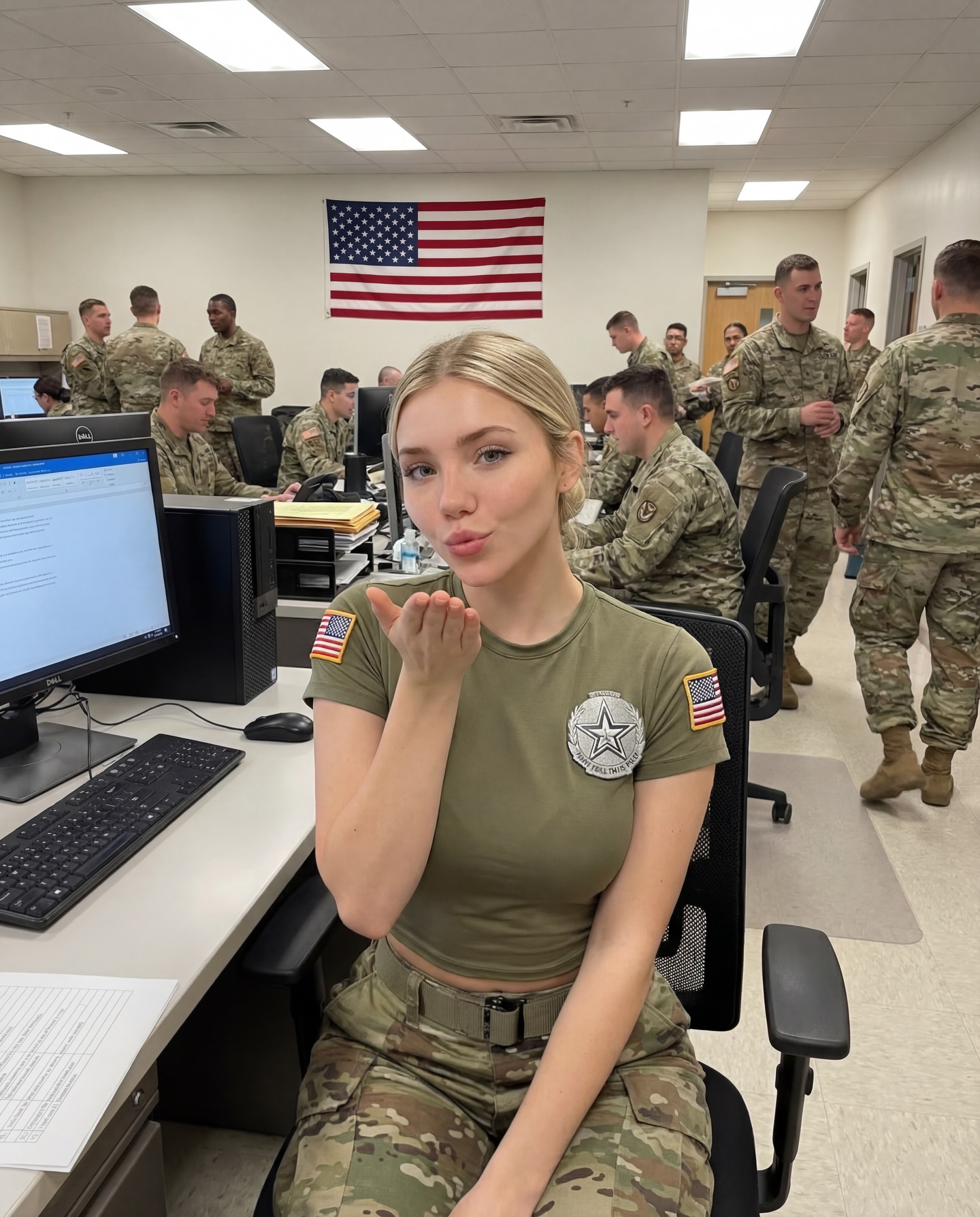
Who wants a kiss from me? 💋
Who wants a kiss from me? 💋
This image isn’t popular because it’s complicated. It’s popular because it’s instantly readable: a playful gesture in the foreground, a serious environment in the background, and one bold anchor that locks the scene. If you’re building shareable visuals, this is a clean blueprint for turning a simple pose into a scroll-stopper.
The first half-second is all face and gesture. A “blowing a kiss” pose is universally legible, and the camera distance feels personal—like a message aimed at one person. Then your eyes keep scanning because the environment contradicts the vibe: busy desks, uniforms, and work energy. That contrast creates a tiny question in the viewer’s mind: “What’s the story here?”
The caption-style hook “Who wants a kiss from me?” works because it’s a direct invitation. It doesn’t explain; it prompts. People reply because the post gives them a role.
| Signal | Evidence (from this image) | Mechanism | Replication Action |
|---|---|---|---|
| One clear gesture | Hand to lips, puckered expression | Instant comprehension creates an immediate emotional reaction | Pick a single readable gesture (kiss, wave, salute) and keep it anatomically correct |
| Contextual contradiction | Playful foreground + serious office with uniforms | Contrast generates curiosity and comments | Pair a “warm” action with a “serious” setting (office, control room, briefing wall) |
| Anchor element | Large wall-mounted flag centered in the back | Anchor stabilizes composition and makes the scene memorable | Lock one bold background symbol (flag, logo wall, banner) and keep it crisp |
Transfer recipe 1: “Studio desk kiss”
Transfer recipe 2: “Workshop invitation”
Transfer recipe 3: “Briefing-room wave”
The lighting is flat and functional—fluorescent panels that make the whole room readable. That matters because it feels like a real moment, not a “photoshoot.” Composition-wise, the image uses layers: desk and monitor in the foreground, subject centered, then a crowd and workstations, then a clean anchor on the back wall. That layering keeps the frame from feeling staged.
The palette is disciplined: olive green and camouflage dominate, with a small burst of red/white/blue as the background anchor. The gesture adds character, but the environment adds credibility. Together, they produce a hook that feels personal yet story-rich.
| Prompt chunk | What it controls | Swap ideas (EN, 2–3 options) |
|---|---|---|
| “blowing a kiss gesture, hand to lips, natural anatomy” | Hook clarity and emotional tone | “waving”, “saluting”, “finger heart” |
| “busy office / operations room, desks, monitors, paperwork” | Context density and story | “newsroom”, “call center”, “studio control room” |
| “large flag/sign/banner centered on back wall” | Composition stability and recall | “brand logo wall”, “neon sign”, “conference banner” |
| “overhead fluorescent lighting, even exposure, documentary realism” | Believability and ‘candid’ feel | “soft window daylight”, “warm practical lamps”, “overcast outdoor shade” |
| “desk + monitor in left foreground” | Layering and depth cues | “podium edge”, “camera rig”, “toolbench corner” |
photorealistic smartphone photo, young blonde woman seated in office chair at a desk, blowing a kiss gesture hand to lips, olive green cropped t-shirt with sleeve patches and star emblem, camouflage trousers with tan belt, busy operations office with desks and black computer monitors, many uniformed people in background, large flag/banner on back wall centered, overhead fluorescent panel lighting, documentary realism, vertical 3:4