0:00 / 0:00
▶
This long surreal short film is built like an illustrated fable about contact, kindness, and alien domestic life. Instead of following one literal story arc, it presents a sequence of quiet encounters between children, adults, and strange hybrid creatures, all linked by tiny rituals of offering flowers, holding dandelions, blowing seeds, pouring tea, and sitting together in stillness.
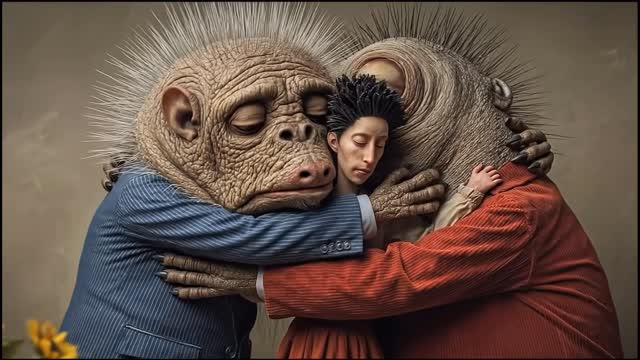
The visual world is muted and handmade in feeling, even though the creatures are impossible. Giant frog heads, lizard faces, bird beaks, television screens, ladybug bodies, and elephant-like noses all appear within the same soft melancholic universe, making the film feel like a lost fairy tale rather than a collection of random monster images.
The central motif is the flower as a bridge. Dandelions, sunflowers, and small blossoms are passed from hand to hand, creature to child, parent to child, or stranger to stranger. They are never decorative props only. They are how the characters show trust, curiosity, grief, affection, and recognition.
That is what gives the film coherence across its many scenes. Even when the creature design changes radically, the emotional vocabulary stays the same: approach slowly, offer something fragile, wait for a response, and hold the moment in silence.
The film uses a repeated visual grammar of frontal portrait compositions, sparse rooms, faded walls, and tabletop arrangements. Characters rarely rush. They lean, sit, hug, pass an object, or blow gently at a seed head. This controlled pacing creates emotional weight that would disappear if the scenes were cut or performed too aggressively.
Creature design is equally important. The beings are uncanny but not presented as threats. Their scale, eyes, and textures make them feel unfamiliar, yet their posture and behavior remain soft. That contrast is what makes the film emotionally affecting: the monsters behave with more tenderness than many human characters in ordinary dramas.
To recreate this kind of video, the prompt should begin with the full emotional and material language of the world: muted storybook interiors, stop-motion-like realism, fragile floral exchanges, sad but gentle expressions, and strange family-group compositions. If the prompt starts only with “weird creatures and people,” it will miss the softness that defines the piece.
The second requirement is timeline discipline. This is not a single surreal portrait. It is a long chain of related vignettes. The prompt needs to preserve the sequence of encounters: child with reptile, girl with frog, flower-table family, amphibian embrace, television-headed group, insect encounter, tea-table conversation, and final standing gift exchange. The order matters because the emotional rhythm builds through repetition.
It is also important to describe restraint. These scenes are powerful precisely because they do so little. The camera, the characters, and the backgrounds all leave room for tiny gestures to matter.
For creators, this film is a useful example of how AI video can support emotional worldbuilding without dialogue, spectacle, or fast editing. It proves that a repeated symbolic object, a unified grade, and a consistent movement vocabulary can hold a very long short-form piece together.
From an SEO perspective, this is exactly the kind of clip that deserves a detailed breakdown. It teaches creators how to build recurring motifs, how to make surreal creatures feel emotionally legible, and how to turn a sequence of still portraits into something that reads as cinema rather than a slideshow of pretty frames.