
細胞の輪廻 The cycle of cellular reincarnation - #aivideo #aifashon #aianimetion #aivideo #generativeart #stablediffision #midjourney #artificialfriends #Liber #japan #klingai
細胞の輪廻 The cycle of cellular reincarnation - #aivideo #aifashon #aianimetion #aivideo #generativeart #stablediffision #midjourney #artificialfriends #Liber #japan #klingai
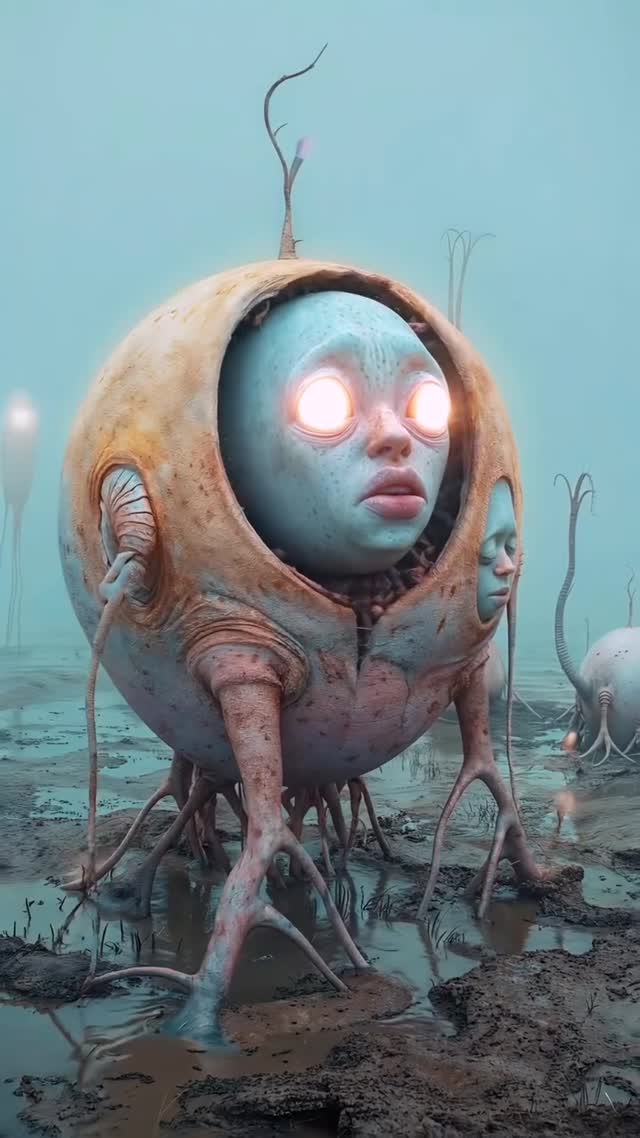
This artwork hits a rare viral zone: beautiful and disturbing at the same time. The glowing eyes create immediate focus, while the body design raises unresolved questions. Viewers pause because they cannot classify it quickly as “cute,” “horror,” or “sci-fi.” That classification delay is powerful for retention.
The muddy wetland setting adds credibility to the fantasy. Instead of floating in a blank background, the creature exists in a tactile world with mud, reflections, and atmospheric depth. That world-building makes the image feel like a frame from a larger narrative universe.
The core mechanism is contradiction. The face is doll-like and almost innocent, but the shell body and root-like legs feel alien and unsettling. Contradiction creates emotional friction, and emotional friction drives comments, saves, and reposts.
Another key lever is center-weighted design. The glowing eyes sit near the visual center, pulling immediate attention. Once the viewer locks onto the face, secondary details (legs, mud texture, distant organisms) keep them scanning longer than a typical single-subject render.
| Signal | Evidence (from this image) | Mechanism | Replication Action |
|---|---|---|---|
| Emotional contradiction | Soft humanoid face inside grotesque organic shell | Ambivalence triggers deeper cognitive processing | Design one “beauty” cue and one “unease” cue in the same subject |
| Primary focal lock | Bright glowing eyes at center | Immediate attention capture on mobile screens | Use a single luminous feature as the visual anchor |
| World plausibility | Mud, reflections, haze, and distant lifeforms | Makes fantasy scene feel explorable and real | Add 3-4 environmental micro-details beyond the main subject |
| Memorable silhouette | Round shell body + multiple insect-like legs | Improves recall in crowded feeds | Prioritize silhouette uniqueness before texture polishing |
{core_face} inside {hybrid_shell}, glowing focal eyes, wet foggy terrain{humanoid_core} in {alien_body}, underwater haze, bioluminescent accents{delicate_face} embedded in {survival_shell}, desolate landscape, distant entitiesThe palette is restrained and strategic: cyan atmosphere, bone-like shell tones, and muddy earth neutrals. This limited palette prevents chaos and allows the eye glow to dominate. A single strong highlight channel often outperforms over-saturated fantasy palettes.
The composition also helps. The creature is centered and low to the ground, making the horizon and fog layers feel expansive. That scale contrast creates a “small subject, vast world” feeling, which implies lore and encourages audience speculation.
| Observed | Recreate evidence rule |
|---|---|
| Centered uncanny creature | Use one dominant subject with unique silhouette occupying central frame |
| Luminous eye focal point | Keep one bright emissive feature to lock attention |
| Wet muddy terrain detail | Add reflective puddles, sticky ground textures, and footprints/indentations |
| Atmospheric depth haze | Layer fog and distant shapes to imply environment scale |
| Muted cyan-brown palette | Limit hues and reserve brightness for focal accents |
| Prompt chunk | What it controls | Swap ideas (EN, 2-3 options) |
|---|---|---|
| humanoid infant-like face embedded in alien shell body | Emotional contradiction and concept hook | “elder face in larval shell”; “ceramic doll face in fungal shell”; “android face in organic pod” |
| glowing white eyes as primary emissive | Instant focal hierarchy | “amber eye glow”; “pulsing cyan core”; “single-eye luminescence” |
| mudflat biome with puddles and root-like appendages | World texture and realism | “salt marsh”; “ash swamp”; “toxic wetland” |
| foggy cyan atmospheric depth with distant creatures | Scale and lore implication | “dense mist with silhouettes”; “rain haze”; “dusty twilight atmosphere” |
| photoreal bio-surreal cinematic render | Output style fidelity | “dark fantasy matte paint style”; “high-detail ZBrush look”; “filmic creature concept shot” |
Baseline lock: silhouette shape, eye-emission focal point, and biome texture language.
Change one variable per run. This prevents style drift and helps you identify exactly what increases saves and shares.