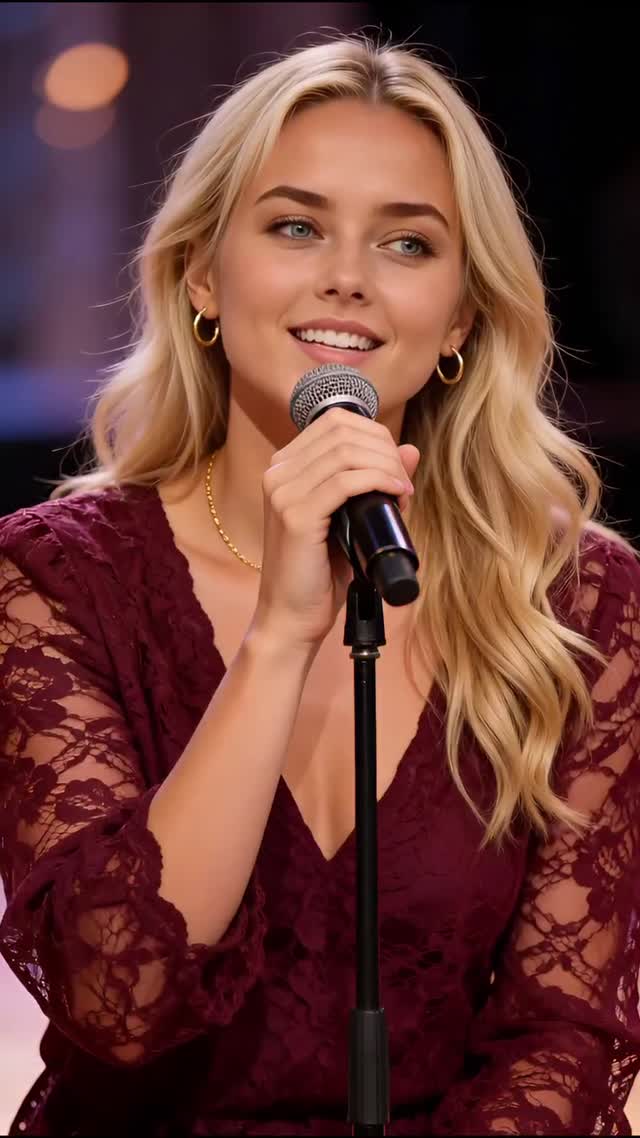
Feeling every emotion in “Callin’ U (Tamally Maak)” 💫 This beautiful Arabic love song, originally written by Mahmoud El Esseily and famously performed by Elyanna, carries so much longing and softness. I couldn’t resist bringing my own feeling into this moment. 🎧 This video is a lip sync using the original song.
Case Snapshot
This 11.8-second vertical performance clip is built on a deceptively simple formula that scales: a single close-up of a blonde singer in a deep burgundy lace dress, holding a microphone on a stand, lit like studio portrait photography with warm amber bokeh lights behind her. There are no cuts, no location changes, and no distracting props, which makes it feel polished and “real.” The pacing comes from the on-screen subtitle lines (white italic serif) that change across the clip: “I don’t need nobody” → “I don’t feel nobody” → “I don’t call nobody but you my one and only.” Even if viewers watch on mute, the text carries the emotional narrative and creates a beat-by-beat progression. For indie creators, this is a repeatable template for “Arabic love song lip sync” style reels (阿拉伯情歌 对口型 短视频) and for AI video prompting workflows: lock one face, one lens look, one lighting recipe, then swap the subtitle timeline and wardrobe color to produce a series of consistent, high-retention posts.
What You're Seeing
1) Subject Consistency (The Whole Video Is One Person)
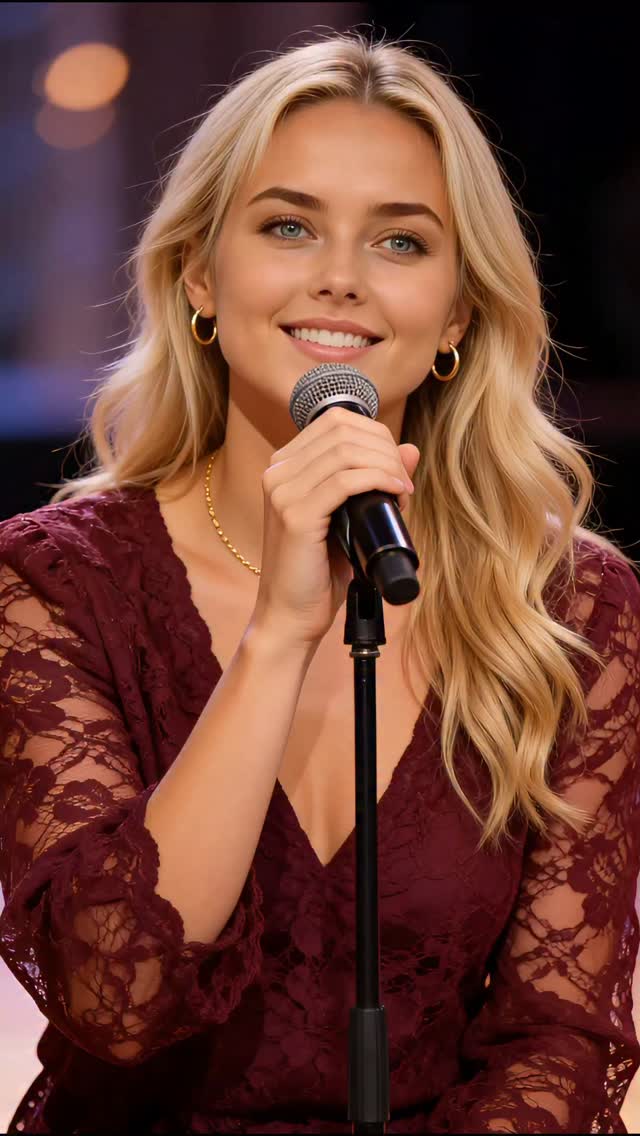
The entire clip stays on one singer: fair skin, long blonde waves, gold hoop earrings, thin gold necklace, and a burgundy lace long-sleeve V-neck dress. Consistency is the product here.
2) Prop Anchor: Microphone + Stand
The mic and stand are the central geometry. Because the stand stays straight and centered, it reduces AI-style “float” and makes the shot feel grounded.
3) Camera Language
It reads as a stable medium close-up with a portrait lens feel (50-85mm). Motion is minimal: tiny head tilts, a brief eye-close beat, and small mouth-shape changes.
4) Lighting Recipe
The lighting is flattering and warm: clean key light on the face and hair, with large amber bokeh circles in the background. That soft bokeh is what makes it “studio premium.”
5) Subtitle Typography
The subtitles are white italic serif, centered in the lower third, with subtle shadow. This specific typography choice feels romantic and “song lyric,” not like a generic caption.
6) Shot-by-Shot Breakdown (estimated; single shot segmented by subtitles)
Time range
Visual content
Shot language (framing / focal-length feel / movement)
Lighting & color tone
Viewer intent
00:00-00:03.5 (estimated)
Soft smile, mic close, subtitle: “I don’t need nobody”
Stable portrait close-up, minimal drift
Warm key + amber bokeh
Hook: readable line + premium face lighting
00:03.5-00:06.5 (estimated)
Emotional beat, eyes close briefly, subtitle: “I don’t feel nobody”
Same framing, micro head tilt
Same warm grade
Retention: emotion shift without scene change
00:06.5-00:11.8 (estimated)
Stronger delivery + slight smile near end, subtitle: “I don’t call nobody but you my one and only”
Same lens look, steady mic alignment
Warm amber remains consistent
Completion: longest line creates “final beat” payoff
7) Why It Looks High Quality
It avoids the hardest AI problems: no fast camera moves, no complex background motion, no multiple characters, and no hand-heavy actions. Everything is constrained and therefore believable.
8) What to Swap for Variations
Keep the lighting and lens consistent, then swap only one variable per post: dress color, subtitle lines, background bokeh color, or emotional arc (soft to intense vs intense to soft).
Why It Went Viral
Topic Selection Analysis (250-300 words)
The topic is romantic lip-sync performance, which is one of the most proven short-form formats because it’s both emotional and low-context: you don’t need backstory to “get it.” This clip focuses the viewer’s attention on three things only: a beautiful face, a microphone (performance context), and a readable lyric line on screen. That combination works across audiences: music fans watch for vibe, casual viewers watch because the text tells them what to feel, and creators watch because it’s a clean, reproducible visual template. The burgundy lace wardrobe signals “date-night elegance,” while the warm amber bokeh background creates a cozy, intimate stage mood. Importantly, the performance is subtle: small head tilts, eye-close timing, and controlled mouth shapes. That subtlety helps retention because it feels real, not over-acted.
The subtitle progression is the viral mechanic: it’s short, emotionally direct, and escalates to a longer “final line.” Each subtitle swap is a micro-reset that refreshes attention without needing a cut. The last line (“…my one and only”) acts as a payoff that encourages completion, and completion is a strong platform signal. For an account that blends music and AI aesthetics, this is the perfect repeatable asset: same setup, many lines, many posts.
Platform-Signal View (about 100 words)
Watch time likely comes from instant readability (big italic serif text) plus steady close-up lighting that feels premium on a phone screen. Shares and saves likely come from quote utility: viewers can reuse the lines as captions, and creators can study the lighting and composition. The lack of cuts reduces cognitive load and prevents “what changed?” confusion. The last subtitle is longer and functions like a finish line, boosting completion. Overall, it’s a low-risk, high-aesthetic format that scales well without triggering low-quality thin-content signals.
5 Testable Viral Hypotheses
Observed evidence: mic + stand stays centered. Mechanism: stable geometry boosts perceived realism. Replication: include one rigid prop that never breaks.
Observed evidence: warm bokeh background. Mechanism: cinematic look increases saves. Replication: keep background defocused with large light orbs.
Observed evidence: subtitles change in 3 phases. Mechanism: micro-resets maintain attention. Replication: design 3 subtitle beats for any 10-15s clip.
Observed evidence: final line is the longest. Mechanism: completion target increases finish rate. Replication: make the last subtitle a “payoff” line.
How to Recreate (0 to 1)
Step 1: Pick the Series Positioning
Best fit: music aesthetic pages, AI performance experiments, “cinematic lyric reels,” and creators doing lip-sync style content. Avoid if your audience expects fast-cut tutorials.
Step 2: Lock the Character Sheet
Define hair (blonde waves), jewelry (gold hoops + necklace), and a signature dress color/material (lace works because texture reads as “real”).
Step 3: Lock Lighting
Use warm key light and large background bokeh lights. Keep the background abstract to avoid AI geometry failures.
Step 4: Generate Keyframes for Mouth Shapes
Keyframes should capture: neutral face, open vowel, eye-close beat, and a small smile near the end. Reject any frame that breaks teeth or lips.
Step 5: Build the Subtitle Timeline
Write 3 subtitle beats. Use one font style (white italic serif) and keep placement consistent. Exact spelling matters.
Step 6: Render as a Single Shot
Render 10-15 seconds with minimal camera movement. Stability is your realism advantage.
Step 7: Troubleshoot Common Failures
If the mic stand bends, reduce motion and increase “rigid straight stand” constraints. If text flickers, restate “stable text, no flicker, exact font” in every segment.
Step 8: Packaging
Cover: face sharp + one subtitle line visible. Title: “Arabic love song lip-sync template (AI prompt + subtitles).”
Step 9: Publish and Scale
Post 3 variants with different lines and track saves. Double down on the line structures that get comments (“one and only” style endings).
Growth Playbook (Distribution & Scaling)
3 Opening Hook Lines
"This is how you make a lip-sync reel look cinematic with one shot."
"Steal this warm bokeh stage setup for your next AI video."
"3 subtitle beats that keep people watching to the end."
4 Caption Templates
Template A: Hook: "Arabic love song vibe, one-shot." Value: "Warm bokeh + subtitle timeline." Question: "Want the exact prompt?" CTA: "Comment ‘ARABIC’."
Template B: Hook: "If your AI lip-sync looks fake, simplify." Value: "One subject, one prop, one lighting recipe." Question: "Should I share the negative prompt?" CTA: "Save this."
Template C: Hook: "Subtitles are the pacing." Value: "3 beats = micro-resets." Question: "Which line hits harder?" CTA: "Reply with your favorite."
Template D: Hook: "Burgundy lace reads expensive." Value: "Texture sells realism." Question: "Next: black satin or white silk?" CTA: "Follow for the series."