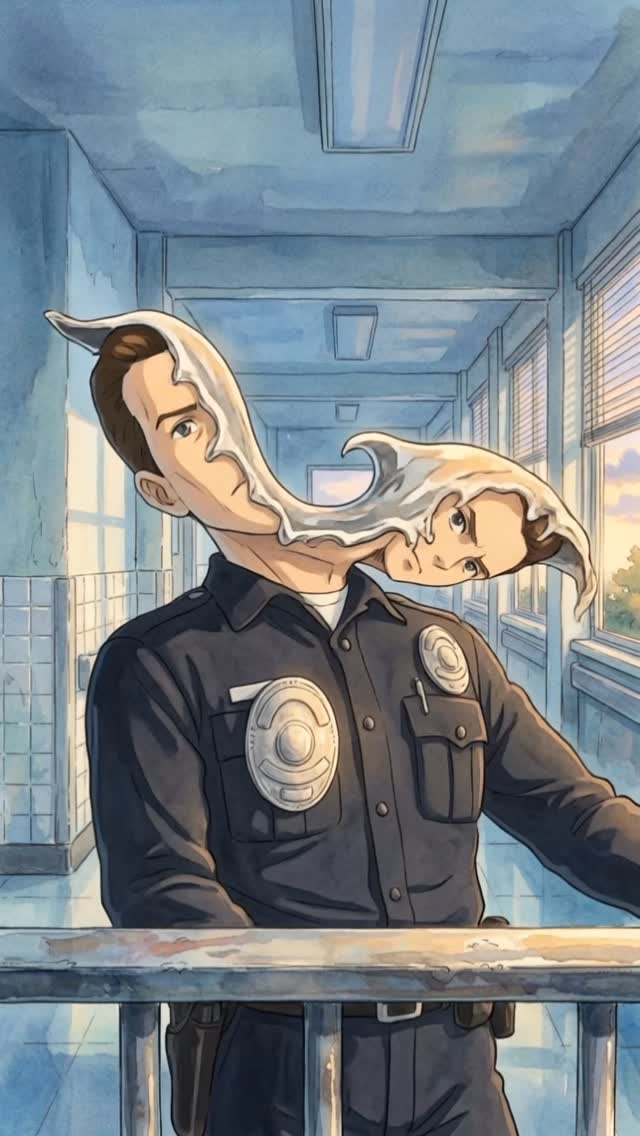
This image works because it stages surreal distortion inside an otherwise ordinary institutional corridor. The uniform, hallway, badges, windows, and railing all signal stability and routine. That stability is exactly what makes the liquid head transformation unsettling and memorable. The surrealism has something rigid to push against.
The best choice in the image is that the transformation is not violent. It is smooth, pale, and almost ribbon-like, which shifts the mood away from horror and toward dream logic. The image becomes uncanny without becoming grotesque. That distinction is important if the goal is conceptual poster art rather than shock imagery.
| Signal | Evidence (from this image) | Mechanism | Replication Action |
|---|---|---|---|
| Ordinary setting vs impossible subject | The corridor, badges, railing, and windows all feel believable and mundane. | Realistic surroundings make a surreal intervention much more effective. | Ground surreal effects in a highly readable everyday environment. |
| Fluid transformation | The head stretches into a pale ribbon connecting two face fragments. | Smooth deformation feels more poetic and uncanny than aggressive fragmentation. | Describe transformations as flowing, continuous, and elegant instead of broken or explosive. |
| Perspective support | The hallway lines pull backward while the distortion sweeps horizontally. | Contrasting movement directions add visual tension. | Use architectural depth behind a sideways or off-axis surreal gesture. |
| Cool-warm balance | The blue corridor is offset by warm light from the windows. | Temperature contrast keeps the scene legible and prevents visual flattening. | Mix cool interior tones with one secondary warm light source. |
| Painterly restraint | The rendering is soft and illustrative rather than hyper-literal. | A slight painterly filter helps surreal concepts feel intentional and atmospheric. | Use polished painterly realism when the concept relies on visual metaphor. |
From a prompt-writing perspective, this image shows that surreal ideas need a clear physical rule. Here, the rule is simple: the head behaves like liquid fabric or cream, stretching from one face form into another. That singular rule gives the image coherence. Without it, distortion effects quickly become random.
It also demonstrates the value of keeping symbolic transformation localized. The body remains intact, the corridor remains believable, and only the head is altered. That containment makes the idea easier to read and stronger as a poster. Too much deformation everywhere would weaken the metaphor.
| Prompt chunk | What it controls | Swap ideas (EN, 2–3 options) |
|---|---|---|
| uniformed officer in a blue institutional hallway | Creates the grounded reality layer of the image. | teacher in a classroom corridor; doctor in a hospital hall; clerk in a civic building passage |
| head transforming into a pale liquid ribbon connecting two faces | Defines the exact surreal rule of the scene. | wax-like facial stretch; silk-like melting profile; porcelain face ribbon split |
| metal railing in the foreground | Adds real spatial depth and anchors the composition. | window ledge foreground; reception desk edge; classroom partition rail |
| cool blue interior with warm window daylight | Controls the scene’s color logic and emotional balance. | green hallway with amber sunset light; gray corridor with soft gold side light; pale hospital blue with warm exterior glow |
| painterly surreal realism | Keeps the image atmospheric and conceptual instead of graphic-horror literal. | watercolor-style uncanny realism; soft storyboard surrealism; polished concept-art illustration |
If you want to iterate on this concept, keep the hallway and body stable while changing only one variable such as the transformation material, the profession, or the light temperature. That makes it easier to understand which part of the image is producing the strongest uncanny response.
This construction is ideal for conceptual posters, surreal editorial illustrations, dream-logic story visuals, and AI imagery that needs to feel psychologically strange without relying on gore. The formula is simple: one realistic setting, one localized impossible transformation, and one restrained painterly finish that keeps the surrealism readable.