Feelin’ 🔵 I need better outfit ideas… wanna help? ⬇️⬇️ #aibaddie
Feelin’ 🔵 I need better outfit ideas… wanna help? ⬇️⬇️ #aibaddie
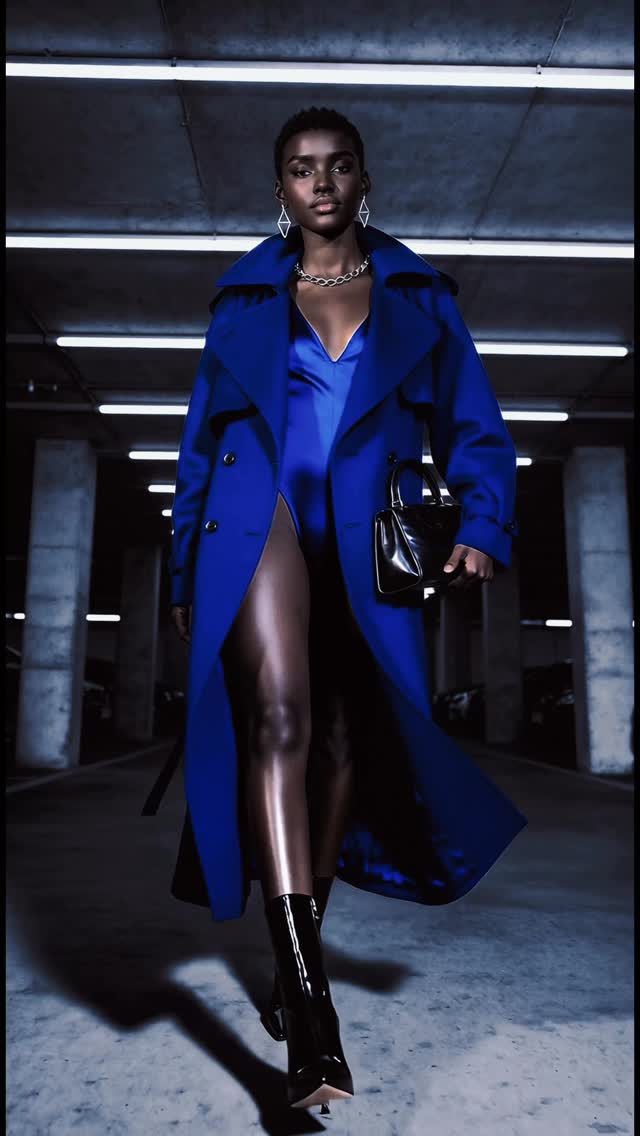
This visual works because it compresses runway authority into a real urban space. The subject walks directly at the viewer, the camera sits low, and the overhead light grid creates instant momentum. You do not just see an outfit; you feel movement and status.
The color strategy is also disciplined. Instead of many hues, the image stacks tonal blue layers (coat + innerwear) against neutral concrete and black accessories. That keeps the look memorable and premium without looking chaotic. For feed performance, this kind of limited palette often outperforms over-styled color explosions.
Most importantly, the location is functional storytelling. A garage is not glamorous by default, but the lighting geometry turns it into a dramatic runway. This is exactly the kind of transferable concept creators need: strong visual identity using accessible infrastructure.
| Signal | Evidence (from this image) | Mechanism | Replication Action |
|---|---|---|---|
| Power perspective | Low-angle full-body stride toward lens | Makes subject appear dominant and cinematic | Drop camera to knee height and direct one forward step |
| Linear light architecture | Parallel ceiling strips receding into depth | Creates built-in leading lines and drama | Scout locations with repeated overhead fixtures |
| Tonal color discipline | Cobalt outerwear + royal innerwear + black accents | Strong style memory with minimal visual noise | Pick one hero hue, then vary tone not hue count |
| Utility location reframe | Concrete garage presented as editorial stage | Elevates common spaces into campaign aesthetics | Use industrial spaces and control framing before adding props |
{industrial corridor} {hero outerwear} {forward stride} {low-angle editorial}{single hue family} {dark accessories} {cool architectural light}{one subject walk} {one hand prop} {structured urban geometry}The aesthetic power comes from alignment between wardrobe geometry and environment geometry. The trench coat’s long vertical lines echo the garage columns, while fluorescent strips reinforce direction and speed. The blue fabric adds richness against cold gray concrete, and the black accessories lock the palette. The pose is controlled: not exaggerated, just enough stride to imply narrative. This blend of constraint and motion is why the frame feels editorial instead of costume-like.
| Observed | Recreate | Evidence cue |
|---|---|---|
| Low camera perspective | Shoot from knee-height with slight upward tilt | Subject appears powerful and elongated |
| Repeating top light bars | Use corridors with linear luminaires | Natural leading lines guide eye to subject |
| Hero hue in tonal layers | Match coat and innerwear in same color family | Look feels intentional, not random |
| Black accessory anchors | Use dark bag and boots to ground palette | Contrast points stabilize composition |
| Prompt chunk | What it controls | Swap ideas (EN, 2-3 options) |
|---|---|---|
| “adult woman walking toward camera, confident neutral face” | Gesture and attitude | “half-turn walk”, “strong stop pose”, “coat-swing step” |
| “oversized cobalt trench over satin innerwear” | Silhouette + texture hierarchy | “long wool coat”, “structured blazer dress”, “vinyl trench” |
| “industrial garage with fluorescent ceiling lines” | Spatial drama and depth | “subway corridor”, “parking deck ramp”, “service tunnel” |
| “low-angle 9:16 full-body frame” | Platform fit and dominance | “4:5 editorial crop”, “wider 3:4 movement shot”, “tight 2:3 fashion crop” |
| “cool high-contrast cinematic lighting” | Mood temperature and edge definition | “neutral industrial light”, “teal-blue noir”, “hard white top-light” |
Prioritize saves and shares as decision metrics. In fashion-action imagery, these signals usually indicate stronger downstream discovery than like count alone.