
❣️💋 . . . #model #influencerdigital #influencer
❣️💋 . . . #model #influencerdigital #influencer
A single-frame aesthetic can outperform “busy” concepts when every pixel supports a clear feeling. This breakdown shows how to recreate the look, then remix it without losing what made it travel.
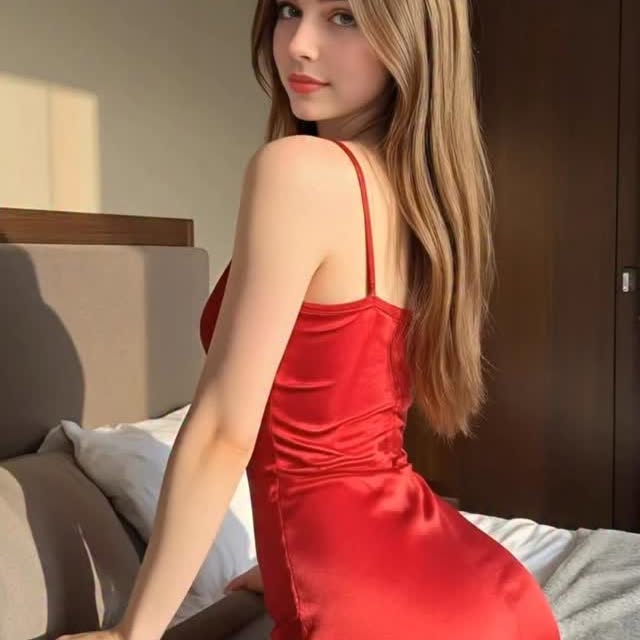
What makes this format sticky isn’t novelty—it’s clarity. The frame reads in half a second: a strong silhouette, a confident over-the-shoulder glance, and one dominant color that instantly becomes the headline. The background doesn’t compete, so the viewer’s eyes have nowhere to “wander off” before the feeling lands.
The sunlight is doing more work than most creators realize. That rectangle of sun on the wall is a built-in “stage,” and it tells your brain a story: real time, real place, real warmth. At the same time, satin turns light into texture—highlights trace the fabric, which adds depth and a sense of touch. That combination (believable room + premium texture) creates a fast emotional payoff.
There’s also a quiet tension that boosts retention: the pose is turned away, but the gaze comes back. It feels like a moment caught mid-turn. This micro-narrative is subtle, but it invites the viewer to pause, zoom, and re-check details—exactly the kind of behavior many platforms reward. Keep the scene simple, keep the light directional, and let the material carry the “luxury signal.”
| Signal | Evidence (from this image) | Mechanism | Replication Action |
|---|---|---|---|
| Instant readability | One subject, clean room lines, centered-right placement | Fast comprehension increases “stop rate” in the feed | Reduce background objects; keep one dominant subject occupying ~60–70% of the frame |
| Premium texture cue | Glossy satin highlights along folds and curves | Specular highlights create tactile realism and perceived “quality” | Lock “glossy satin, strong specular highlights”; raise contrast slightly, keep skin natural |
| Micro-narrative tension | Body turned away, gaze back at camera | Implied movement increases dwell time (second look / zoom) | Prompt “over-the-shoulder look, torso turned away, hands braced” and keep the angle consistent |
| Natural light authenticity | Directional sunlight from the left + sun patch on wall | Feels “real,” not overly produced; boosts trust and shareability | Add a hard sunbeam element: “rectangular sun patch on beige wall, window light from left” |
Recipe 1 — “Golden hour café”
Keep: directional window light from the left, glossy fabric highlights, 85mm shallow depth of field
Change: scene to a quiet café corner, wardrobe to a satin blouse + skirt, prop to a coffee cup
Slot template (EN): “{café corner} {satin outfit} {one small prop} {soft confident glance}”
Recipe 2 — “Minimal hotel hallway”
Keep: clean background geometry, center-right subject placement, single dominant color accent
Change: scene to an upscale hallway, wardrobe to a satin mini dress in emerald/black, background to warm wall sconces
Slot template (EN): “{hotel hallway} {satin mini dress color} {warm practical lights} {over-the-shoulder pose}”
Recipe 3 — “Bedroom morning robe”
Keep: beige wall + sun patch idea, natural bounce fill, subtle micro-narrative gaze
Change: wardrobe to a silky robe + slip, prop to a book on the bed, mood to quieter/softer
Slot template (EN): “{sunlit bedroom} {silky robe set} {simple bed prop} {calm morning mood}”
The image succeeds because it’s built on a tight, two-layer contrast: warm architecture versus high-shine fabric. The beige wall and dark wood wardrobe act like a neutral frame, while the red satin becomes the only “loud” element. That’s why the dress reads like a headline even at thumbnail size. The sunlight isn’t just illumination—it’s a compositional shape. The rectangular sun patch on the wall creates a second, quieter rectangle that echoes the wardrobe panels, giving the frame a clean rhythm of verticals and blocks.
Notice how the highlights glide across the satin rather than breaking into noisy sparkle. That’s a controlled specular look: bright enough to feel expensive, but smooth enough to keep the face flattering. The camera distance feels slightly telephoto, which compresses the room and keeps background lines calm. Finally, the pose is a cheat code: the body points away (mystery), the eyes return (connection). Recreate those three ideas—shape, sheen, and glance—and you can swap almost everything else.
| Prompt chunk | What it controls | Swap ideas (EN, 2–3 options) |
|---|---|---|
| Subject + gaze | Connection, retention, “pause” impulse | “direct eye contact”, “over-the-shoulder glance”, “looking past the camera” |
| Wardrobe material | Premium cue via specular highlights and texture | “glossy satin”, “silk charmeuse”, “soft velvet (less shine)” |
| Lighting direction | Depth, shadow shape, realism | “window light from left”, “window light from right”, “soft key + subtle rim light” |
| Background cleanliness | Readability and focus | “minimal bedroom”, “plain studio wall”, “simple hotel room” |
| Lens / depth of field | Editorial feel and separation | “85mm shallow DOF”, “50mm natural”, “105mm compressed” |
| Composition constraints | Stops the model from drifting into random crops | “head-to-mid-thigh framing”, “subject center-right”, “clean negative space on left” |
Photorealistic fashion editorial portrait, vertical 2:3. One young adult woman in a glossy red satin slip mini dress with thin spaghetti straps, torso turned away, looking back over shoulder, soft confident half-smile, coral-red lipstick. Modern minimal bedroom, beige wall with a rectangular patch of sunlight, gray upholstered bed edge foreground, white bedding and light gray blanket, dark wood wardrobe doors background right. Directional window sunlight from the left, warm daylight, soft bounce fill, shallow depth of field, 85mm lens feel, crisp focus on face and satin texture, clean background, no text, no watermark.Change only 1–2 knobs per run. If you change wardrobe and lighting and background, you’ll never know what broke the look.