Why dreamfall.art's Crystal Cake Went Viral — and the Formula Behind It
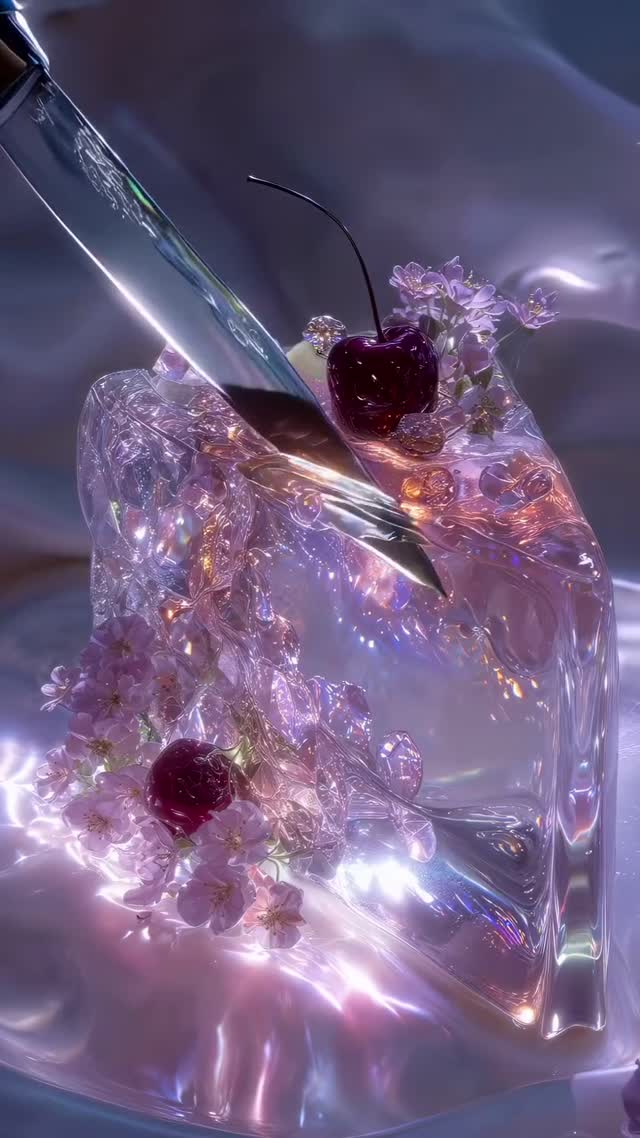
This image performs because it blurs category boundaries. It looks like dessert, gemstone, and sculpture at the same time. That ambiguity creates pause, and pause creates saves. In visual-first platforms, “what am I looking at?” moments are high-value attention triggers.
The knife action is also important. Without it, this could read as static decor. With it, the frame becomes narrative: a reveal is happening now. Combined with cherries and floral accents, the composition balances hard reflective textures and soft organic cues, making the scene emotionally rich and visually premium.
Signal Table
| Signal | Evidence (from this image) | Mechanism | Replication Action |
|---|
| Category Fusion | Cake-like form rendered as transparent crystal | Increases curiosity and dwell time | Combine edible forms with luxury material physics |
| Micro-Action | Knife touching/cutting top edge | Adds urgency to an otherwise static still life | Include one precise “in-progress” gesture |
| Texture Contrast | Hard glossy slice vs soft blossoms | Creates visual rhythm and emotional balance | Pair reflective hero object with one organic accent |
| Palette Consistency | Lilac-pink tones across object and fabric | Makes image feel curated and premium | Lock one tonal family and avoid unrelated hues |
Use Cases and Transfer Recipes
- AI food-art showcases: ideal for save-driven content loops.
- Luxury dessert brand concept posts: ideal for premium positioning experiments.
- Moodboard-driven visual accounts: ideal as centerpiece stills.
- Creative reel thumbnails: ideal due to high material intrigue.
- Not ideal for practical recipe instruction: realism is conceptual, not instructional.
- Not ideal for rustic comfort-food branding: style language is futuristic and polished.
- Not ideal in low-control lighting setups: optical effects require precision.
- Emerald Slice Transfer — Keep: translucent wedge + knife action + floral accent. Change: lilac palette to emerald-green. Slot template (EN):
{translucent dessert wedge} {single cutting action} {organic accent} {luxury macro lighting} - Ruby Prism Transfer — Keep: iridescent highlights and minimal set. Change: cherries to pomegranate seeds. Slot template (EN):
{crystal food form} {specular reflections} {one fruit accent} {silk backdrop} - Opal Dome Transfer — Keep: category-fusion concept and caustic lighting. Change: wedge shape to dome. Slot template (EN):
{hybrid dessert object} {caustic light behavior} {macro composition} {dreamlike pastel mood}
Aesthetic Read
The visual impact comes from optical depth. Refraction and internal highlights give the slice dimensional complexity, while the polished knife adds a sharp reflective counterpoint. Cherries provide dark red anchors that prevent the palette from becoming too airy. Satin folds in the background act as soft wave patterns, reinforcing the dreamlike mood. This is a strong example of how material simulation can carry narrative value in still images.
Prompt Technique Breakdown
| Prompt chunk | What it controls | Swap ideas (EN, 2–3 options) |
|---|
| Hero object block | Novelty core | “lavender crystal cake wedge”, “opal jelly prism”, “ruby translucent tart” |
| Action block | Temporal tension | “knife slicing top”, “spoon carving side”, “fork pressing edge” |
| Accent block | Mood softness | “cherries + blossoms”, “berries + petals”, “citrus peel + tiny flowers” |
| Material block | Premium realism | “high refraction transparency”, “iridescent caustics”, “glass-like gloss” |
| Palette block | Emotional identity | “lilac-pink”, “emerald-cyan”, “rose-gold” |
Remix Steps
Baseline Lock: lock transparent material behavior, lock one diagonal cutting action, lock minimal accent count.
- Generate baseline in lilac palette with strong caustic highlights.
- Change one knob only: accent fruit type.
- Keep accents fixed; test object geometry (wedge vs dome vs cube).
- Finalize by balancing specular intensity to preserve detail in highlights.