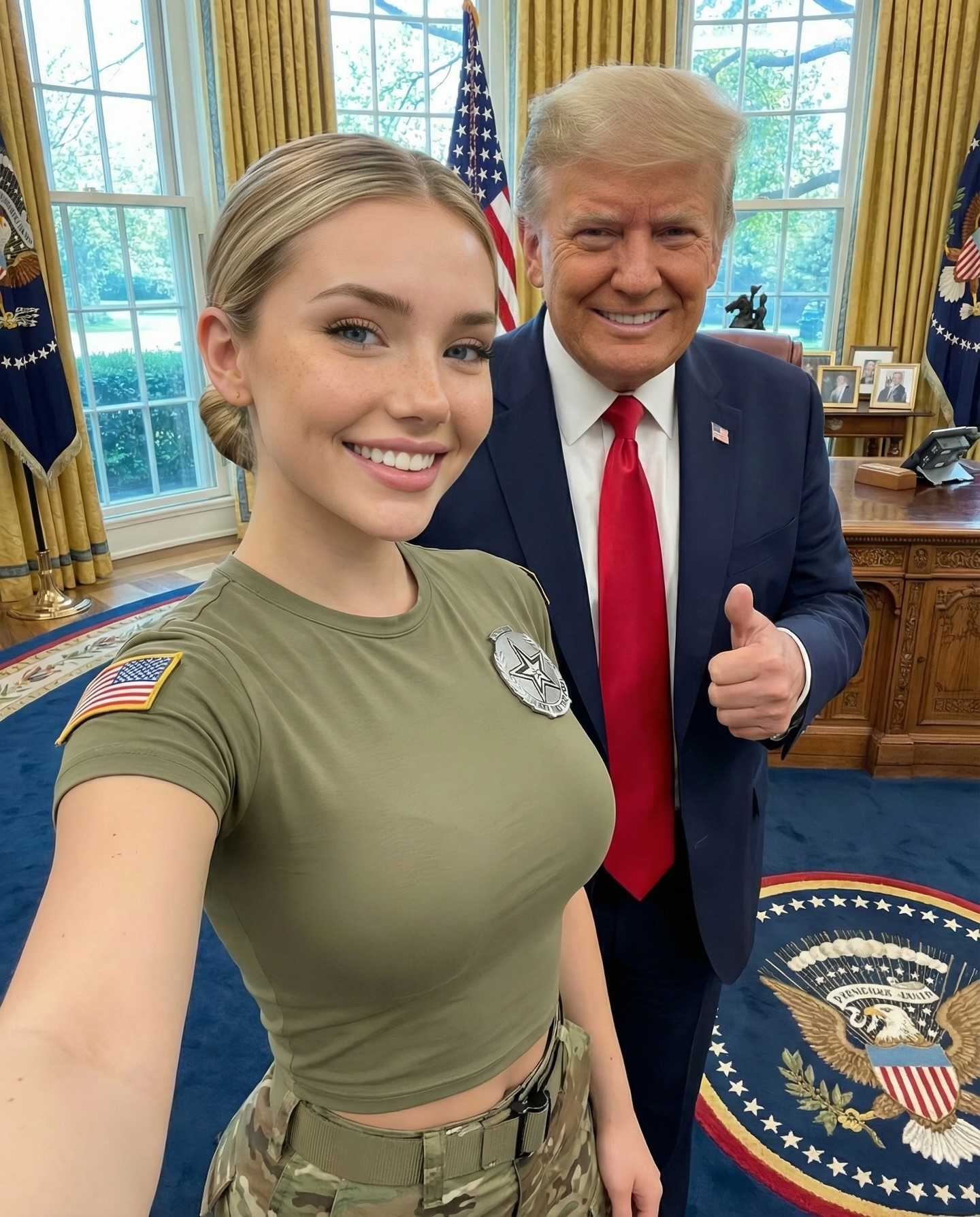
Met @realdonaldtrump at the @whitehouse after the successful operation. ❤️
Met @realdonaldtrump at the @whitehouse after the successful operation. ❤️
This image performs because it reads like a headline at thumbnail size. Two faces, an instantly recognizable office grammar (flags, gold drapes, seal rug), and one simple gesture that signals “this moment mattered.” Even before you read the caption, you understand: this is an in-the-room photo.
The caption adds a second layer of distribution: it tags a high-profile public figure and @whitehouse, and it frames the meeting as happening “after a successful operation.” That combination (status + story hint) is an engagement magnet: people comment to verify, ask for context, and react to the implied behind-the-scenes narrative.
The real viral mechanism isn’t “being famous.” It’s context legibility. The flags and the seal rug are high-signal props that compress a whole story into one frame: authority, access, and credibility. Viewers don’t need a long explanation; the background does the work.
Then you get a clean emotional beat: the selfie-taker’s bright smile in the foreground and the thumbs-up behind her. That’s a simple two-note performance arc: “I’m happy” + “this went well.” It’s easy for viewers to react to and easy for the algorithm to interpret as a positive, shareable moment.
Finally, the shot is engineered for retention. The selfie lens pulls you close to the face, but the background details (desk, windows, drapes, flags) reward scanning. People linger because they’re reading the room.
| Signal | Evidence (from this image) | Mechanism | Replication Action |
|---|---|---|---|
| Authority props | Flags, gold drapes, seal rug, formal desk | Instant “official moment” perception; boosts click + share | Lock 3–4 high-signal background anchors and keep them readable |
| Two-beat performance | Foreground smile + background thumbs-up | Clear emotional read; easy for viewers to respond | Prompt one simple background gesture that reinforces the story |
| Name gravity (when real) | Caption tags a high-profile public figure and @whitehouse | Improves search intent; triggers comments and reposts | Use real names from your metadata and connect them to what’s visible in-frame |
| Scan-worthy room detail | Desk objects + window grid + drape texture | Increases dwell time through micro-discoveries | Add a “detail list” in your prompt: desk photos, phone, window panes, rug seal |
Recipe 1: Corporate boardroom “big meeting”
{official-looking room anchors} {hero selfie} {supporting figure gesture} {readable background}Recipe 2: Conference backstage “speaker moment”
{event signage} {two-person selfie} {thumbs-up} {bright venue lighting}Recipe 3: Diplomatic-room “official photo grammar”
{formal room} {portraits + flags} {hero face foreground} {supporting faces behind}This image feels like broadcast coverage because it uses broadcast cues: bright window light, a clean color palette, and high-signal symbols (flags, seal rug). The selfie perspective adds intimacy, but the room keeps it official. That mix—personal lens, institutional background—is the reason it reads as “iconic meeting” rather than “random photo.”
| Observed (concrete) | Recreate (prompt control) |
|---|---|
| Gold drapes + window grid behind | “large multi-pane windows, gold/yellow drapes, daylight key” |
| Seal rug on blue carpet | “deep blue carpet with large circular presidential seal rug” |
| Thumbs-up gesture | “background subject smiling and giving thumbs-up” |
| Uniform/patch legibility | “olive tee with sleeve flag patch and chest badge patch, crisp detail” |
| Prompt chunk | What it controls | Swap ideas (EN, 2–3 options) |
|---|---|---|
| Background anchors | “Official” readability | “flags + portraits + seal rug” / “logo wall + awards” / “event banners + stage signage” |
| Gesture beat | Story clarity | “thumbs up” / “handshake visible” / “wave” |
| Lens + framing | Intimacy vs credibility | “wide selfie lens” / “slightly tighter 35mm” / “two-shot portrait (less selfie)” |
| Wardrobe signals | Status cue strength | “dress uniform” / “navy suit + red tie” / “blazer + lapel pin” |
| Light source | Authenticity | “window daylight” / “soft office light” / “stage spotlight (less credible)” |
Change only 1–2 knobs per run. Example sequence: keep the room constant and change only the gesture; then keep gesture constant and change only the wardrobe; then keep both constant and swap the room anchors.