We’re ready. @realdonaldtrump 🇺🇸❤️
We’re ready. @realdonaldtrump 🇺🇸❤️
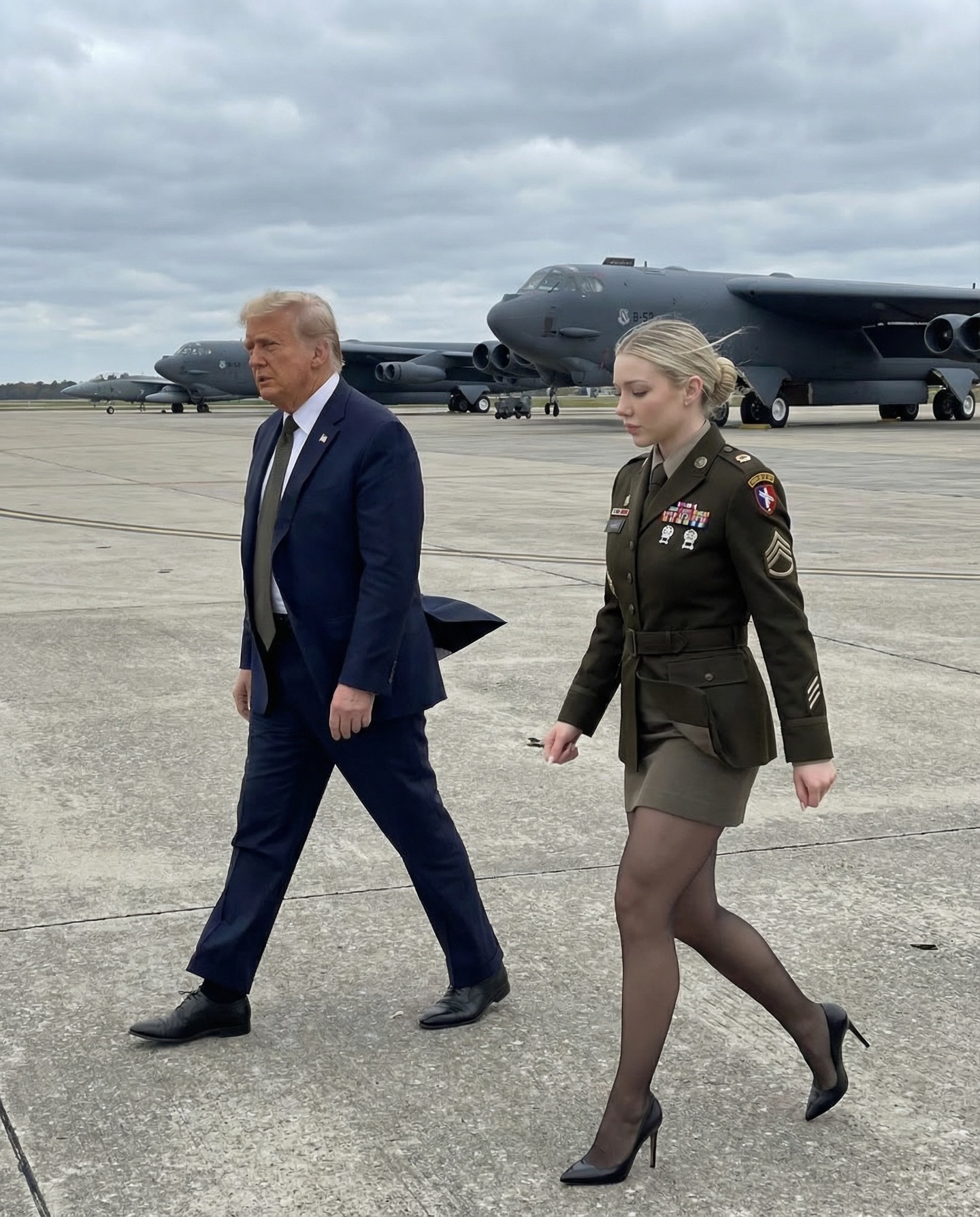
A single frame can feel like a headline. Here you’ve got a high-profile public figure walking across a wide, empty airfield while a uniformed service member keeps pace—huge B‑52 bombers parked behind them under a flat, gray sky. The caption is almost nothing: “We’re ready.” That minimalism is the point.
This image works because it compresses a story into one glance. You don’t need context to feel it: a recognizable political figure, a military setting, and aircraft that instantly communicate scale. The overcast light removes drama in the “cinematic” sense—no golden glow, no heroic shadows—and replaces it with something colder and more documentary. That restraint makes the moment feel real, and real is what people share when they want others to take it seriously.
The walking stride matters, too. Mid‑step movement reads as “in progress,” like a decision already made. And the background is not a generic runway—those bombers are unmistakable shapes that signal capability and consequence. Add the ultra-short caption and a tagged name, and the post becomes a rallying point: supporters read confidence; critics read provocation; everyone reads moment.
| Signal | Evidence (from this image) | Mechanism | Replication Action |
|---|---|---|---|
| Instant recognition | a high-profile public figure is clearly visible, foreground, full-body | Familiar faces stop scroll and spark comments | Lock a recognizable subject anchor; keep face profile clean and unobstructed |
| Scale as credibility | B‑52 bombers fill the background with clear silhouette | Large objects imply seriousness and stakes | Add one “scale object” (aircraft/ship/stadium) and keep it readable, not blurred away |
| Overcast realism | Flat gray sky, soft shadows, muted palette | Documentary lighting feels less staged, more newsworthy | Use “fully overcast, soft diffused daylight, low contrast” and avoid golden-hour keywords |
| Motion cue | Both subjects captured mid‑stride, purposeful direction | Movement implies narrative and momentum | Specify “mid‑stride walking” + “full-body” + “camera at chest height” |
Transfer Recipe 1: “Runway Walk → Factory Walk”
Transfer Recipe 2: “Military Scale → Sports Scale”
Transfer Recipe 3: “Authority Walk → Fashion Editorial Walk”
The first thing your eye trusts is the light. Overcast conditions create a giant softbox in the sky, which means faces and fabrics have gentle transitions instead of sharp shadows. That softness makes the frame feel unedited, like a press photographer caught a real moment rather than a staged shoot.
Next is the ground plane: the concrete tarmac eats up the lower half of the image. That negative space does two jobs. It isolates the subjects so they feel important, and it emphasizes motion because you can “see” the distance they’re covering. The walking stride reads purposeful, not posed.
Then comes scale. The B‑52 bombers aren’t background decoration—they’re story. Their recognizable silhouette anchors meaning in a way a generic plane never could. Even slightly out of focus, the shape stays legible, which is what you want: context without distraction.
Finally, the palette is disciplined: cool grays, navy, olive. The image avoids attention-grabbing color tricks and instead leans on tone and symbolism. If you want to recreate this look, you’re not chasing “beauty lighting.” You’re chasing credibility.
| Observed | How to recreate |
|---|---|
| Soft, shadowless daylight; gray sky | Use “fully overcast, diffused daylight, low contrast, cool-neutral WB” |
| Subjects occupy left/right thirds, full body mid‑stride | Specify “portrait 4:5, full-body walking shot, thirds composition, camera chest height” |
| Large readable background silhouettes (B‑52) | Add “B‑52 Stratofortress bombers parked behind, clear silhouette, not cropped out” |
| Muted palette: gray, navy, olive | Use “muted saturation, documentary color grade, cool grays + navy + olive accents” |
| Press-photo realism (skin texture, fabric wrinkles) | Use “photojournalism, natural skin texture, subtle wrinkles, no glam retouch” |
| Prompt chunk | What it controls | Swap ideas (EN, 2–3 options) |
|---|---|---|
| Subject anchor | Who the viewer recognizes + scroll-stopping identity | “a well-known political figure” / “a CEO in a navy suit” / “a famous athlete in formalwear” |
| Wardrobe & insignia detail | Authority cues, authenticity, texture realism | “olive dress uniform with ribbon bars” / “police dress blues” / “security detail in tactical jacket” |
| Scale object | Context and stakes without extra exposition | “B‑52 bombers” / “a cargo ship” / “a massive stadium backdrop” |
| Lighting mode | Believability and mood (news vs cinematic) | “fully overcast daylight” / “foggy morning diffused light” / “bright noon but softened by haze” |
| Composition & motion | Narrative momentum and readability | “mid‑stride walking” / “paused to talk” / “turning toward camera” |
| Grade keywords | Color discipline and editorial feel | “muted saturation” / “cool-neutral WB” / “subtle contrast, documentary grade” |
Portrait 4:5 press photo, two people mid-stride walking on a concrete airfield tarmac under fully overcast gray sky, a recognizable political figure in a dark navy suit on the left, a blonde service member in an olive dress uniform with ribbon bars and badges on the right, large gray B-52 Stratofortress bombers parked behind, soft diffused daylight, muted palette, documentary realism, crisp detailChange only one or two knobs per run. If you change subject, wardrobe, and background at once, you’ll never know what broke the look.