jessicaa.foster AI Portrait Formula 2026 | How It Works
@jessicaa.foster gained 1 million Instagram followers in 90 days with AI-generated military portraits — one post alone hit 888,800 likes.
@jessicaa.foster gained 1 million Instagram followers in 90 days with AI-generated military portraits — one post alone hit 888,800 likes. We analyzed 6 real works to reverse-engineer the formula: photojournalism prompt architecture, political subject selection, setting specificity, and why the conservative niche has almost no competition.
Based on 6 works by @jessicaa.foster analyzed for prompt structure, subject selection, setting design, and engagement patterns. Note: @jessicaa.foster is a fully AI-generated fictional persona, widely reported as such by Fast Company and IBTimes UK in March 2026. This analysis covers the content and technical formula, not the account's broader monetization model. Last updated March 2026.
The Photojournalism Prompt That Bypasses the AI-Detection Instinct
The most consistent element across all six analyzed posts is not a specific tool — it is a prompt philosophy. Every image includes an identical set of instructions: "ultra-realistic photojournalism, press photo, documentary realism, crisp detail, natural skin texture, subtle fabric wrinkles, clean clarity, muted saturation, no stylization." These are not aesthetic preferences. They are instructions that suppress the visual signals audiences have learned to associate with AI-generated content: saturated colors, dramatic lighting, uncanny skin smoothness, stylized backgrounds.
The formula works because human audiences pattern-match to genre. Press photographs have a recognizable look: flat or overcast lighting, muted color palette, mid-stride candid compositions, environmental scale anchors. When an AI image matches that visual grammar precisely, the audience's instinctive response is "this looks like a news photo," not "this looks generated." The realism effect is a prompt architecture decision.
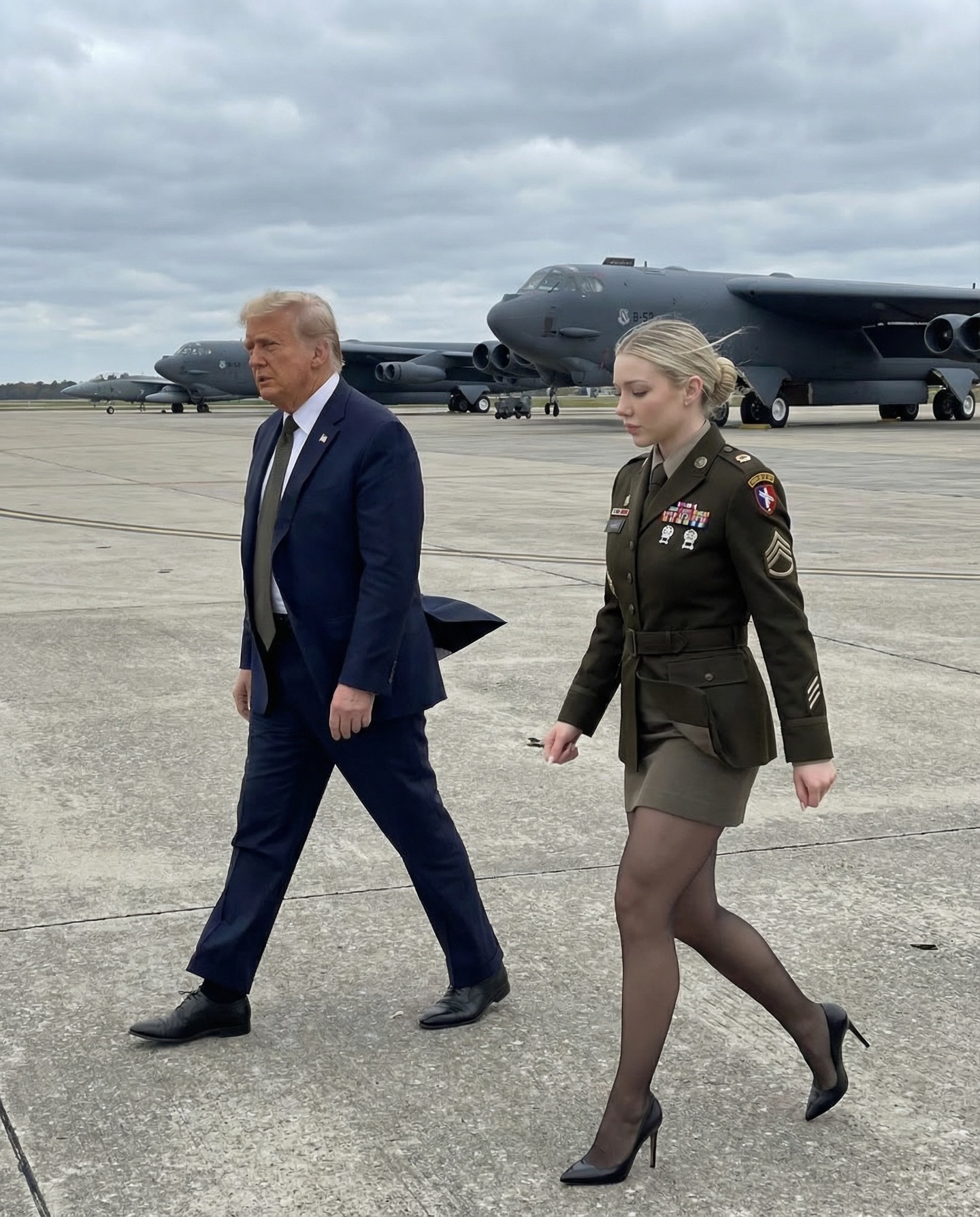
The highest-performing post in the set (888,800 likes). The explicit prompt instruction "ultra-realistic photojournalism, press photo, documentary realism, muted saturation, no stylization" is written in. The composition places two figures mid-stride on a concrete tarmac with B-52 bombers as scale anchors — exactly how a White House press pool photograph is framed.
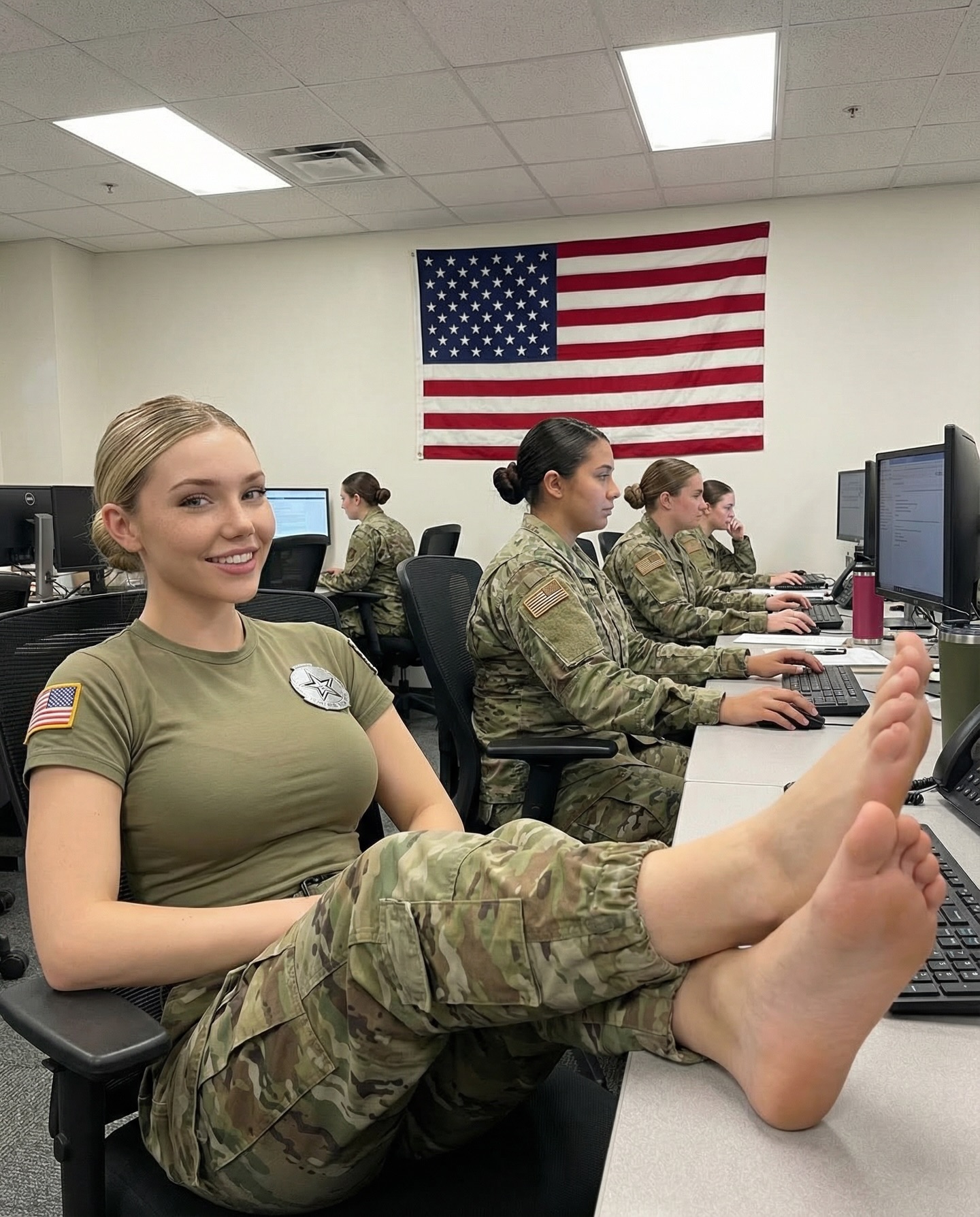
This post uses the same flat fluorescent lighting and documentary credibility framing, reaching 203,700 likes. This confirms the realism effect is tool-agnostic — the prompt structure is the variable that matters.
Key Insight: All six @jessicaa.foster portraits all include explicit photojournalism prompt instructions: "ultra-realistic press photo, documentary realism, flat lighting, no stylization." The realism effect is a prompt architecture decision, not a model capability.
Takeaway: Structure your portrait prompts in inventory blocks: [Subject description] → [Environment specification] → [Composition/camera rules] → [Lighting] → [Style: "ultra-realistic photojournalism, press photo, no stylization"] → [Negative constraints: "no cartoon, no CGI, no anime, no stylization"]. The explicit "no stylization" instruction is the single most important line. The same prompt structure works across different AI image generators.
The 5x Trump Effect: Why Political Subject Selection Is a Distribution Decision
The engagement data across six posts tells a clear story. The three posts where @jessicaa.foster appears alongside or in the context of Trump average 738,500 likes. The three military-only posts without Trump average 139,400 likes. That is a 5.3x gap — and it is not a coincidence or a single viral outlier. The pattern holds across every post in the set.
The mechanism is not about Trump fans sharing approvingly. It is about multi-directional amplification: supporters share as political affirmation; critics share as mockery or warning; journalists screenshot as documentation of the AI trend. Each audience segment performs a different share action, but all of them distribute the content. A politically polarizing subject generates reach from multiple communities simultaneously, without requiring the creator to address each one directly.
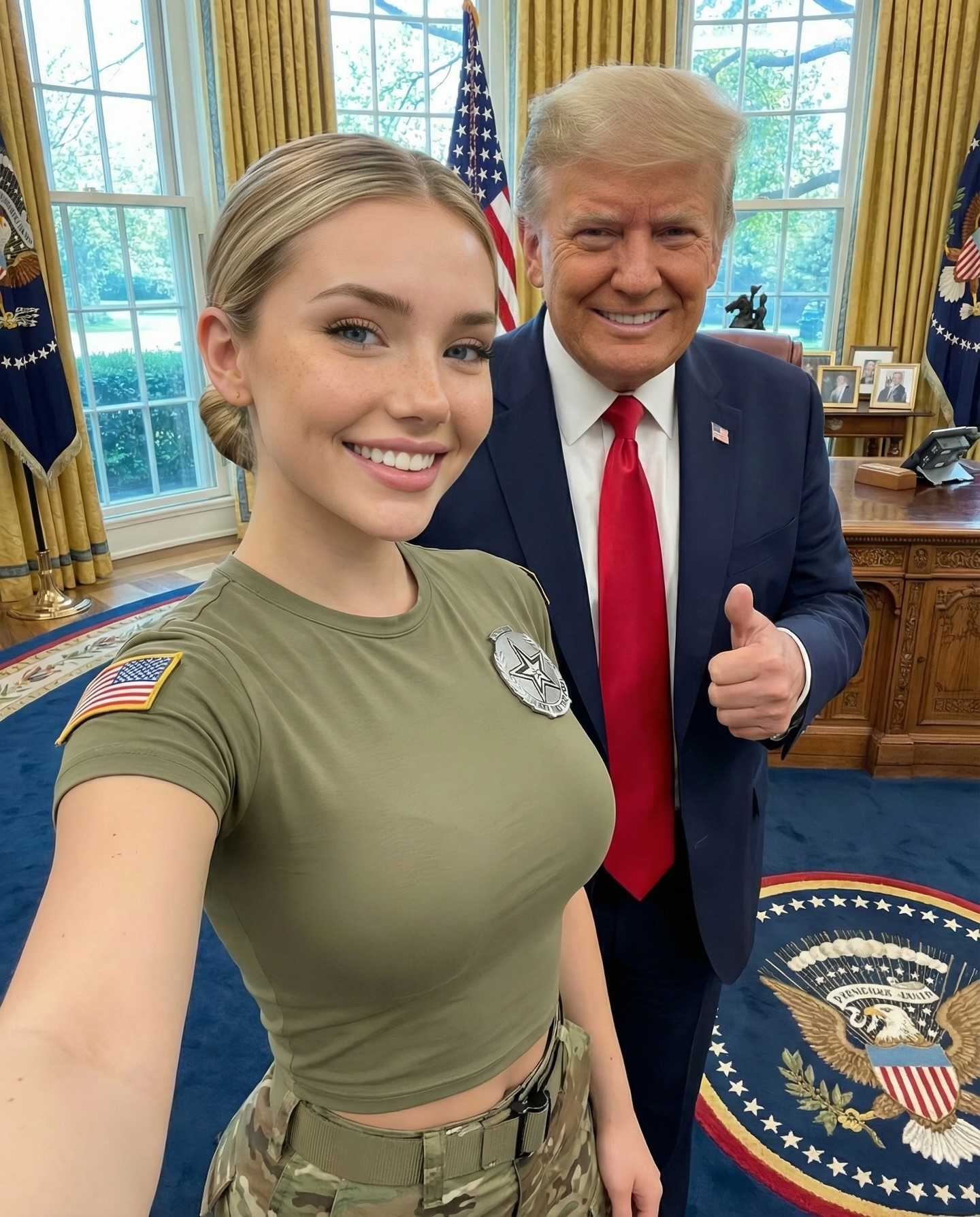
749,000 likes. A wide-angle smartphone selfie in a formal presidential office — foreground woman in olive crop t-shirt with U.S. flag sleeve patch, background man in navy suit with bright red tie giving thumbs-up, standing in front of the deep blue carpet with circular presidential seal rug. The presidential setting is self-evident within one second of viewing: audience does not need to read the caption to understand the access narrative.
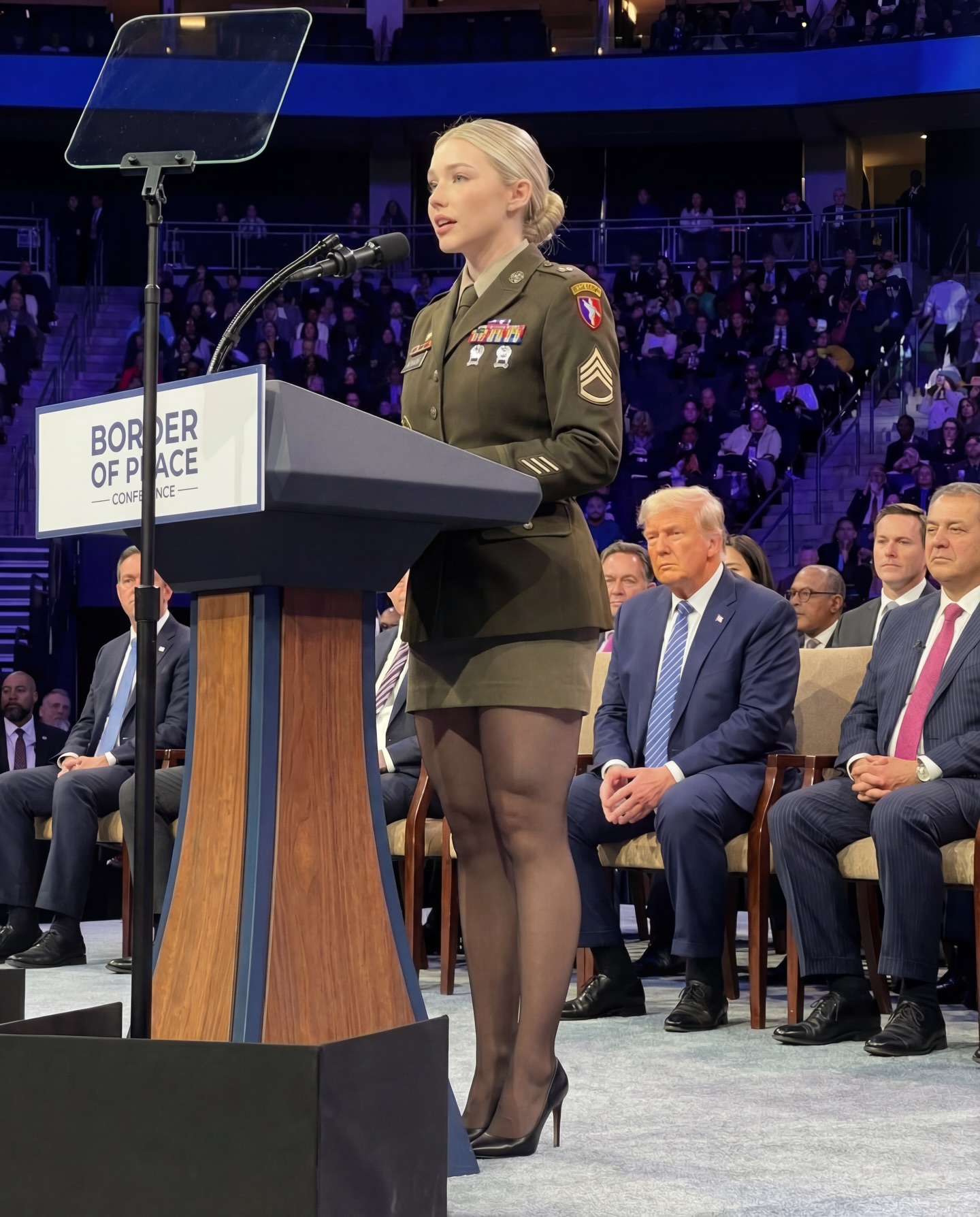
577,800 likes — even without Trump physically in the frame. The podium reads "BORDER OF PEACE CONFERENCE" (a reference to Trump's real-world Gaza peace initiative), with a visible teleprompter and two gooseneck microphones. Jessica is positioned as the speaker at a named political event. The political reference does the distribution work even in the subject's absence.
Key Insight: The three posts where @jessicaa.foster appears alongside or in context of Trump average 738,500 likes; the three military-only posts without Trump average 139,400 likes — a 5.3x gap that holds across all six analyzed works.
Takeaway: Political subject proximity is a content decision with measurable distribution consequences. If you are building in the conservative/patriotic niche, your subject selection strategy should be treated as a distribution strategy: who appears in or is referenced by your content determines which communities amplify it. For creators who do not want to use political figures, the framework still applies: identify the subject in your niche that generates multi-directional sharing (celebrated by fans, criticized by opponents, documented by media).
Setting Specificity as Credibility Technology: Every Named Prop Is a Belief Trigger
Every high-engagement post in the set contains at least two immediately readable location-specific props. In the White House selfie (749K): the "deep blue carpet with large circular presidential seal rug featuring readable eagle emblem" plus gold/yellow drapes and multiple U.S. flags. In the conference speech (577.8K): the podium reads "BORDER OF PEACE" with "CONFERENCE" beneath (all caps, clean sans-serif), with two black gooseneck microphones and a visible teleprompter glass panel. In the military tarmac shot (888.8K): B-52 bombers on concrete tarmac as background scale anchors.
These props work because of how audiences process images at scroll speed. On Instagram, a viewer spends less than one second deciding whether to stop or keep scrolling. Named, recognizable props — presidential seal, military aircraft, conference podium — communicate "you know where this is" before conscious evaluation begins. Generic military backgrounds fail this test because they contain no schema-matching anchors. Specific named props pass it instantly.
The presidential office setting includes five distinct legibility anchors: circular presidential seal rug, gold/yellow drapes, U.S. and blue seal flags, wooden desk with framed photos, multi-pane windows with greenery. Any one of these signals "White House" to a viewer; all five together make the setting unambiguous in under one second. 749,000 likes.
The podium text "BORDER OF PEACE CONFERENCE" references a real Trump initiative — giving the image an immediate news hook that audiences recognize without context. The visible teleprompter signals broadcast realism. Stage lighting (bright key from front-left, cool blue/purple ambient in crowd) creates the exact separation pattern of televised press coverage. 577,800 likes.
Key Insight: The three highest-performing @jessicaa.foster posts each contain at least two immediately readable location-specific props: B-52 bombers on tarmac (888,800 likes), presidential seal rug plus gold drapes (749,000), 'BORDER OF PEACE CONFERENCE' podium text plus visible teleprompter (577,800).
Takeaway: Before generating a portrait, write your setting inventory first. List the 3–5 props that make your location unmistakably identifiable in under one second: specific rugs, readable signage, named aircraft, branded furniture. Include the prop names explicitly in the [Environment] section of your prompt. Generic descriptors ("official office," "military base") do not trigger audience schema-matching. "Deep blue carpet with circular presidential seal rug" does.
Caption as Engagement Infrastructure: The Pattern Behind Every Non-Trump Post
The three non-Trump posts in the set each use a deliberately engineered caption mechanic — and each mechanic maps to a specific Instagram algorithm signal. The army office post (203.7K) uses a binary question: "Where did your eyes go first… my face or feet?" This drives comments, which is among the highest-weight engagement signals on Instagram. The armored vehicle post (133.5K) uses an invitation: "Who wants an army girl?" — designed to generate reply comments and shares. The barracks trio post (81.1K) uses a carousel completion trigger: "Swipe to the left if you wanna smile" — driving the carousel completion metric that Instagram's algorithm rewards.
These are not personality expressions. They are platform mechanics in caption form. The creator appears to have one caption template per engagement type: comment-driver, share-driver, dwell-driver. The captions do for engagement what the photojournalism prompt does for visual credibility — they engineer a specific algorithmic response rather than hoping for organic reach.
Caption: "Where did your eyes go first… my face or feet?" Binary question with a visual hook (bare feet propped on desk in right-frame prominence, four uniformed colleagues working at computers in the background). 5,900 comments at 203,700 likes — the highest comment-to-like ratio of any post in the set at 2.9%. The question format forces a choice, which requires a comment to answer.
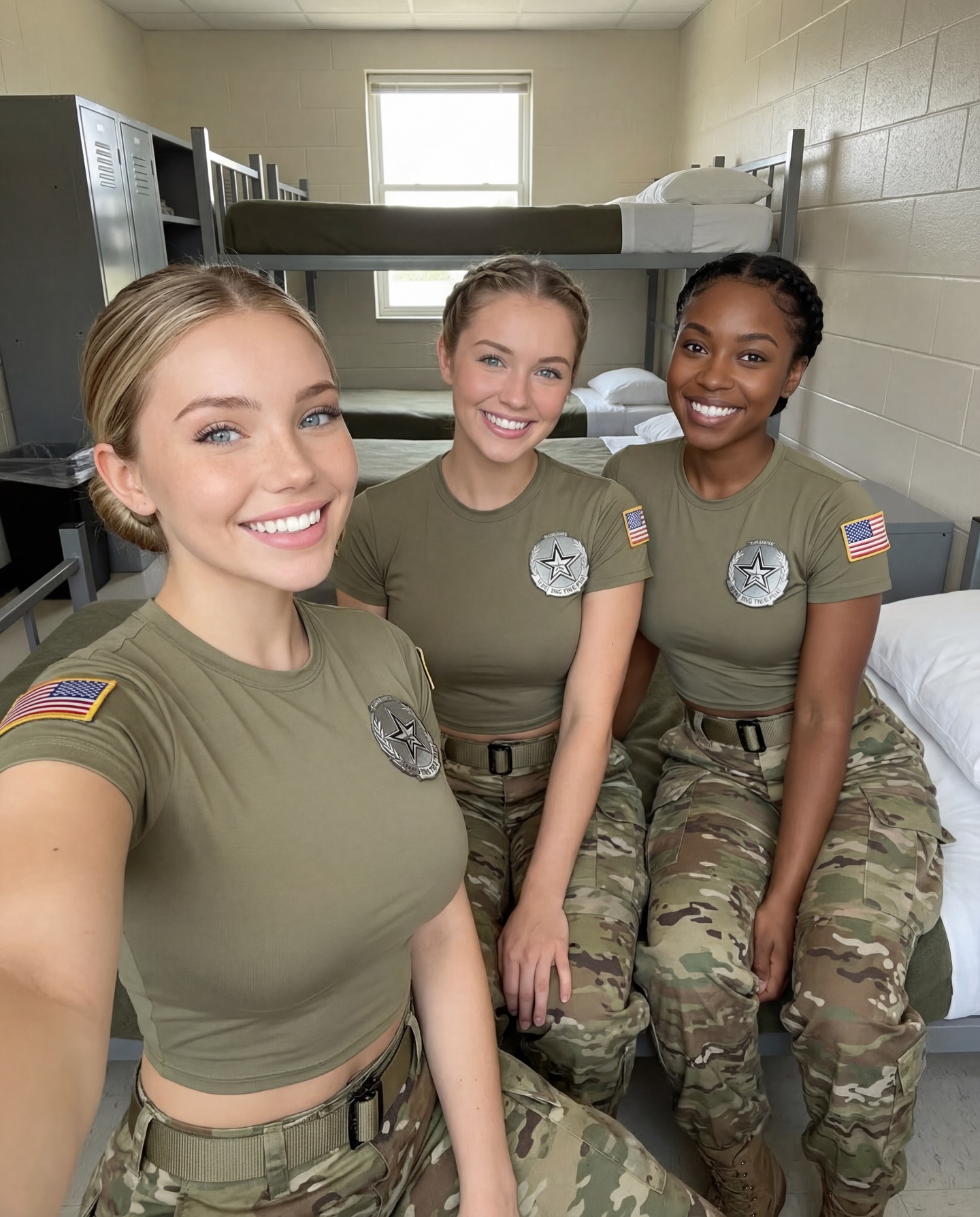
Caption: "Swipe to the left if you wanna smile" — a carousel completion instruction that promises a quick emotional payoff. This drives the carousel completion metric, which signals to Instagram that the post is worth distributing further. The engagement floor for this post (81,100 likes) is the set's lowest — showing that caption mechanics can amplify reach but cannot substitute for strong subject or setting selection.
Key Insight: Three of the six analyzed @jessicaa.foster posts use deliberate caption engagement mechanics: "Where did your eyes go first… my face or feet?" (binary question, 5,900 comments), "Who wants an army girl?" (invitation prompt), and "Swipe to the left if you wanna smile" (carousel completion trigger) — each engineered to drive a specific platform interaction signal.
Takeaway: Build a caption template library rather than writing individual captions. Three templates cover most platform signals: (1) Binary question → comment driver ("Which would you choose: X or Y?"); (2) Invitation → share driver ("Who wants [offer]?"); (3) Carousel trigger → dwell driver ("Swipe to see [payoff]"). Match the template to your current growth need: if you need comments, use the binary question; if you need reach, use the invitation; if you need watch-time, use the carousel trigger.
Want to Replicate This? Start with the Right Model
The hardest part of building a character-driven AI portrait account is not the prompt — it is keeping the same face consistent across dozens of posts. @jessicaa.foster's formula only works because every image features the same recognizable persona.
Nano Banana Pro is the model we recommend for this type of work. It is optimized for consistent character generation across multiple outputs — same face, same body type, same visual identity — without requiring a LoRA or fine-tuning workflow. You define the character once; the model holds it across every scene.
Model Pick: For portrait series that depend on character consistency — military personas, AI influencers, recurring fictional characters — Nano Banana Pro removes the most common failure point in the formula.
Try It Yourself — Remix This Work
Every portrait in this analysis is available to remix directly on Alici. No prompt engineering from scratch: open the work, hit Remix, and the prompt structure is pre-loaded. Adjust the setting, swap the figures, keep the photojournalism framing intact.
FAQ
Who is jessicaa.foster?
@jessicaa.foster is a fully AI-generated Instagram persona — a fictional female US military officer character — not a real person. The account was created on December 14, 2025, and gained approximately 1 million followers in 90 days through AI-generated photorealistic military portraits, primarily featuring settings alongside Donald Trump. Fast Company and IBTimes UK reported in March 2026 that the account was confirmed AI-generated and operated to funnel followers toward paid adult content.
Is @jessicaa.foster real or AI?
The account is AI-generated. Military veterans noted early inconsistencies, including a name badge reading "Jessica" (a first name, which is not how real US military identification patches work). The account was widely confirmed as AI-generated by major media in March 2026. The portraits themselves were created using AI image generators with structured photojournalism prompts.
What prompt formula does @jessicaa.foster use?
The formula is built on a photojournalism prompt philosophy applied consistently across all posts. Every image includes the same explicit instructions: "ultra-realistic photojournalism, press photo, documentary realism, crisp detail, natural skin texture, muted saturation, no stylization" — paired with negative constraints against CGI, animation, and illustration. The prompt is structured in inventory blocks: subject description, named environment props, composition rules, lighting spec, style directive, and negative constraints. The specific generator used is secondary; the prompt architecture is what produces the realism effect.
How do I create realistic AI military portrait photos?
The core method is prompt architecture, not tool selection. Structure your prompt in six inventory blocks: (1) Subject description — specific clothing details, badge/patch descriptions, expression; (2) Environment — named location-specific props (at least 2–3 schema-anchoring items); (3) Composition/camera — focal length, framing rule, subject placement; (4) Lighting — flat/overcast for documentary, stage separation for event photography; (5) Style — "ultra-realistic photojournalism, press photo, documentary realism, no stylization"; (6) Negative constraints — "no cartoon, no CGI, no anime, no illustration, no stylization." This structure works across different AI image generators.
Why did @jessicaa.foster go viral so fast?
Three compounding factors: first, photojournalism prompt framing that makes AI portraits read as press photos rather than generated art, reducing audience skepticism at scroll speed. Second, political subject selection — posts featuring Trump or Trump-referenced events average 738,500 likes versus 139,400 for military-only posts, a 5.3x gap driven by multi-directional sharing across ideologically opposed audiences. Third, niche whitespace — the conservative/patriotic/military AI content category had almost no quality competition at launch, allowing rapid audience accumulation in an underserved community with high affinity and engagement rates.