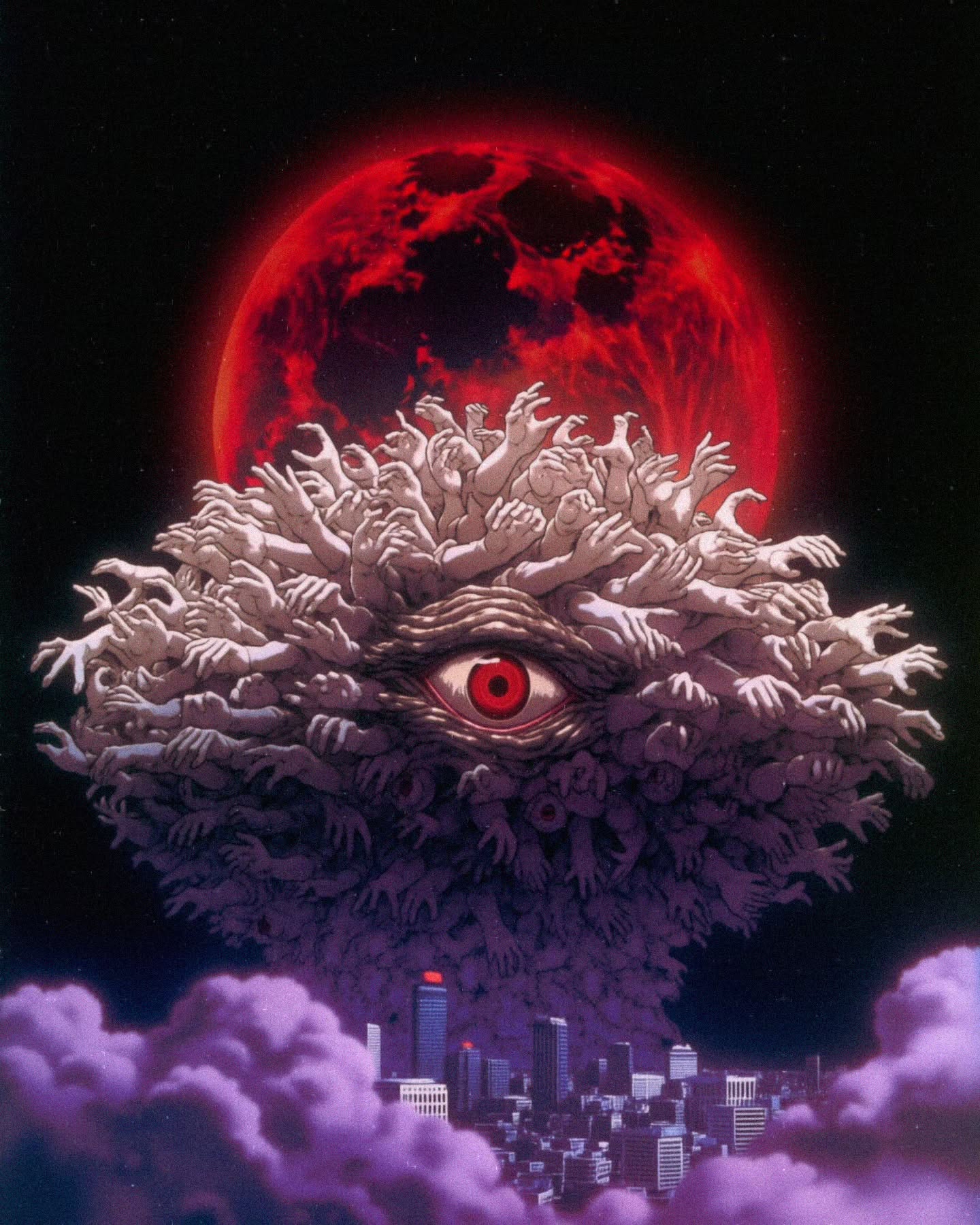
This image works because it is built like a symbol, not just a scene. You do not need backstory to understand that something terrible is hanging over the city. The giant red moon gives the image scale, the single central eye gives it focus, and the mass of human hands gives it immediate body horror. Those three ideas are enough. The picture does not waste energy explaining itself. It presents one unforgettable silhouette and lets the viewer react.
The strongest decision is that the monster is made of hands instead of something more expected like smoke or tentacles. Hands are more intimate. They imply grasping, pleading, worship, violence, and panic all at once. Because the viewer already has a strong human relationship to hands, the shape feels more disturbing than a generic creature would. That is why the image stays with you.
For creators, this is a very useful lesson in surreal image design: choose one form that carries emotional meaning on its own, then repeat it until it becomes monumental. That is exactly what happens here.
The silhouette is simple enough to read in one second. Big moon. Big monster. Small city. That scale ladder is clear even before you inspect details. Then the eye locks you in, and only after that do you realize the whole creature is built from human hands. That delayed recognition is powerful because it rewards the second look without making the first look confusing.
The image also benefits from refusing clutter. There are no extra characters, no lightning bolts, no collapsing buildings, no complicated foreground story. Everything is directed toward the central icon. That discipline is what makes the picture feel like a poster rather than a random fantasy collage.
| Signal | Evidence (from this image) | Mechanism | Replication Action |
|---|---|---|---|
| Single iconic monster shape | The hand-creature forms one large readable floating mass | Simple silhouettes travel faster than messy creature design | Design one central form that reads at thumbnail size before adding texture |
| Delayed horror reveal | The viewer notices the hands after first seeing the eye and moon | Second-look recognition increases memorability and share value | Hide the most disturbing detail inside an easy first-read silhouette |
| Scale compression | The city is tiny under the floating creature and moon | Small city scale makes the monster feel mythic and world-level | Reduce the environment to a thin base layer if you want the creature to dominate |
| Limited palette | Black, crimson, pale flesh, and purple carry the whole frame | Color discipline makes surreal scenes feel authored instead of noisy | Use 3-4 major colors max when building horror poster images |
The image is borrowing from anime horror, occult poster design, and cosmic dread all at once, but it stays controlled because the center of gravity never shifts. Everything is arranged around the eye. The hands radiate from it, the moon halos it, and the city exists below it like a helpless witness. That centralization is what gives the image authority.
The purple clouds are a subtle but important decision. Without them, the bottom of the frame would be too plain. They act like a soft stage curtain, separating the monster from the city and adding atmosphere without stealing attention. Small framing devices like that often make the difference between a good surreal image and a finished one.
| Observed | Why it matters |
|---|---|
| Exactly one central eye | Keeps the image focused and iconic |
| Human hands used as creature texture | Adds immediate psychological discomfort through familiar anatomy |
| Huge red moon directly behind the monster | Creates instant silhouette clarity and apocalyptic mood |
| Tiny skyline below | Gives the image mythic scale without requiring detailed narrative |
| Purple cloud layer in foreground | Softens the lower edge and improves atmospheric depth |
{single surreal monster} hovering over {small city} beneath {oversized celestial body}{iconic creature silhouette} with {one focal detail} in {restricted horror palette}{apocalyptic entity} above {small world element} under {dominant moon}| Prompt chunk | What it controls | Swap ideas (EN, 2-3 options) |
|---|---|---|
| floating creature made of human hands | The body-horror identity of the monster | “mass of grasping hands”, “cloud of pale arms”, “hand-built horror creature” |
| one giant red central eye | The focal point and psychological lock | “single crimson eye”, “central glowing iris”, “one staring eye” |
| blood-red moon backdrop | The silhouette clarity and apocalypse tone | “oversized red moon”, “crimson lunar halo”, “red eclipse-like moon” |
| small city skyline at bottom | The scale comparison that makes the monster feel enormous | “tiny skyline strip”, “compressed city lights”, “small urban horizon” |
| purple cloud framing | The atmospheric lower-edge softness | “lavender cloud bank”, “purple mist foreground”, “soft violet clouds” |
Lock three things first: the hand-based monster silhouette, the single central eye, and the red moon directly behind it. Those are the image’s core decisions. If the monster loses its hand anatomy, it becomes generic. If the eye count increases, the design gets messier. If the moon shifts away, the poster power weakens immediately.
The larger lesson is that surreal horror becomes stronger when it behaves like an emblem. This image understands that perfectly.