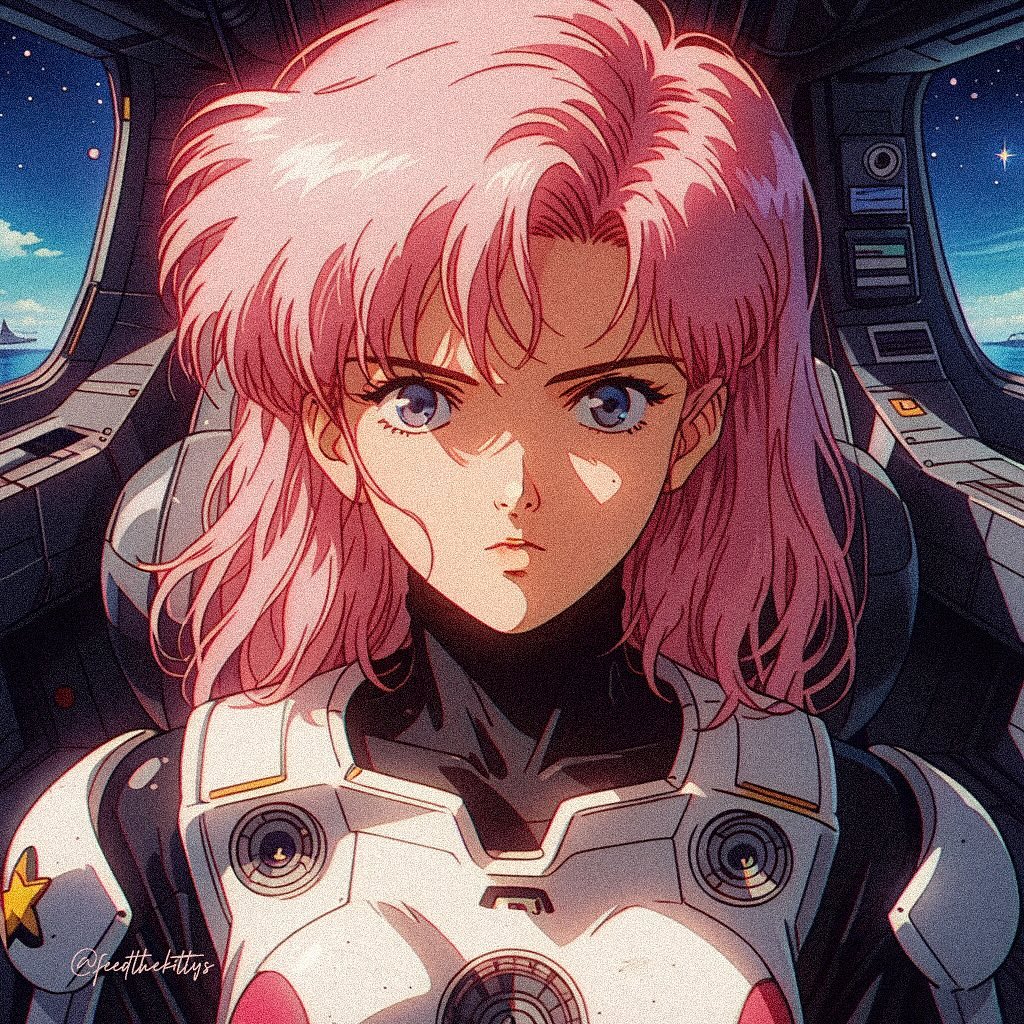
𝙃𝙚𝙖𝙙𝙚𝙙 𝙩𝙤𝙬𝙖𝙧𝙙 𝙙𝙚𝙚𝙥 𝙨𝙥𝙖𝙘𝙚 9 🚀
like, comment, follow for more Ai creations. Thank you for being here!
#digitalart #retroanime #90sanime #ai #comics #aiart #ConceptArt #90sanimeaesthetic #80sanime #anime #animegirl #animeart #retroanime #saturday #aesthetic #photoshop #rocket #pilot #stablediffusion #feedthekittys
How feedthekittys Made This Space Pilot Anime AI Art and How to Recreate It
The image works because it mixes intimacy with worldbuilding in exactly the right proportion. The face is still the center, but the cockpit windows, seat, and armor provide enough context to make the portrait feel like part of a larger universe. That balance is difficult to get right. Too little environment and the image becomes generic beauty art. Too much environment and the face loses its force. This one stays in the sweet spot.
The second reason it lands is the retro sci-fi discipline. The armor design, the cockpit framing, and the starfield are all simple enough to feel iconic. Nothing is overloaded with modern UI clutter or random tech detail. For creators, this is one of the best lessons in anime sci-fi portrait work: strong shapes age better than overdesigned gadgets.
Signal Table
Signal
Evidence (from this image)
Mechanism
Replication Action
Face-first worldbuilding
The portrait is tight, but the cockpit windows and armor still read clearly
This lets the character carry emotion while the setting carries genre
Use only 2-3 sci-fi signals around the face instead of building a whole bridge scene
Retro technology language
Rounded armor forms and restrained cockpit panels feel older and more iconic
Simple shapes read better and feel more timeless than overloaded interfaces
Favor rounded modules, analog framing, and visible silhouette cues over UI clutter
Warm-cool contrast
Pink hair and warm highlights sit against blue windows and dark cabin shadows
Color contrast increases emotional presence without breaking the genre tone
Pair one warm character color with one cool environmental light family
Centered pilot framing
The subject is seated frontally and framed symmetrically by the cockpit
Symmetry gives the portrait heroic stability and poster authority
Use balanced side windows or panels when you want a cockpit shot to feel iconic
Best-Fit Scenarios
Retro mecha portrait pages. The image is ideal for explaining character-first sci-fi composition.
Prompt studies on controlled worldbuilding. It shows how little environment is needed to define genre strongly.
Creator feeds mixing nostalgia and polish. The retro look feels familiar without becoming dated.
Character launch visuals. The centered seat framing makes the portrait feel like a proper key visual.
Not Ideal
Action combat scenes. The image is quiet and resolute, not kinetic.
Hard-surface concept sheets. The tech is too stylized and reduced for engineering-focused use.
Casual fashion portraits. The suit and cockpit dominate the identity.
Three Transfer Recipes
Moon-orbit version. Keep: centered cockpit portrait and retro armor. Change: blue starfield to a moonlit grey orbital window view. Slot template (EN): {retro anime space pilot portrait} {centered cockpit seat} {simple armor design} {controlled cosmic backdrop}
Red-alert version. Keep: facial seriousness and cockpit symmetry. Change: cool space fill to red warning light and darker panel shadows. Slot template (EN): {serious sci-fi heroine} {front-facing cockpit close-up} {retro tech shapes} {single dramatic color-light shift}
Hangar-prep version. Keep: shoulder armor and pilot-seat framing. Change: space windows to a dim hangar bay beyond the cockpit shell. Slot template (EN): {anime mecha pilot key visual} {face-first composition} {rounded armor cues} {minimal industrial environment}
Aesthetic Read
The image’s strongest move is the centered seat composition. It gives the pilot dignity and control without requiring any dramatic pose. That is one of the most reliable visual tricks in sci-fi portrait work. When the seat, the windows, and the shoulders all align, the character feels like the axis of the machine.
The pink hair is another smart choice because it softens the militaristic reading of the armor. Without it, the portrait could tip toward cold machinery. With it, the image feels emotional and memorable. For creators, this is a reminder that one non-mechanical color can humanize an entire sci-fi frame.
The space windows are also nicely restrained. They give genre, scale, and quiet wonder without competing with the face. That is exactly how background windows should work in a tight cockpit portrait.
Observed
Why It Matters
Pink hair against dark cockpit interior
Keeps the portrait emotionally memorable and highly readable
White retro armor with circular ports
Defines the genre through shape language rather than overdetail
Centered front-facing seat pose
Creates authority and poster stability
Blue side windows with stars
Add cool contrast and quiet worldbuilding
Serious direct stare
Anchors the entire image emotionally
Prompt Technique Breakdown
Prompt chunk
What it controls
Swap ideas (EN, 2-3 options)
centered pink-haired pilot in a cockpit seat
Character authority and composition
front-facing pilot portrait / seat-centered key visual / cockpit-symmetry framing
white retro-futuristic armor with circular details
Genre and era feel
80s anime pilot suit / rounded mecha armor / analog sci-fi costume language
side windows opening to blue space
Minimal worldbuilding
cosmic side framing / starfield windows / calm orbital backdrop
strong front-left key light with cool side fill
Cinematic polish
heroic cockpit lighting / warm-cool contrast / anime film still finish
serious expression with direct eye contact
Emotional tone
quiet resolve / pilot focus / controlled intensity
Useful control principle
In sci-fi portraits, keep the technology readable by silhouette first. If every mechanical detail needs explanation, the image is already too busy.
Remix Steps
Baseline Lock: centered cockpit seat, retro armor silhouette, and one warm-versus-cool color contrast.
Lock the seat and camera framing before detailing the cockpit.
Design the pilot suit with a few iconic modules rather than many tiny panels.
Add side windows for scale and genre, but keep them visually quiet.
Use the final passes to refine hair volume, armor highlights, and eye focus rather than filling the cabin with extra screens.
Iteration example
1. Lock: front-facing pilot portrait seated in cockpit center
2. Lock: white rounded armor over black undersuit
3. Add: blue side windows with stars beyond
4. Add: pink hair and focused direct expression to humanize the frame