How iam_zlu Made This SmartThings Find Galaxy Buds Billboard Video - and How to Recreate It
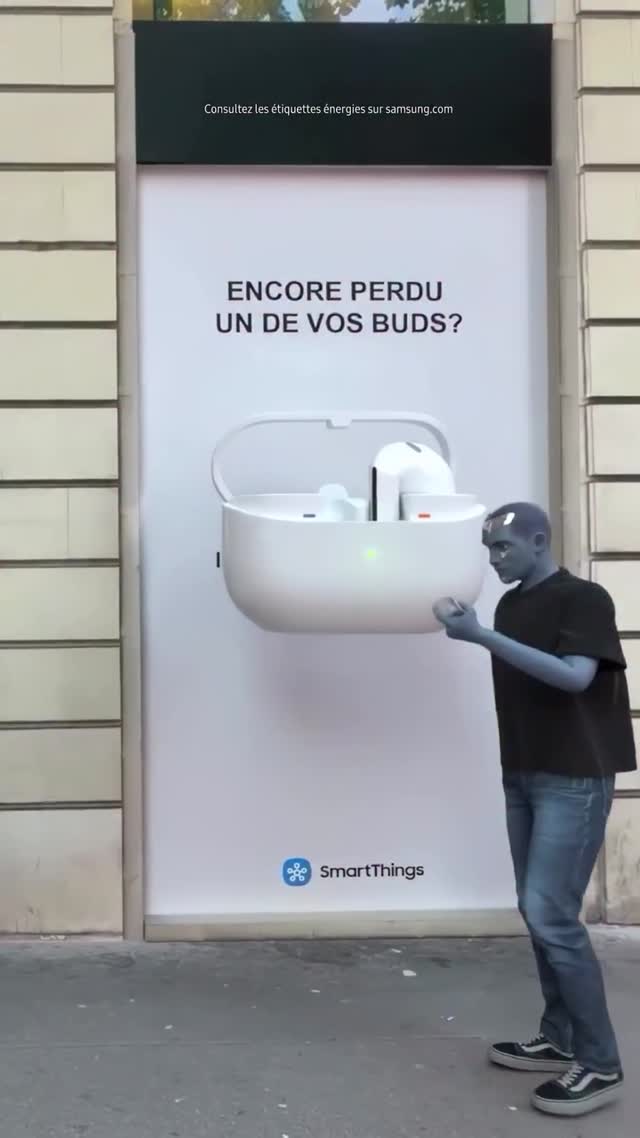
This reference is effective because it turns a common product problem, losing one earbud, into a physical urban story. Instead of showing a standard phone demo in a clean studio, the ad stages the problem on a real city street through a giant billboard, a handheld phone interface, and a person actively searching. That gives the feature a stronger sense of consequence and makes the technology feel useful in everyday life.
The billboard concept is especially smart. A normal static ad could communicate the problem, but this activation-style version makes the ad feel interactive and memorable. The viewer sees the product problem on the wall, then sees the phone’s locator interface, then watches the wall become part of the solution. This progression gives the feature a narrative arc: problem, search, resolution.
Visual structure and brand logic
The visual language is grounded in handheld realism. Overcast daylight, sidewalk traffic, and slight phone-camera instability make the clip feel like something discovered in the city rather than a polished CG-only commercial. That realism matters because the technology being advertised is practical. A practical feature tends to feel more convincing when the environment also feels practical.
The French copy on the billboard helps localize the scene and gives the ad a real-world media-placement feel. It does not look like a generic global campaign mockup. It looks like an actual street poster in a specific place. For prompt reconstruction, that kind of contextual specificity is valuable. Small local details often make brand visuals feel much more believable.
The transformation of the billboard into a giant locator display is the main spectacle moment, but it still serves the product logic. The ad does not become abstract just for the sake of effect. The enlarged earbud case, route-map graphics, and SmartThings cues all reinforce the core promise: the ecosystem helps you find what you lost. That is why the effect feels useful rather than random.
Prompting lessons creators can reuse
To recreate this kind of clip, start with the user problem first. In this case, define a street billboard showing a missing earbud scenario. Then introduce a handheld phone map interface and a pedestrian using it in real space. Only after those two pieces are clear should you add the transformation moment where the billboard becomes interactive. This order matters because it preserves product logic.
It is also important to hold onto documentary realism even when the billboard changes. The camera should remain handheld and street-level. The actor should move like a real person trying to locate an object, not like a superhero in an effects sequence. That grounded behavior is what keeps the ad persuasive.
This format is useful for smart-home ecosystem promos, device-finder features, urban interactive-billboard concepts, and feature-focused product storytelling. It shows how AI-generated or composited scenes can make a tech feature feel more tangible by placing it in public space rather than inside an abstract app demo.