
▶
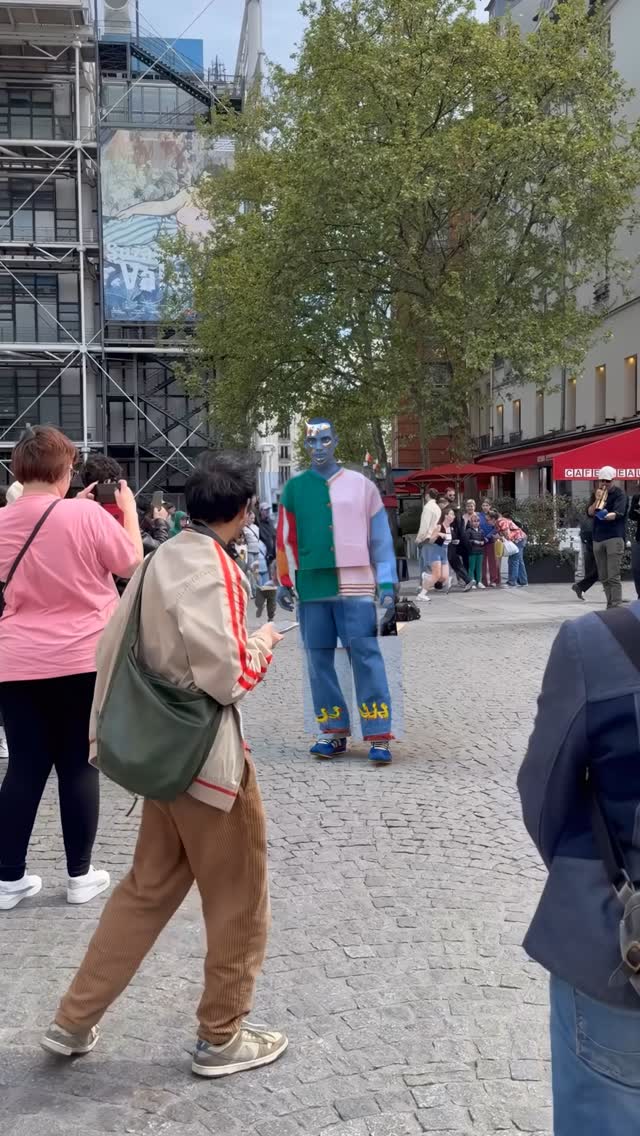
One body, three outfits 😎 Front look: @outsidersdivision Back look: @kenzo - - - - - #fashion #paris #illusion #fashionstyle #streetart #art #fashiondesigner
One body, three outfits 😎 Front look: @outsidersdivision Back look: @kenzo - - - - - #fashion #paris #illusion #fashionstyle #streetart #art #fashiondesigner
This short-form street performance is a loop-friendly illusion fashion video built around one instantly legible promise: one body, three outfits. The clip runs about 8 seconds in a vertical smartphone frame and takes place in a real cobblestone plaza with a live crowd, a large tree canopy, industrial facade elements on the left, and cafe awnings on the right. The performer keeps a consistent blue-painted body while rotating through segmented costume states that read as (1) a colorful patchwork sweater and jeans, (2) a green graphic tee back look, and (3) a silver futuristic look before snapping back to the first state. That sequence creates an optical rhythm where each turn becomes a reveal beat. From a creator perspective, this is a strong example of fashion illusion content, street art performance, and human practical effect storytelling that feels highly shareable without needing dialogue. The practical staging also lowers trust friction because viewers can see on-site spectators filming in real time, which makes the transformation feel physically real instead of purely post-produced AI. If you want to replicate this format, focus on hook clarity in the first 1-2 seconds, strong body silhouette changes, and loop closure that lands on the same visual identity users saw at the start.
The central character is a blue-painted street performer using a segmented wearable rig to create rotating outfit reveals. The visual consistency comes from keeping body paint, body shape, and movement cadence constant while wardrobe surfaces change.
The location is an open pedestrian square with cobblestones, real foot traffic, and a semicircle of onlookers filming. This public setting adds social proof and raises perceived authenticity.
The video is effectively one handheld shot in vertical 9:16, mostly static with slight natural micro-shake. No fancy reframes are needed because the performer movement drives all major beats.
Lighting is soft daylight with neutral-to-cool street color. The phone look keeps moderate compression and practical detail, which helps the clip feel immediate and platform-native.
The body rotation acts like an edit without actual cuts: each turning phase introduces a new outfit state. The strongest transformation moments are around 2-3 seconds and 6-7 seconds.
There is no critical on-screen text in-frame; the concept is visually self-explanatory. Audio reads as soundtrack plus ambient crowd tone, with no essential spoken line.
| Time range | Visual content | Shot language (framing / focal-length feel / movement) | Lighting & color tone | Viewer intent |
|---|---|---|---|---|
| 00:00-00:01 (estimated) | Foreground passerby partially blocks performer; crowd and plaza context establish realism. | Vertical medium-long, eye-level smartphone, tiny handheld drift. | Soft overcast daylight, neutral cool tones. | Hook by curiosity: "What am I looking at?" |
| 00:01-00:02 (estimated) | Performer back-facing in patchwork outfit; rotation begins. | Same framing, no zoom, body-centered composition. | Natural street palette, high texture legibility. | Reinforce persona and setup transformation logic. |
| 00:02-00:03 (estimated) | Mid-transition split between patchwork and green-shirt state. | Single-shot continuity, motion-driven reveal. | Color contrast increases due to wardrobe split. | Create first wow moment and retention spike. |
| 00:03-00:06 (estimated) | Green back look holds with subtle sway; rig edges visible. | Stable handheld hold; no editorial cut. | Flat daylight, consistent environment colors. | Let viewers inspect mechanism and increase rewatch probability. |
| 00:06-00:07 (estimated) | Side rotation reveals silver futuristic look. | Same camera position, dynamic profile reveal. | Metallic highlights stand out against muted plaza. | Second surprise beat to prevent drop-off. |
| 00:07-00:08 (estimated) | Return to frontal patchwork state, ending on loop-ready frame. | Centered finish, minimal shake. | Balanced, natural grade. | Loop closure for replay and completion rate. |
Observed evidence: first major reveal appears by ~3s. Mechanism: early payoff reduces swipe-away before midpoint. Replication: force your first transformation beat before second 3.
Observed evidence: no hard cuts, only body rotation transitions. Mechanism: continuous shot increases trust and perceived difficulty. Replication: design transformation around one uninterrupted movement arc.
Observed evidence: real spectators filming in frame. Mechanism: social proof signals authenticity and event value. Replication: stage in public or simulate credible bystander reaction layers.
Observed evidence: ending returns to a visually strong outfit state. Mechanism: loop closure supports rewatch and algorithmic distribution. Replication: end where your opening identity can naturally restart.
Observed evidence: concept understood without spoken explanation. Mechanism: low language dependence expands audience reach. Replication: prioritize visual grammar that works with muted autoplay.
Best fit: fashion illusion, street performance, prop design, or practical VFX creator accounts. Avoid over-broad lifestyle positioning for this format.
Use a one-line concept like "one body, three outfits" and keep every production decision serving that statement.
Create a mini character sheet: body paint color, silhouette, gait speed, stance width, and hand behavior. Keep these locked across all outfit states.
Design three readable looks with high contrast in color blocks and texture. Engineer side panels so reveal edges are believable during rotation.
Map timeline as setup (0-2s), reveal A (2-3s), hold (3-6s), reveal B (6-7s), loop lock (7-8s). Rehearse timing until transitions are smooth.
Choose a plaza or wide street with enough background layers and natural bystanders. Keep camera eye-level and 3-5 meters from performer.
Use handheld smartphone vertical capture, mostly static. Prioritize performer motion precision over camera motion complexity.
Trim to 7-9 seconds, preserve continuity, and cut endpoint where frame can restart without visual shock.
Cover frame should show one strong look plus visible crowd context. Title/caption should present the promise in plain language, not mystery-only clickbait.
Publish native 9:16 on Instagram Reels and TikTok, keep caption concise, and test two posting windows across one week to compare retention and shares.
Broad (reach): #fashion #streetart #reels #visualillusion. Use for discovery pools with large traffic.
Mid-tier (relevance): #fashionillusion #streetperformance #practicaleffects #reelideas. Use for audience-quality balance.
Niche long-tail (intent): #onebodythreeoutfits #rotationtransition #illusioncostume #loopreeltechnique. Use for searchable creator intent and saves.
A vertical smartphone camera, practical costume rig, and precise rotation rehearsal are the core stack.
"single performer consistency," "rotation reveal," and "loop-ready ending" do the most work.
Because identity locks are weak during high-motion transitions, so keep face paint, silhouette, and camera distance fixed.
Keep real-world crowd context, practical lighting, and physical rig edges visible instead of over-clean composites.
Both can work, but Instagram often rewards aesthetic saves while TikTok can amplify debate-driven comments faster.
Yes, especially when enhancement is substantial, because trust and repeat audience value matter more than short-term ambiguity.