
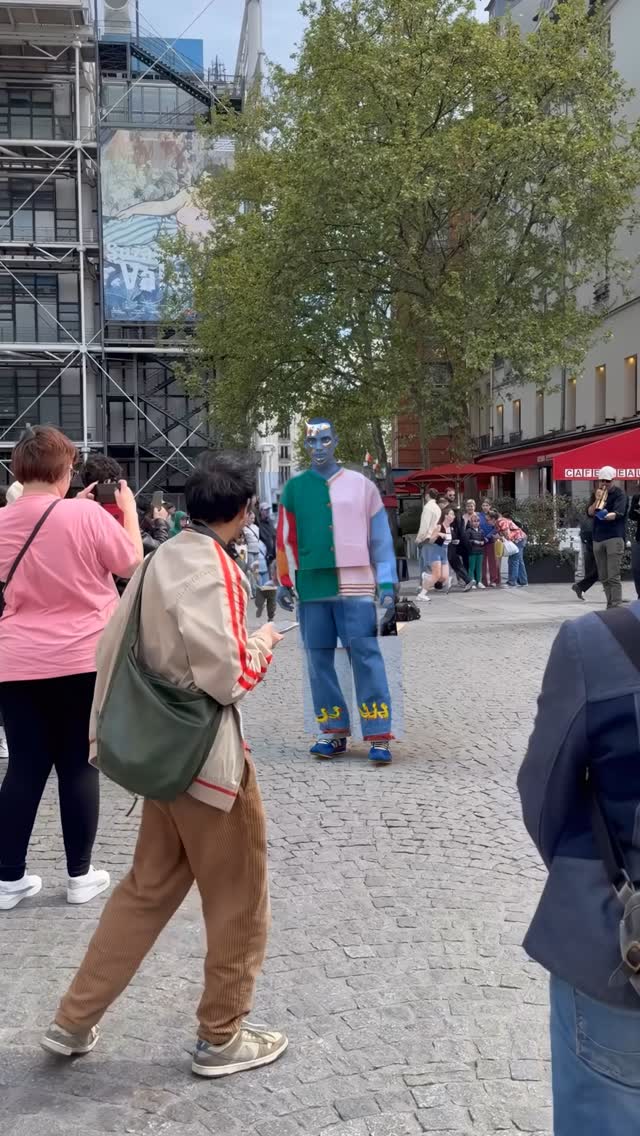
One body, three outfits 😎 Front look: @outsidersdivision Back look: @kenzo - - - - - #fashion #paris #illusion #fashionstyle #streetart #art #fashiondesigner
One body, three outfits 😎 Front look: @outsidersdivision Back look: @kenzo - - - - - #fashion #paris #illusion #fashionstyle #streetart #art #fashiondesigner
This frame feels casual at first glance, but it carries a built-in puzzle: regular city movement in the foreground, a painted performer in the center, and a fashion narrative hinted by the caption idea of one body shifting across looks. That tension between everyday realism and staged illusion is exactly what keeps people watching.
Recipe 1: Beauty to Street Theater
Keep: directional movement, mid-ground focal character, neutral background texture.
Change: replace performer styling with makeup concept and change wardrobe family.
Slot template (EN): {city_street} {moving_foreground_person} crossing in front of {stylized_subject} wearing {look_theme} under {overcast_light}
Recipe 2: Travel Hook Version
Keep: cobblestone-like surface, background crowd, one saturated color anchor.
Change: local architecture, props, and performer identity to match destination.
Slot template (EN): {historic_square} with {crowd_density}, foreground {pedestrian_action}, mid-ground {local_character}, accent color {anchor_color}
Recipe 3: Brand Collab Version
Keep: candid documentary framing, layered depth, soft daylight.
Change: brand-coded garment colors, logo-safe negative space, hero action timing.
Slot template (EN): {brand_palette_wardrobe} + {public_space_texture} + {foreground_crossing_motion} + {center_hero_pose} + {audience_reaction}
The image works because it avoids perfect symmetry and still feels intentional. The foreground walker takes a large share of the frame, which creates immediacy and a "you are there" sensation. Instead of fighting that occlusion, the composition uses it to build narrative depth: we see action in front, spectacle in the middle, and context in the back. This layering makes the frame feel alive rather than posed.
Color handling is also sharp. Most surfaces are low-saturation stone and gray architecture, so the performer's painted face and costume become the natural focal signal. The red awning on the right acts as a secondary color echo, keeping the eye moving horizontally. Lighting stays soft and diffused, which preserves texture in clothing and environment without harsh shadow distractions.
Finally, the mild motion blur is a strength, not a flaw. It confirms real movement and gives the frame temporal energy, especially for social feeds where static perfection often reads as ad-like. This shot feels observed, not manufactured, and that feeling is a major trust advantage.
| Observed | Recreate Knob | Why It Matters |
|---|---|---|
| Foreground subject fills about half of frame height | Set subject scale to 45-55% of frame | Immediate presence and scroll stop |
| Single saturated focal character in mid-depth | Use one dominant accent color and one focal costume | Clear visual anchor amid crowd complexity |
| Soft overcast lighting with low contrast shadows | Keep neutral-cool white balance and soft shadow rolloff | Preserves realism and fabric detail |
| Urban texture: cobblestone + scaffold + cafe frontage | Use at least three distinct environment layers | Adds credibility and place identity |
| Mild motion blur in moving limbs | Allow subtle movement blur; avoid freeze-frame perfection | Signals real-time event energy |
| Prompt chunk | What it controls | Swap ideas (EN, 2-3 options) |
|---|---|---|
| Subject hierarchy: foreground walker + mid-ground performer + background crowd | Narrative depth and attention order | "foreground cyclist", "foreground skater", "foreground commuter with tote" |
| Pose/gesture timing: crossing stride with slight forward lean | Kinetic feel and documentary realism | "mid-step stride", "half-turn glance", "fast crosswalk pace" |
| Wardrobe contrast: muted streetwear vs vivid performer costume | Primary focal separation | "earth-tone commuter vs neon mime", "black denim vs metallic dancer", "minimal coat vs painted artist" |
| Environment texture: cobblestone, scaffold facade, red awning | Location authenticity | "tram stop + old stone", "market alley + banners", "museum square + cafe terrace" |
| Background cleanliness level: controlled chaos, not clutter overload | Readability of focal subject | "small crowd", "mid-density pedestrians", "few clustered observers" |
| Lighting direction and softness: overcast diffuse daylight | Skin/fabric texture and mood | "soft cloudy noon", "bright haze daylight", "diffused urban shade" |
| Lens feel: wide mobile documentary | Spatial depth and candid perspective | "24mm smartphone", "26mm handheld", "28mm street reportage" |
| Imperfections: mild motion blur + compression grain | Believability and platform-native texture | "subtle motion blur", "light social compression", "natural edge softness" |
Treat this as an execution workflow, not a one-shot prompt gamble.
Only change 1-2 knobs per run. If output drifts, revert to the last stable version before testing a new variable.