The Nihilist Penguin: How invideo.io Built This AI Art
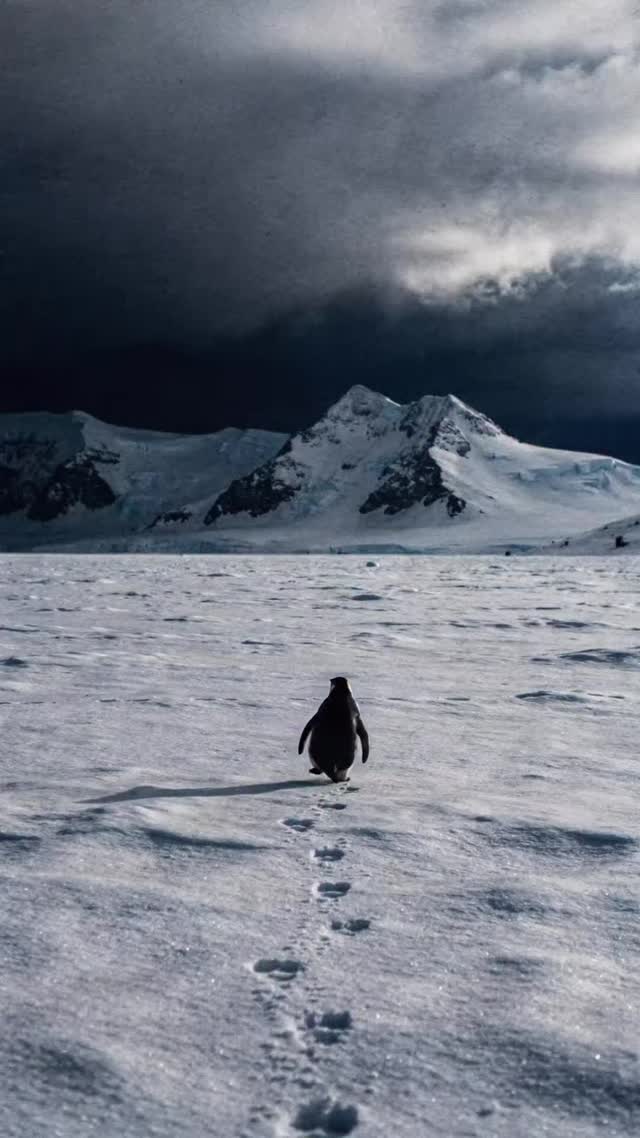
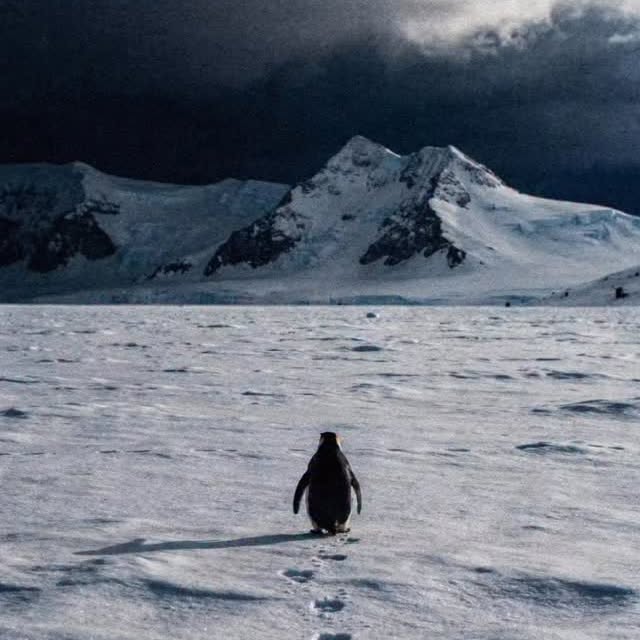
This image hits because it’s narrative, not decorative. A lone penguin walks away from the camera across a huge snowfield, leaving footprints that lead your eye straight into the distance. You don’t need context to feel what it’s saying: isolation, stubbornness, and a question the viewer can’t help but ask—where is it going?
For creators, this is a masterclass in using scale and negative space. The penguin is small, the world is massive, and the sky is heavy. That imbalance is the emotion.
Why it spreads: an open-ended story people project onto
Viral frames often do one thing well: they create a clean prompt for the viewer’s imagination. This scene is basically a question mark. The subject is walking away from safety (implied), toward mountains and storm clouds (implied risk). That ambiguity invites interpretation, captions, memes, and philosophical commentary.
Composition makes it even stronger. The footprints are a literal leading line, and leading lines are attention machines. Your eyes follow the path automatically—so the image “plays” itself without you trying.
Signal table
| Signal |
Evidence (from this image) |
Mechanism |
Replication Action |
| Open loop narrative |
Subject walking away into emptiness |
Viewers invent meaning and captions |
Design scenes that imply a “why” without answering it |
| Leading line |
Footprints from foreground to subject |
Eyes follow automatically; higher retention |
Add a single path/track line that points to the subject |
| Negative space |
Huge snowfield and heavy sky |
Amplifies loneliness and scale |
Make the subject small and protect empty space |
| Weather drama |
Dark storm clouds over bright snow |
Contrast adds tension instantly |
Use storm/light contrast for emotional tone |
Use cases & transfers
Best-fit scenarios
- Story-first creators: visual metaphors for captions and voiceovers.
- Meme formats: open-ended scenes are easy to caption.
- Documentary-style reels: quiet frames that feel “real.”
- Brand storytelling: resilience, exploration, solitude, ambition themes.
Not ideal
- Fast dopamine aesthetics: this is slow and contemplative by design.
- Text-heavy overlays: text can break the minimal power of the frame.
- Busy compositions: adding more subjects ruins the metaphor.
Transfers (3 recipes)
-
Recipe 1: Lone subject series
- Keep: tiny subject, huge environment, strong leading line
- Change: {subject} = penguin / hiker / robot silhouette
- Slot template: “single {subject} walking away, footprints/track line, massive landscape, moody sky”
-
Recipe 2: Weather swap
- Keep: negative space and path line
- Change: {weather} = storm clouds / fog bank / snowfall
- Slot template: “{weather} over empty terrain, subject small, path leading line”
-
Recipe 3: Terrain swap
- Keep: the same composition logic
- Change: {terrain} = snowfield / desert / salt flats
- Slot template: “wide {terrain}, distant mountains, track line, solitary subject”
Aesthetic read: the footprints are the secret weapon
Without the footprints, the penguin would feel lost in the frame. With them, you get structure: a beginning (foreground), a middle (subject), and an end (mountains). It’s a built-in story arc. That’s why this image feels like a film still, not just a landscape photo.
The storm cloud adds tension. It creates the sense that the subject is walking into uncertainty. That’s the emotional engine that people respond to.
Prompt technique breakdown (control manual)
| Prompt chunk |
What it controls |
Swap ideas (EN) |
| “single lone subject walking away, back view” |
Isolation and mystery |
“standing still”, “running”, “looking back” |
| “clear footprints leading line from foreground” |
Eye guidance and story arc |
“tire tracks”, “drag marks”, “single path in sand” |
| “vast empty snowfield, massive negative space” |
Scale and mood |
“salt flats”, “desert plain”, “empty beach” |
| “dramatic storm clouds, high contrast sky” |
Tension |
“fog wall”, “snowstorm”, “twilight sky” |
| “cold overcast daylight, desaturated grade” |
Documentary realism |
“warm sunrise”, “blue hour”, “monochrome” |
Starter prompt
Photoreal cinematic Antarctic landscape: a vast flat snowfield leading to distant jagged snow-covered mountains under dramatic dark storm clouds. A single lone penguin walks away from the camera, small in frame and centered. A clear line of footprints starts in the foreground bottom-center and leads directly to the penguin, forming a strong leading line. Vertical framing, low camera height close to the snow surface, massive negative space, cold overcast daylight, desaturated grade, crisp snow texture, high resolution, no text.
Remix steps: build a “one subject” storytelling series
Baseline lock
- Composition: leading line from foreground to subject
- Scale: subject stays small
- Weather: dramatic sky contrast
One-change rule (example 4 runs)
- Run 1: lock the footprints and camera height.
- Run 2: change only the subject (penguin → lone hiker silhouette).
- Run 3: change only the weather (storm clouds → fog wall).
- Run 4: change only the terrain texture (snow ridges → smooth salt flats).