How invideo.io Made This Lone Penguin AI Art — and How to Recreate It
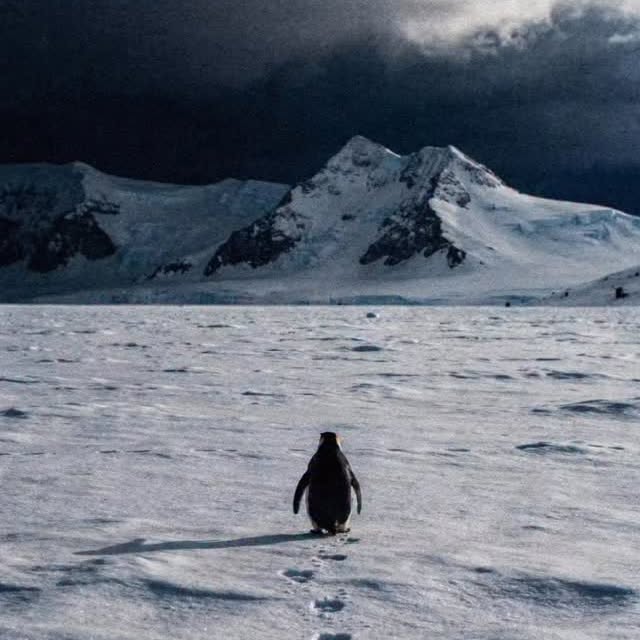
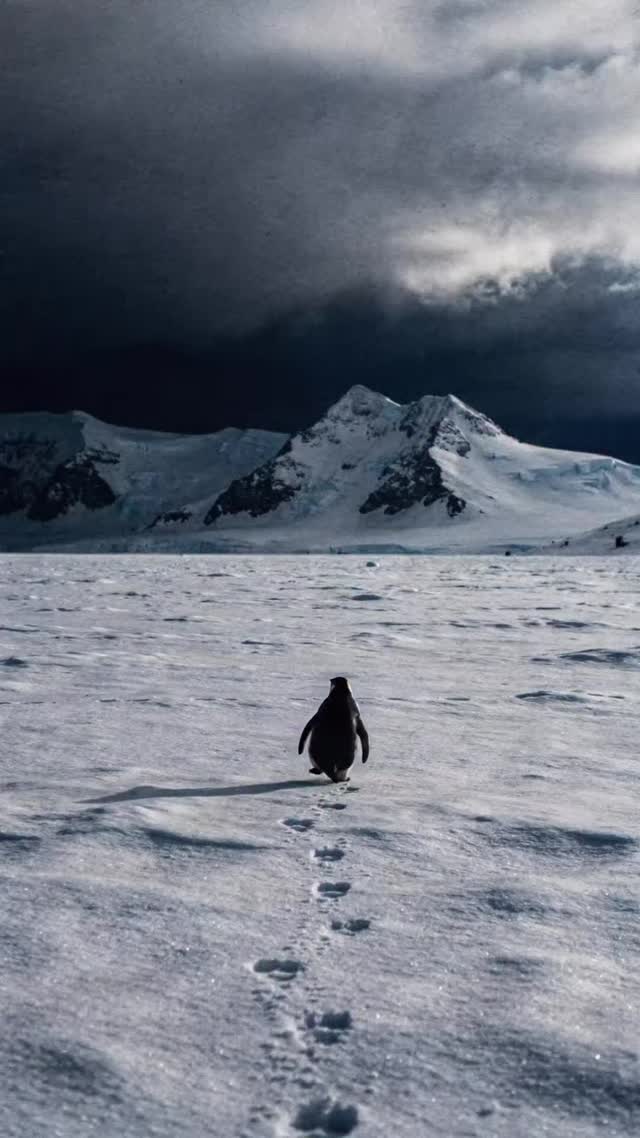
This image is powerful because it compresses a huge philosophical question into one simple visual action: a single penguin walking away from safety into emptiness. No text is needed to trigger interpretation. That ambiguity is a strong engagement engine.
The second strength is scale contrast. The subject is tiny, while snowfield, mountain mass, and dark sky dominate. This imbalance communicates isolation and uncertainty better than explicit narration. Viewers project their own emotions onto the scene, which drives comments and repost captions.
It also uses restraint effectively. The palette is muted, composition is sparse, and there is no visual clutter competing for attention. In a feed full of over-designed content, this kind of visual silence can be surprisingly sticky.
Signal Table
| Signal | Evidence (from this image) | Mechanism | Replication Action |
|---|
| Narrative ambiguity | Lone penguin moving away with no explicit reason | Open-ended meaning invites audience interpretation | Frame one unexplained action and avoid over-explaining in image |
| Extreme scale contrast | Tiny subject vs vast landscape and sky | Scale gap amplifies emotional intensity | Keep protagonist under 10% of frame area for isolation stories |
| Mood coherence | Dark sky, cold tones, long shadow | Consistent atmospheric cues create strong affect | Lock palette and light direction to one emotional register |
| Minimal visual noise | No crowd, no text, no extra objects | Low clutter improves symbolic clarity | Remove all secondary elements that do not support the core idea |
Use Cases and Transfers
Best-fit scenarios
- Philosophical/mood storytelling posts: fit is high because interpretation is open-ended.
- Music visual snippets: fit is high for tracks with contemplative or melancholic tone.
- Essay-style carousel openers: fit is high as a symbolic first frame.
- Documentary-inspired shorts: fit is high where atmosphere matters more than dialogue.
Not ideal
- Product promotions requiring immediate practical information.
- Comedy formats that depend on clear punchline setup.
- Instructional content needing explicit subject detail and context.
Exactly 3 transfer recipes
-
Lone Figure Transfer
Keep: tiny protagonist and vast hostile environment.
Change: penguin to person, deer, or lone vehicle silhouette.
Slot template (EN): "single {subject} moving away across {vast_terrain}, under {mood_sky}, strong negative space"
-
Urban Existential Transfer
Keep: isolation through scale and sparse composition.
Change: snowfield to empty city plaza at dawn/night.
Slot template (EN): "tiny {subject} in large empty {urban_space}, muted palette, contemplative atmosphere"
-
Sci-Fi Mood Transfer
Keep: lone movement toward unknown horizon.
Change: polar mountains to alien terrain and dramatic cloud layer.
Slot template (EN): "solitary {traveler} walking toward distant {landform}, moody sky, cinematic emptiness"
Aesthetic Read
The frame succeeds through disciplined emptiness. The composition leaves most of the image to snow texture and atmospheric sky, so the subject becomes a symbolic punctuation mark rather than a descriptive character. Long shadow and footprints quietly imply time and direction, adding narrative momentum without visual noise. This is a strong strategy for creators who want emotionally resonant visuals that remain simple and shareable.
| Observed | Recreate |
|---|
| Subject placed low and small | Keep protagonist near lower third with large surrounding emptiness |
| Directional movement away from viewer | Use back-facing subject to create unresolved narrative tension |
| Dark sky over bright ground | Build tonal contrast between oppressive sky and open terrain |
| Subtle track/shadow cues | Add minimal traces that imply journey and time |
| Mutual silence of scene elements | Avoid secondary objects that dilute emotional focus |
Prompt Technique Breakdown
| Prompt chunk | What it controls | Swap ideas (EN, 2-3 options) |
|---|
| Scale ratio directive | Isolation intensity | "tiny subject" | "small distant subject" | "mid-size subject" |
| Movement orientation | Narrative direction | "walking away" | "standing still" | "crossing laterally" |
| Atmosphere lock | Emotional tone | "stormy sky" | "foggy overcast" | "clear cold dusk" |
| Terrain descriptor | World-building context | "snow plain" | "salt flat" | "volcanic ash field" |
| Clutter suppression | Symbolic clarity | "no extra objects" | "minimal traces only" | "empty horizon" |
Remix Steps
Baseline Lock: lock lone-subject scale, away-facing motion, and moody sky contrast first.
One-change rule: change one to two variables per iteration.
- Iteration 1: keep structure fixed, test subject size (5% vs 10% frame).
- Iteration 2: keep size winner, test sky darkness levels.
- Iteration 3: keep sky winner, test shadow length for mood strength.
- Iteration 4: keep winners, test footprint visibility for narrative subtlety.