How kakudrop Made This Electrostep Cyberpunk Fashion AI Portrait — and How to Recreate It
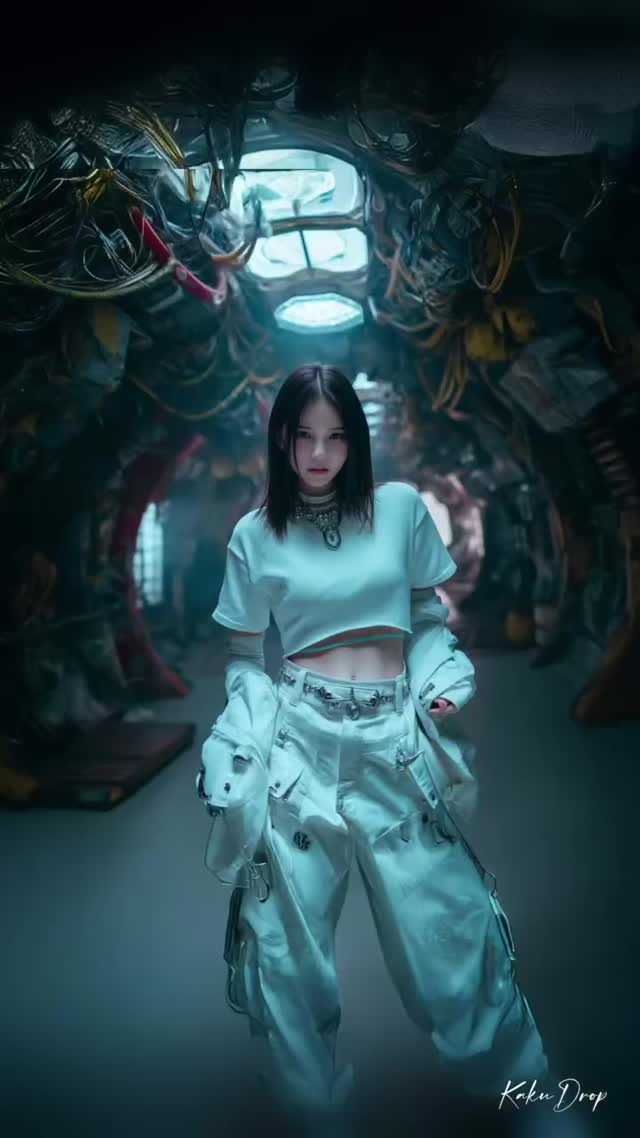
This image is powerful because it merges strong character styling with environment storytelling. The creator does not rely on pose alone. The corridor itself acts like a narrative machine, making the frame feel like a scene from a larger world.
For growth, this matters: posts that imply a universe often get higher saves and rewatches than isolated portraits. Viewers want to inspect details, then imagine what happens next.
Signal Table
| Signal | Evidence (from this image) | Mechanism | Replication Action |
|---|
| Worldbuilding density | Ceiling packed with cables and mechanical structures | Detail-rich backgrounds increase dwell time | Prompt one high-density environment layer (ceiling or walls), not both randomly |
| Color-brand consistency | Cyan/teal lighting with white outfit contrast | Distinct palette improves recognizability across posts | Lock a 2-color system: cool environment + neutral wardrobe |
| Centered hero composition | Subject aligned with tunnel vanishing point | Leading lines force attention toward character | Keep subject on center axis in corridor scenes |
| Motion implication | Forward walking posture and jacket drape | Adds cinematic momentum in still frame | Use walk-forward pose instead of static standing |
Best-Fit Scenarios
- Best fit: AI fashion persona accounts. Why fit: strong style + world context creates identity depth. What to change: rotate wardrobe silhouette, keep corridor language.
- Best fit: sci-fi campaign teaser posts. Why fit: scene feels like a trailer frame. What to change: add one narrative prop per episode.
- Best fit: music/edm visual branding. Why fit: cyan industrial atmosphere matches electronic aesthetics. What to change: sync text overlays to track keywords.
- Best fit: character-universe storytelling series. Why fit: easy to serialize across locations and costume versions.
- Not ideal: minimal clean lifestyle pages. Reason: this visual language is intentionally dense and dramatic.
- Not ideal: product catalog shots. Reason: environment complexity competes with isolated product focus.
- Not ideal: educational carousel slides. Reason: high scene detail can reduce text readability.
Three Transfer Recipes
Transfer 1: Neon subway variant
Keep: centered walking pose, cool palette dominance, white outfit contrast.
Change: industrial cable tunnel to neon subway corridor.
Slot template (EN): {centered walking model} {cool neon corridor} {white utility outfit} {cinematic haze}
Transfer 2: Bio-lab corridor variant
Keep: vanishing-point composition and overhead light rhythm.
Change: cable clusters to translucent tubes and lab modules.
Slot template (EN): {hero walk portrait} {futuristic lab tunnel} {cool top lighting} {high-detail environment}
Transfer 3: Desert tech bunker variant
Keep: single hero framing and atmospheric depth.
Change: cyan interior to dusty warm-tech bunker with selective blue highlights.
Slot template (EN): {single model center frame} {bunker corridor} {mixed warm/cool lights} {streetwear sci-fi look}
Aesthetic Read
The scene uses depth and contrast as primary tools. White clothing pops because the corridor is dark, cluttered, and cool-toned. The overhead panels create a visual rhythm that repeats down the tunnel, giving the frame cinematic perspective. Texture layering is key: soft cotton fabric, rigid metallic pipes, bundled cables, and atmospheric haze all coexist without flattening. The model’s forward posture and direct gaze keep the image character-driven despite background complexity. Color restraint is another strength. The image mostly stays in teal-cyan and white, which avoids chaos and makes the frame feel authored rather than random. For creators, this is a high-value blueprint for sci-fi fashion content: design one dense environment spine, keep wardrobe palette disciplined, and center the subject inside strong leading lines.
Prompt Technique Breakdown
| Prompt chunk | What it controls | Swap ideas (EN, 2-3 options) |
|---|
| "single female model walking toward camera" | Narrative momentum and hero focus | "static stance" / "slow turn" / "running pose" |
| "white cropped top + oversized white cargo pants" | Wardrobe contrast against dark environment | "black tactical outfit" / "silver jacket set" / "neon accent streetwear" |
| "cable-dense futuristic corridor" | Worldbuilding complexity and sci-fi tone | "neon subway" / "server tunnel" / "bio-lab passage" |
| "cool cyan overhead panel lighting" | Mood temperature and depth separation | "purple neon top light" / "mixed amber-cyan" / "cold white strips" |
| "vertical centered vanishing-point composition" | Readability and cinematic perspective | "off-center composition" / "wide horizontal crop" / "tight headshot" |
Remix Steps
Baseline Lock: lock center-axis composition, lock cool top-light system, lock white wardrobe block.
One-change rule: change one variable per render batch.
- Render 1 baseline with cyan corridor and white utility outfit.
- Render 2 change only corridor subtype (wires vs tubes).
- Render 3 keep corridor winner, change only haze density.
- Render 4 keep haze winner, change only accessory detail (neckwear/jacket drape).
This process gives coherent series output while preserving novelty.