How kelly_boesch_ai_art Made This Elderly Fashion Shoot AI Art -- and How to Recreate It
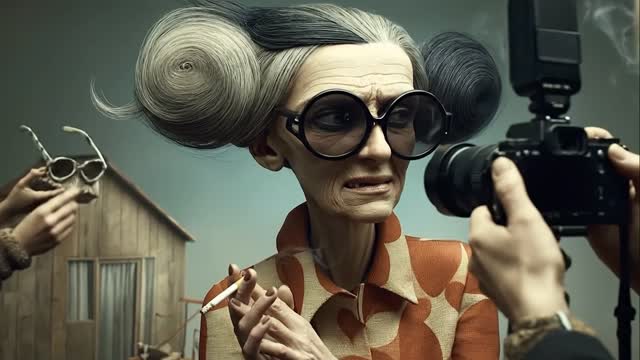
This portrait works because it treats age, styling, and production context as equal parts of the image rather than as separate ideas. The central figure is an elderly fashion character with sharply sculpted gray side buns, oversized black sunglasses, an orange patterned jacket, and a cigarette held between tense fingers. Her face carries deep lines and a guarded expression that feels lived-in rather than softened. At the same time, a photographer and camera dominate the foreground, making the image feel like a portrait about being photographed as much as a portrait of a person. That layered self-awareness is the source of the image’s strength.
The composition never asks the viewer to simply admire a stylish elder subject in isolation. Instead, it places the subject inside the machinery of fashion image-making. The camera intrudes into the frame, hands appear at the edges, and the set feels intentionally sparse but unmistakably staged. Because of this, the image becomes more than a fashion portrait. It becomes a commentary on pose, spectacle, age, performance, and the act of image construction itself. That is why it feels richer than a cleaner, more conventional editorial close-up would have.
For prompt writers, this is an important kind of image to study. It demonstrates that character, silhouette, and meta-framing can work together if the hierarchy is clear. The elderly face, the dramatic hair shapes, the dark sunglasses, and the foreground camera all serve distinct purposes. Nothing is random. Every component deepens the idea that we are seeing a deliberately strange fashion moment caught from inside the production space rather than outside it.
Why Age Is the Core Design Feature
The portrait is compelling because it refuses to hide age. The lines of the face, the shape of the jaw, and the slight tension in the mouth are not treated as flaws to be polished away. They are part of the image’s visual authority. In many weaker prompts, age becomes secondary to wardrobe, but here age is one of the strongest design languages in the composition. It gives the portrait a gravity and complexity that younger beauty-editorial imagery often cannot reach.
That choice changes the entire emotional tone. Instead of reading as playful fashion eccentricity alone, the image acquires seriousness and friction. The character feels experienced, guarded, and strong in a way that the wardrobe alone could never achieve. When writing prompts in this style, it is therefore important to protect age markers explicitly. Wrinkles, bone structure, and mature facial texture should be kept visible and integrated into the artistic intent rather than treated as details that the model may smooth away.
Silhouette and Accessory Power
The silhouette is instantly memorable because it is built from only a few bold forms. The two oversized gray side buns act almost like sculptural extensions of the head, the black sunglasses form a dense graphic band across the face, and the orange jacket establishes the primary color anchor. These are not small styling details. They are the structural elements that make the portrait readable from afar. Without them, the image would lose much of its fashion-editorial impact.
This is a useful lesson in high-level prompt design. If you want a subject to feel iconic, you need a silhouette that can be summarized in a sentence. Here, that summary would be easy: elderly woman, giant circular gray side buns, round black sunglasses, orange patterned jacket, cigarette gesture, camera in foreground. That kind of silhouette clarity gives the model strong organizing principles. It also makes the final image much more likely to feel intentional.
The Role of the Cigarette Gesture
The hand holding the cigarette is a small detail, but it changes the mood dramatically. It introduces tension, coolness, and a sense of character history. The fingers are poised rather than relaxed, which prevents the gesture from feeling casual. In editorial portraiture, these small hand behaviors can carry a surprising amount of narrative. They suggest attitude and interiority in ways that facial expression alone sometimes cannot.
In prompt terms, the cigarette gesture should be described with care because hand-based details are easy to lose or distort. It is not enough to say smoking. The better instruction is that the subject clasps a cigarette between fingers in an elegant, tense, controlled gesture. This preserves both the visual shape and the emotional quality of the pose. When done correctly, the hand becomes a second focal point after the face and hair silhouette.
| Feature | Role in the Portrait | Prompt Benefit |
|---|---|---|
| Gray sculpted side buns | Define the subject’s iconic shape | Help the portrait read instantly even at reduced scale |
| Oversized round sunglasses | Add graphic weight and mystery | Create a fashion-editorial shield across the face |
| Orange geometric jacket | Serve as the primary color event | Prevent the muted palette from feeling visually thin |
| Cigarette hand gesture | Add attitude and tension | Turns the portrait from static styling into character storytelling |
| Foreground camera | Introduces meta-image logic | Makes the portrait about image production as well as appearance |
| Mature facial structure | Grounds the eccentric styling in reality | Gives the image emotional complexity and credibility |
Foreground Camera as Concept
The foreground camera is not a distraction. It is one of the most intelligent parts of the composition. It reframes the portrait as a scene in progress rather than a polished final illusion. We are reminded that this image is constructed, observed, and staged. That awareness adds tension. It turns the subject into both icon and participant in a larger fashion machine. The result is more contemporary and more self-aware than a conventional centered portrait would be.
For prompt writing, this is a good reminder that meta-framing can create sophistication when used deliberately. A camera in frame is not clutter if the concept is about visibility, construction, or fashion production. The key is to keep it secondary to the subject. Here, the foreground camera occupies strong visual space but still yields emotional primacy to the subject’s face, hair, and posture. That is the correct balance.
Lighting and Surface Control
The lighting remains soft and editorial even though flash equipment is visible. This is another subtle strength. The image does not become a harsh paparazzi shot or a blown-out backstage snapshot. Instead, it keeps a controlled cinematic matte quality, with enough highlight to define the forehead, hair structure, glasses, and jacket pattern without erasing the face’s natural depth. This restraint allows the surreal styling to coexist with believable age and material texture.
A prompt based on this image should therefore ask for soft diffused editorial light, controlled highlight placement, muted color grading, and realistic facial texture retention. Avoid glossy beauty treatment, overexposed flash effects, or exaggerated contrast that erases the sophistication of the subject. The mood should remain slightly uncanny and poised, not chaotic or fashion-camp caricature.
Prompt Building Strategy
A strong prompt should begin with the subject’s identity and silhouette. For example: an elderly fashion figure with sharply sculpted gray side buns, oversized round black sunglasses, an orange geometric-patterned jacket, visible wrinkles, and a cigarette held between elegant fingers. Then define the staging: photographed inside a behind-the-scenes editorial setup with a camera and hands visible in the foreground, minimal set, and shallow depth of field. Finally define the style: avant-garde fashion realism, surreal editorial portrait, cinematic campaign still, slightly uncanny but refined.
The order matters. If you begin with fashion editorial abstraction before locking the subject silhouette, the image may become generic. If you omit the production context until the end, the generator may ignore the camera or misplace it. If you do not explicitly protect age, the subject may become too youthful. Strong ordering reduces that drift and makes the image easier to stabilize through iteration.
Why Minimal Set Design Helps
The set stays sparse, and that is a good thing. The image already contains plenty of complexity in the subject and in the meta-photography framing. If more furniture, crowd detail, or decorative props were introduced, the portrait would become noisy. The emptiness behind the subject works like a pressure chamber. It holds the tension between the orange jacket, the sunglasses, the face, and the camera without forcing the viewer to search for relevance in the background.
Minimal set design is especially useful in editorial prompts where the styling is already highly distinctive. It ensures that the eye returns to the subject instead of wandering across irrelevant objects. This image demonstrates that a sparse set can still feel conceptually rich when the relationships between subject and equipment are strong enough.
Reusable Prompt Template
A reusable version of the prompt might read like this: an elderly avant-garde fashion figure with large sculptural gray side buns, oversized black sunglasses, visible wrinkles, an orange patterned jacket, and a tense cigarette gesture is photographed inside a minimal editorial set with a camera and hands visible in the foreground, rendered as surreal fashion realism with muted grading, soft controlled lighting, and strong character presence. Then add a negative section removing youth-smoothing, background clutter, glossy beauty retouching, duplicate props, and chaotic lighting.
This template can support many variations. You can swap the jacket color, change the glasses shape, or alter the production context while keeping the core idea of age-plus-fashion-plus-meta-framing intact. That makes it useful not just for one portrait, but for an entire series of character-driven editorial campaign images.
Final Creative Takeaway
The key lesson of this image is that style becomes more powerful when it is anchored in character. The hair, glasses, jacket, and cigarette are all striking, but they matter because the face beneath them feels lived-in and emotionally precise. The visible camera matters because the subject feels strong enough to remain the center even when the production apparatus enters the frame. That equilibrium is what gives the portrait its sophistication.
For prompt writers, this is a reminder that eccentric fashion imagery becomes far more memorable when it is structured around clear silhouette, visible age, and a specific staging concept. This portrait does not depend on excess. It depends on exact choices. That is why it feels editorial, cinematic, and character-rich all at once.