Why liberxx0's Porcelain Android AI Art Went Viral
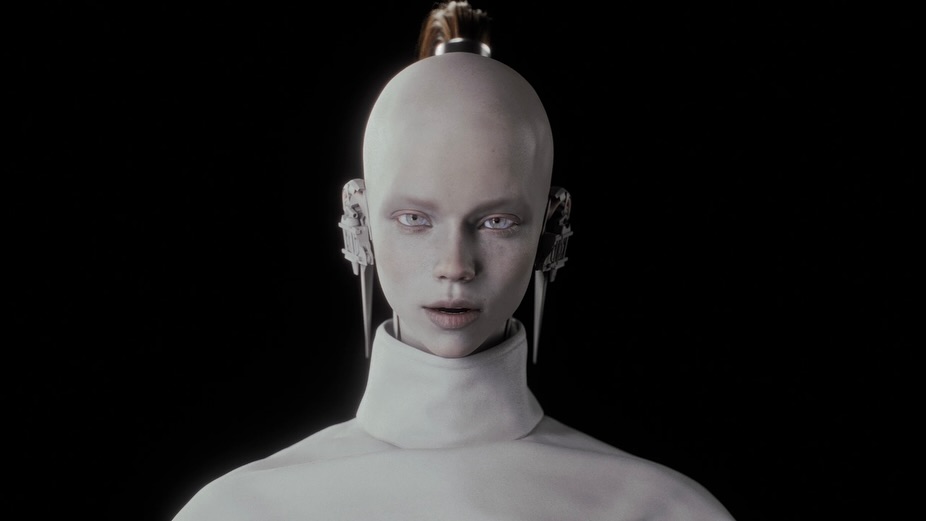
This image wins attention by removing almost everything. One face, one black void, one controlled light source. In a feed full of crowded frames, this kind of reduction creates a visual shock that reads as premium and intentional.
The viral strength of this frame comes from tension. It looks human enough to trigger empathy, yet mechanical enough to feel unfamiliar. That tension creates cognitive friction, and cognitive friction keeps people watching for longer. The viewer does a rapid internal check: “Is this a real person, a render, or a robot concept?” That micro-pause is exactly what improves hold time and often boosts secondary actions like comments and shares.
Another reason this style travels is platform contrast. Social feeds are saturated with colorful edits, busy backgrounds, and trend-heavy overlays. This portrait takes the opposite route: monochrome palette, hard subject isolation, and strict symmetry. The result is immediate recognition in thumbnail size. Even before users understand the details, they understand the intent: this is designed, not random. Perceived intent is a major trust signal for visual creators.
There is also replay value. Minimalist sci-fi portraits invite interpretation, so the image does not end at first glance. People project stories onto it: future identity, machine emotion, ethics, fashion-tech direction. Posts that generate interpretation loops can outperform technically “prettier” images because they trigger conversation behavior, not just likes. If your goal is growth, this is a smart lesson: clarity plus ambiguity can outperform complexity plus noise.
| Signal |
Evidence (from this image) |
Mechanism |
Replication Action |
| Uncanny face tension |
Human-like eyes and lips combined with synthetic skin and robotic ear modules |
Ambiguity increases dwell time |
Lock one human cue and one machine cue in every frame, never all-human or all-mecha |
| Extreme visual economy |
Pure black background with single centered bust |
Low clutter improves first-glance comprehension |
Remove all props and test if concept still reads in 0.5 seconds |
| Monochrome discipline |
White-gray-black palette without accent colors |
Palette restraint signals editorial quality |
Use one base value range and ban neon accents for core series posts |
| Symmetry bias |
Face aligned centrally at eye-level |
Symmetry feels iconic and memorable |
Center the face precisely and keep camera angle neutral for hero shots |
Best Use Cases and Smart Adaptations
- AI character brand launches: Great fit because identity is immediate. Change only one hardware motif across episodes.
- Music visualizers and album teasers: Great fit because mood is cinematic and mysterious. Change lip expression slightly per track.
- Fashion-tech editorials: Great fit because silhouette and material read futuristic. Change collar geometry to match collection themes.
- Creative coding portfolios: Great fit because it signals controlled design systems. Change light direction to show range while keeping model constant.
Where It Is Not Ideal
- Family-friendly lifestyle channels: The uncanny mood may feel emotionally distant.
- Product conversion ads: Minimal props leave little room for practical product storytelling.
- Travel-vlog thumbnails: No environment means weak location context.
Transfer Recipes (3)
- Luxury Beauty Future Edit
Keep: centered symmetry, black void, soft frontal light.
Change: robot skin to polished human skin, keep mechanical earpiece as accessory.
Slot template (EN): {single subject bust} {black background} {hybrid human-tech styling} {soft frontal light}
- Dark Mode Brand Mascot
Keep: monochrome palette and neutral gaze.
Change: head shape and collar design to brand geometry.
Slot template (EN): {androgynous mascot} {minimal void scene} {brand geometry accessory} {quiet uncanny mood}
- Concept Film Poster Frame
Keep: close-up crop and emotionless expression.
Change: add subtle fog band and tiny typography margin outside subject area.
Slot template (EN): {close portrait} {void background} {single atmospheric layer} {futuristic dramatic restraint}
Aesthetic Breakdown: Observed Qualities You Can Rebuild
The image uses a strict hierarchy: face first, hardware second, silhouette third. Nothing in the frame competes with the eyes. The light is soft and frontal, but not flat; there is enough modeling around cheekbones and jawline to preserve form. The black background is not just a style choice, it is a control mechanism that prevents narrative noise and keeps visual bandwidth focused on identity design.
Material contrast is another key driver. The skin reads matte-synthetic while ear components read metallic and precise. That subtle mismatch creates “future realism.” Color restraint also matters: this is a grayscale composition disguised as a portrait. When creators enforce this kind of palette discipline, the output feels intentional even without expensive post-processing. The frame looks expensive because every decision removes distraction.
Prompt Technique Blocks
| Prompt chunk |
What it controls |
Swap ideas (EN, 2-3 options) |
| "androgynous humanoid android bust" |
Identity type and emotional distance |
"female-presenting synth" / "neutral biomech avatar" / "minimal mannequin android" |
| "pure black void background" |
Attention isolation and mood density |
"charcoal seamless backdrop" / "near-black studio void" / "black gradient void" |
| "soft frontal key light" |
Facial legibility and skin roll-off |
"butterfly soft light" / "diffused beauty dish feel" / "cloudy window frontal light" |
| "mechanical ear assemblies" |
Tech signal without full armor |
"delicate cyber ear rigs" / "surgical side modules" / "suspended metallic ear fins" |
| "monochrome white-gray-black palette" |
Editorial minimalism and consistency |
"cold grayscale" / "ivory and graphite" / "sterile neutral tones" |
Execution Playbook for Iteration
Baseline lock: lock centered bust composition, lock black void background, lock soft frontal light.
One-change rule: adjust only one variable per generation to preserve style continuity.
- Pass 1: Fix anatomy and symmetry only.
- Pass 2: Change only ear hardware complexity (simple to intricate).
- Pass 3: Keep hardware, change only skin finish (matte to satin).
- Pass 4: Keep all above, change only crop (headroom tighter) for thumbnail performance testing.
This process creates a coherent series instead of random outputs, which is what repeat audience growth needs.