#NMDPPartner, this campaign was never about one story. It’s about thousands.
Like Cayden, who’s been fighting leukemia since he was 3.
Like Noah, who joined the registry and saved a stranger’s life.
Like Emilee and Riley – both post-transplant and living leukemia-free.
Like the researchers, doctors, and families who show up every single day.
They’re the reason this matters.
Join the registry at nmdp.org/miquela. You could be someone’s match.
How lilmiquela Made This NMDP Registry Campaign and How to Recreate It
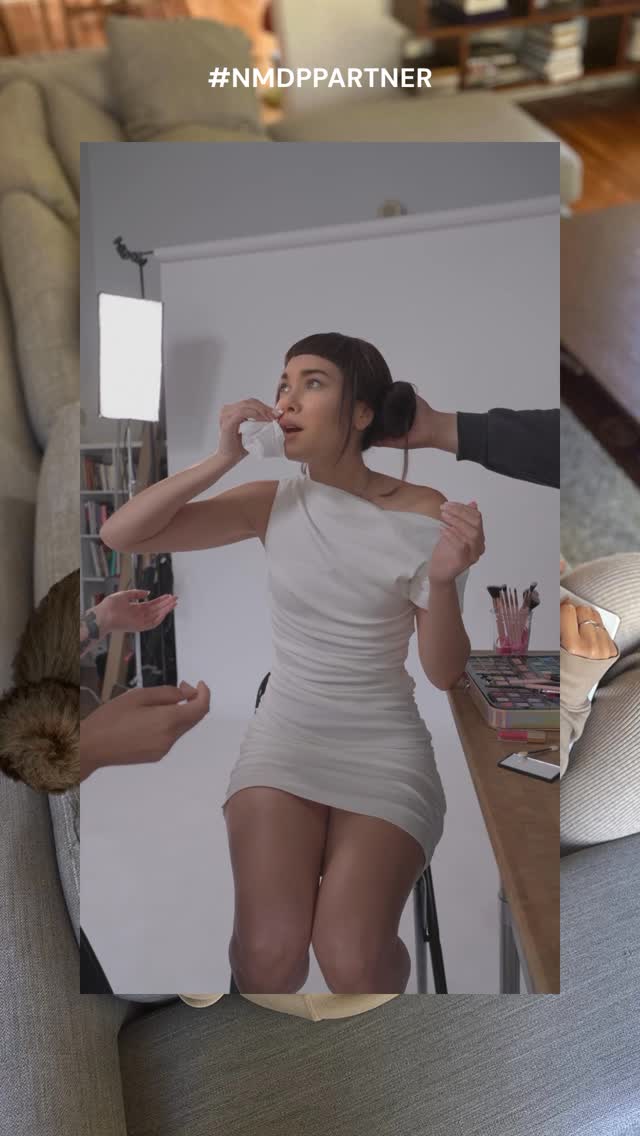
This frame is powerful because it shows process, not just outcome. Instead of a final retouched portrait, we see a printed campaign image placed on a couch, with visible studio prep inside the frame: stylist hands, light panel, and makeup table. That "image within image" structure signals real production and human effort, which matters for cause campaigns where credibility is everything.
The caption's message about many stories, patients, donors, and researchers is mirrored by the visual logic. The post does not center only one hero shot. It reveals the collaborative system behind advocacy storytelling. For creators, this is a high-value pattern when posting mission-driven partnerships: show the making, not only the finished asset.
Why This Format Performs for Advocacy Content
The first mechanism is transparency. A behind-the-scenes glimpse lowers skepticism around branded cause posts. The second mechanism is narrative layering. Outer domestic context plus inner studio frame visually represent "personal life meets public mission." The third mechanism is collective framing. Caption language shifts focus from individual creator to a network of people impacted, which increases perceived sincerity and encourages meaningful engagement.
Signal
Evidence (from this image)
Mechanism
Replication Action
Process visibility
Stylist hands and light setup visible in printed frame.
Builds authenticity and reduces "staged ad" perception.
Include one production detail in campaign visuals.
Layered storytelling composition
Printed photo on couch creates outer/inner narrative layers.
Adds depth and invites longer viewing.
Use frame-within-frame shots for campaign context posts.
Cause label clarity
Visible hashtag "#NMDPPARTNER" at top.
Makes partnership explicit while preserving narrative tone.
Label partnerships clearly without overpowering visual story.
Collective-impact copy
Caption names multiple people and roles in the ecosystem.
Expands emotional scope beyond one creator.
Write captions that spotlight beneficiaries and contributors, not only yourself.
Best Uses, Limits, and Transfer Recipes
Best-fit scenarios
Cause-driven partnerships: Works because process proof increases trust; change hashtag and mission line for your partner context.
Campaign launch carousels: Works as first or second slide before polished hero assets; change sequence to show build-up arc.
Creator transparency posts: Works because it humanizes production; change inner frame to script review, rehearsal, or team prep.
Community mobilization campaigns: Works when CTA is specific and actionable (join registry, donate, volunteer).
Not ideal
Luxury fashion exclusives: Deliberate behind-the-scenes roughness may conflict with premium polish expectations.
Minimalist single-message posts: Layered framing can feel busy if simplicity is the primary goal.
Hard product conversion ads: BTS context may dilute immediate product-benefit focus.
Transfers (exactly three recipes)
Keep: frame-within-frame composition, one clear partner label, visible team process.
Change: swap studio prep for rehearsal, editing bay, or fieldwork prep.
Slot template (EN): "this campaign is built by many hands. here's the process behind the message."
Keep: personal context outer frame + mission context inner frame.
Change: move from couch setting to desk or pinboard display.
Slot template (EN): "from my space to our mission: this is where the work starts."
Keep: collaborative visual cues and explicit CTA in caption.
Change: adjust CTA type (register, volunteer, donate, share story).
Slot template (EN): "many stories, one action: {specific next step}."
Aesthetic Read
The image uses tactile realism to build trust. Sofa fabric texture, slight angle, and casual placement of printed media create an unforced feeling. Inside the print, the high-key studio lighting and white dress contrast against the softer outer environment, producing a strong visual hierarchy between "campaign artifact" and "everyday life."
Compositionally, the rectangular card dominates center while surrounding room details remain peripheral. This keeps focus on the advocacy content but preserves human context. For creators, the practical lesson is that mission posts can feel both polished and authentic when you show evidence of making.
Observed
Recreate evidence
Frame-within-frame storytelling
Photograph a campaign print/screen inside a real environment.
Collaborative process cues
Include hands, tools, or setup elements from production team.
Clear partnership marker
Add concise partner tag that remains legible but unobtrusive.
Balanced polish and intimacy
Combine studio quality in inner frame with natural outer context.
Prompt Technique Breakdown
Prompt chunk
What it controls
Swap ideas (EN, 2-3 options)
"printed campaign photo lying on couch"
Narrative layering and realism
"photo print on desk" | "campaign card on floorboard" | "poster proof on table"