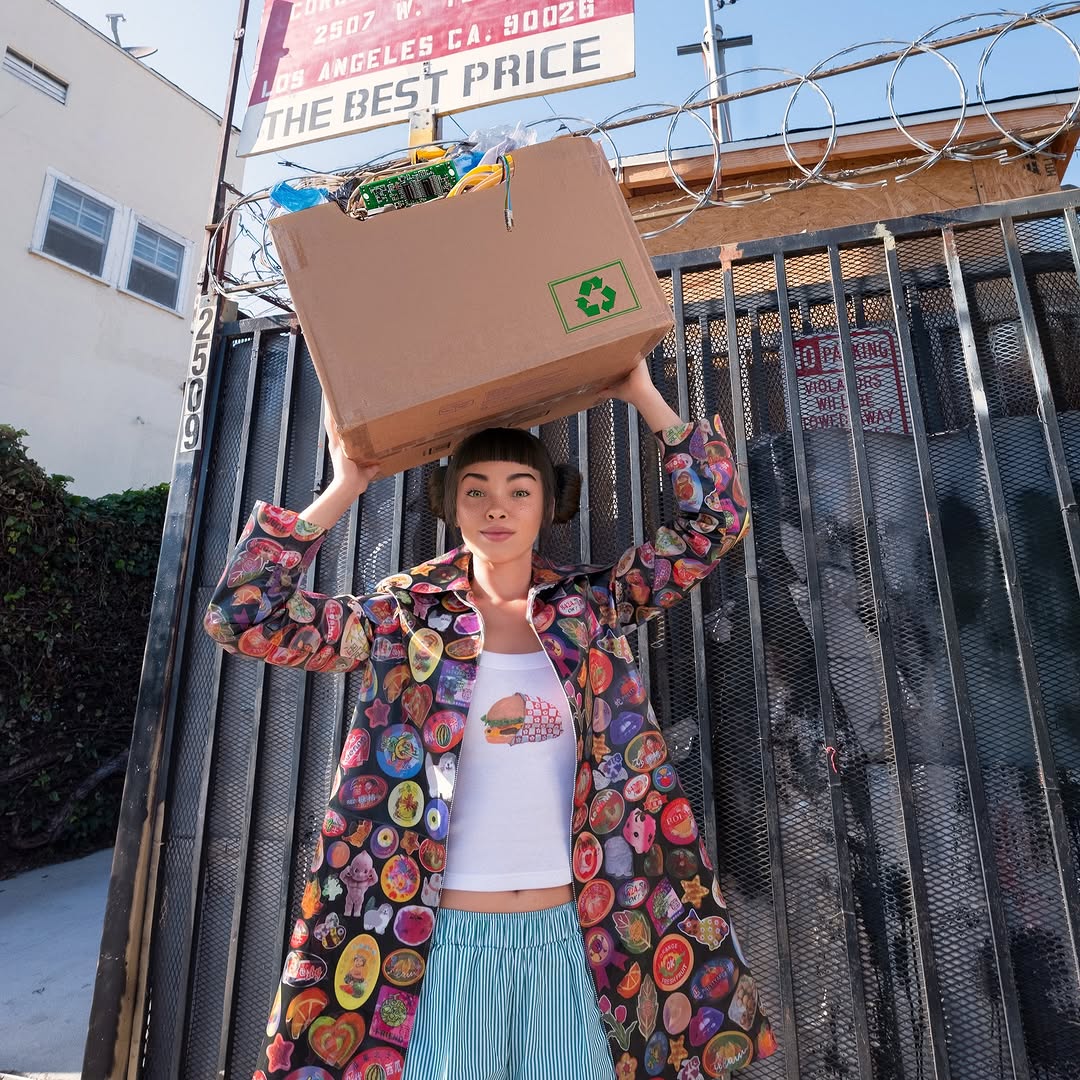
How lilmiquela Built This E-Waste Recycling Guide
This image turns a pile of discarded electronics into a strong visual story about scale, complexity, and waste. It works because viewers can instantly recognize familiar device parts while also feeling the overwhelming volume.
For creators, this format is valuable in sustainability, tech culture, and repair-rights narratives. It communicates impact without needing a long explanation first.
Why This Type of Image Performs
People engage with “evidence piles.” A dense box of components acts like proof: this is not an abstract issue, this is physical volume. The overhead view strengthens that perception by showing total quantity at once.
| Signal | Evidence (from this image) | Mechanism | Replication Action |
|---|
| Scale shock | Box packed edge-to-edge with parts | Visible quantity drives emotional response | Frame full container boundaries to show volume |
| Category familiarity | Recognizable boards, cables, and ports | Audience connects issue to personal tech use | Keep identifiable component types visible |
| Texture complexity | Mixed metal/plastic/circuit surfaces | Visual richness encourages longer viewing | Use high-detail overhead captures with even lighting |
| Documentary honesty | Unsorted, messy arrangement | Raw realism increases trust | Avoid over-styling or tidy rearrangement |
Best-Fit Scenarios
- Sustainability campaigns: ideal for illustrating waste footprint.
- Repair/reuse advocacy: strong for before/after sorting stories.
- Tech education channels: useful for “inside devices” posts.
- NGO reporting visuals: works as evidence-style supporting media.
Not ideal for: luxury tech launches, minimalist brand ads, or polished product hero shots.
Three Transfer Recipes
- Keep: top-down dense container shot. Change: item category. Template: "overhead box of {category waste/material} showing real volume".
- Keep: documentary messiness. Change: narrative stage. Template: "before sorting / after sorting comparison".
- Keep: muted industrial palette. Change: annotation layer. Template: "raw evidence photo + caption-led insights".
Aesthetic Read (Observed to Recreate)
| Observed | Impact | Recreate Move |
|---|
| Cardboard frame visible | Defines measurable volume | Include full container edges in composition |
| Tangling cables across layers | Conveys complexity and entanglement | Avoid flattening cable structure |
| Mixed component scales | Improves visual depth and realism | Retain both small and large hardware pieces |
| Neutral soft lighting | Maximizes object legibility | Use diffuse overhead light to avoid hard shadows |
| No decorative styling | Preserves documentary credibility | Keep scene raw and functional |
Prompt Technique Breakdown
| Prompt chunk | What it controls | Swap ideas (EN) |
|---|
| "top-down e-waste box" | Core perspective and topic | "toolbox parts box" / "recycling bin overview" |
| "dense mixed circuit boards and wires" | Complexity level | "mostly cables" / "mostly boards" |
| "soft diffuse overhead light" | Detail readability | "window top light" / "softbox overhead" |
| "raw unsorted arrangement" | Authenticity tone | "semi-sorted clusters" / "categorized compartments" |
| "muted industrial color palette" | Mood consistency | "high-contrast black-white" / "slightly warmer cardboard emphasis" |
Remix Steps (Execution)
- Lock baseline: same overhead angle and full-container framing.
- Run 1: capture unsorted state with no styling intervention.
- Run 2: capture mid-sort state with simple category grouping.
- Run 3: capture post-sort state and estimate recoverable parts ratio.
- Run 4: package the sequence into a carousel with practical reuse actions.
Impact storytelling is strongest when visual evidence is paired with clear next-step behavior.