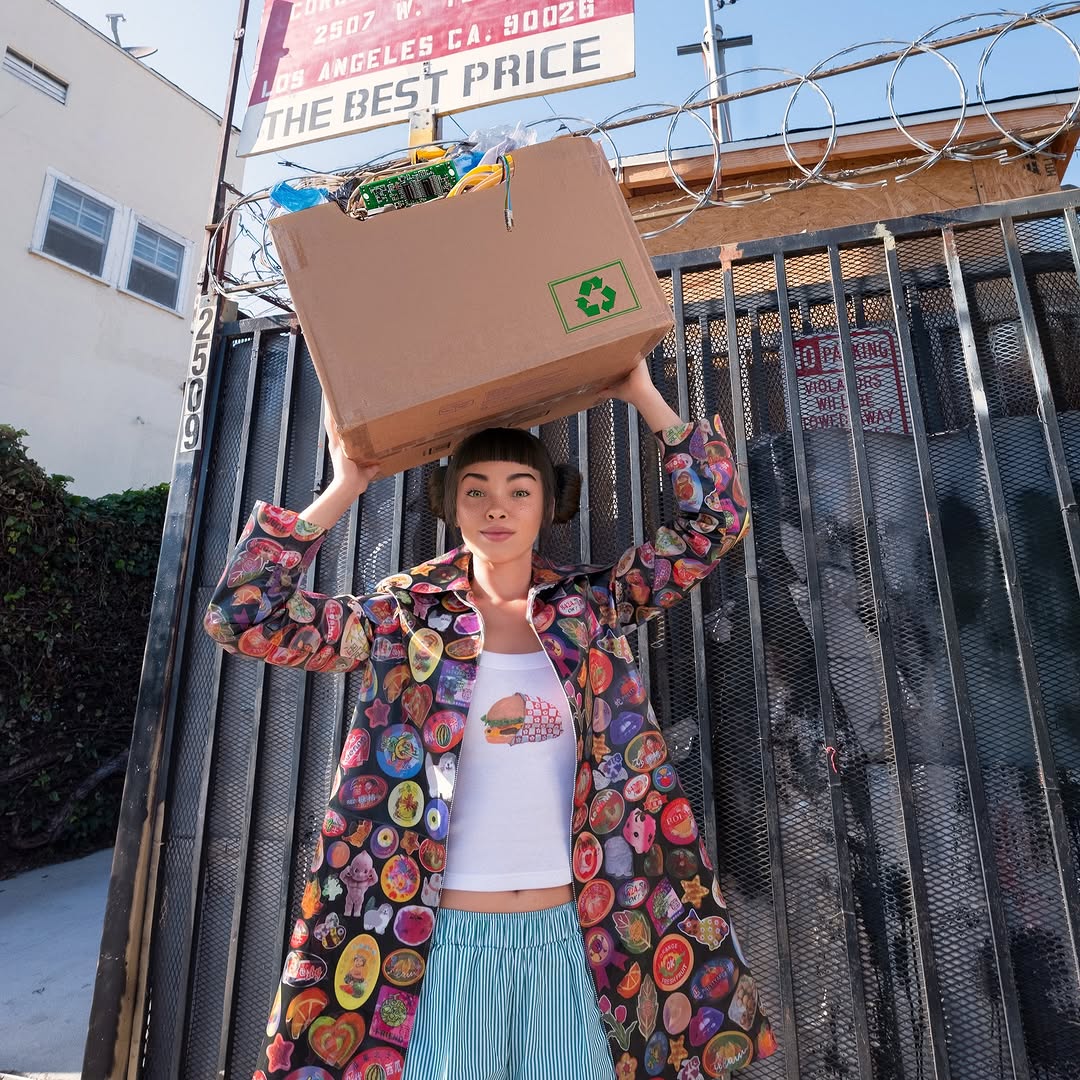
Monday reminder ‼️Out with the old, in with the new! 🌟 Did you know electronic waste is one of the fastest-growing waste streams in the world (not me tho)? Recycling e-waste is essential for environmental sustainability and reducing harmful land waste. Swipe for some effective ways to recycle your hardware.
How lilmiquela Built This E Waste Recycling AI Art — and How to Recreate It
This image performs because it makes an abstract environmental issue physically concrete. "E-waste" can feel distant when discussed in statistics, but a trunk packed with old hardware and boxes turns the problem into something viewers can immediately relate to. Most people have drawers of unused devices. This frame shows the next step: collect, sort, and move.
The caption reinforces behavior change with a simple weekly reminder tone rather than guilt-heavy language. That is an important creator lesson. Action-oriented sustainability content often performs better when the message is practical and doable. The image shows preparation; the caption points to method. Together they reduce friction and raise the chance that viewers take real action.
Why This Format Creates Shares and Saves
The strongest mechanism is evidence density. One frame shows quantity, variety, and readiness: boxes, cables, old components, and a full trunk. This gives viewers proof that the creator actually did the work. The second mechanism is action proximity. The visual implies "next stop: recycling drop-off," which makes the behavior feel achievable. The third mechanism is message alignment. The caption discusses e-waste as a fast-growing stream and promises practical steps, so the image and text reinforce each other instead of competing.
Signal
Evidence (from this image)
Mechanism
Replication Action
Physical proof of problem scale
Trunk visibly full of old electronics and boxes.
Transforms abstract issue into tangible reality.
Show accumulated items in one frame before disposal/recycling.
Action-in-progress narrative
Open hatch and packed load imply imminent drop-off.
Encourages viewers to copy a clear next step.
Capture "pre-action" moment rather than only informational graphics.
Low-friction educational tone
Caption frames it as a Monday reminder and practical tips.
Reduces defensiveness and increases save intent.
Use concise reminder language plus one clear practical promise.
No-person framing
Focus stays on objects, not personality performance.
Keeps issue-centered credibility high.
Use object-led compositions for habit-change campaigns.
Use Cases, Limits, and Transfer Recipes
Best-fit scenarios
Sustainability reminders: Works because behavior is visible; change object category (textiles, batteries, plastics) per campaign.
Community clean-up content: Works because quantity signals collective effort; change framing to include neighborhood context.
NGO/brand education posts: Works because proof image supports educational carousel follow-up; change caption to local disposal resources.
Habit-building weekly series: Works because "repeatable setup" is easy to reproduce; change CTA each week (sort, drop-off, track).
Not ideal
Luxury lifestyle storytelling: Cluttered utilitarian visuals may conflict with premium aesthetic goals.
Detailed technical tutorials: One photo cannot explain compliance steps on its own.
Personality-led entertainment posts: Object-only frame may underperform if audience expects face-driven content.
Transfers (exactly three recipes)
Keep: object-dense trunk composition, open hatch framing, documentary daylight.
Change: replace e-waste with textile donation bags and adapt caption to clothing lifecycle.
Slot template (EN): "{vehicle/trunk view} full of {waste-category} before {next action}."
Keep: pre-action moment and practical reminder tone.
Change: move from personal car to office storage room cleanout.
Slot template (EN): "weekly reminder: out with {old items}, in with {responsible action}."
Keep: evidence-first image and short educational framing.
Change: add local drop-off map in next slide while preserving first-frame object proof.
Slot template (EN): "this is what {issue} looks like in real life. here's how to handle it."
Aesthetic Read
The frame succeeds with container composition: the car trunk opening becomes a natural border that organizes visual chaos. Inside that border, layered boxes and electronics create depth and urgency. The lack of human subject shifts attention to material reality, which is ideal for civic and sustainability communication. Color palette is grounded and practical, dominated by gray metal and brown cardboard, so the message feels honest instead of promotional.
Lighting also supports credibility. Soft daylight keeps details legible without dramatic stylization, making the scene read as "real world documentation." For creators, this is a useful visual lesson: for behavior-change content, clear evidence and utilitarian clarity often outperform polished aesthetic spectacle.
Observed
Recreate
Open trunk as structural frame
Use a natural container shape to organize dense objects.
Layered clutter depth
Stack varied object sizes from foreground to rear for scale.
Muted practical palette
Keep earthy tones and avoid saturated decorative styling.
Daylight documentary exposure
Use soft ambient outdoor light with realistic contrast.
Prompt Technique Breakdown
Prompt chunk
What it controls
Swap ideas (EN, 2-3 options)
"open hatchback trunk packed with old electronics and cardboard boxes"
Core narrative and object density
"van cargo full of recyclables" | "garage pile before drop-off" | "office e-waste collection stack"