How maria-kallevik Made This Split Screen Colossal Dragon Concept Breakdown — and How to Recreate It
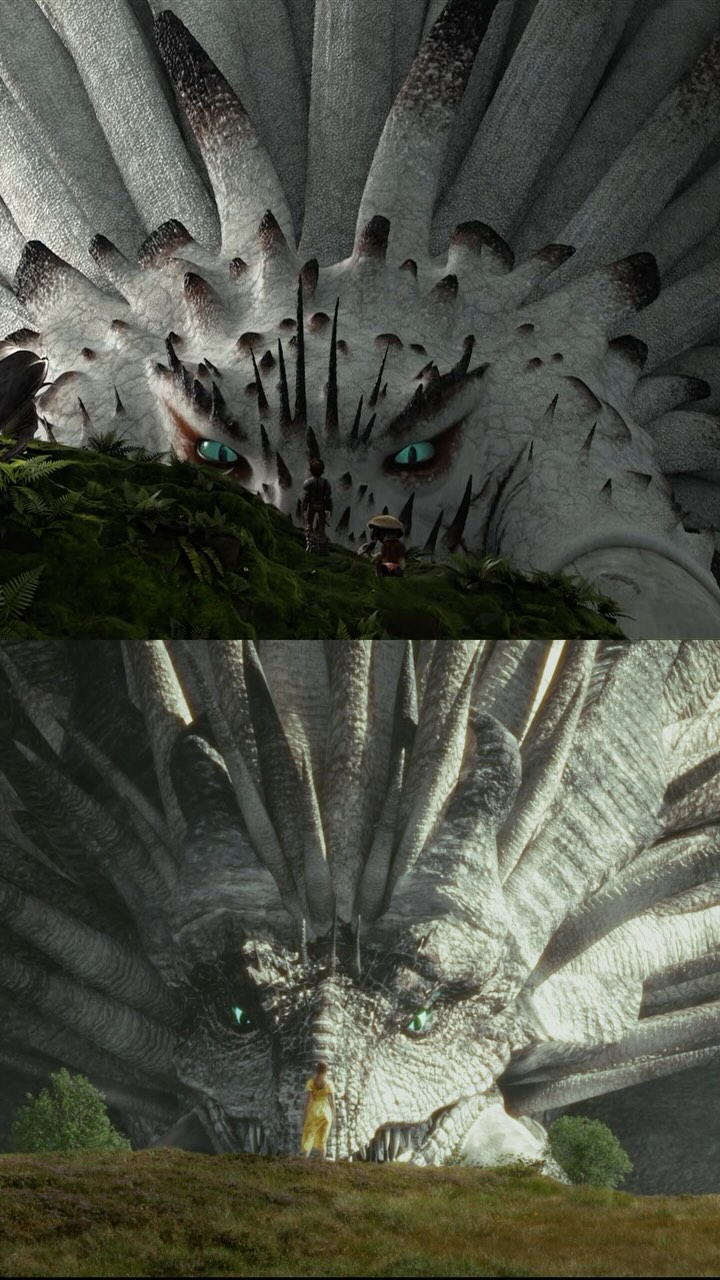
This image works because it understands that scale can be more frightening than motion. The dragon does not need to fly, breathe fire, or destroy a city. It only needs to look at you. By using two related compositions, one partially hidden and one fully confronted, the image turns pure size and stillness into the central spectacle.
Why the Two-Panel Structure Matters
The top panel creates suspense. The dragon is not fully shown, which makes the viewer focus on the eyes, the strange spine crown, and the implied size behind the hill. This is the “something ancient is watching” frame. The lower panel then pays that off by revealing the creature’s frontal mass and placing a tiny human in front of it. This is the “now you understand the scale” frame.
Using both together creates a stronger effect than either one alone. One panel gives mystery. The other gives confirmation. This is a very effective concept-art strategy when the goal is creature awe rather than action spectacle.
Signal Table
| Signal | Evidence (from this image) | Mechanism | Replication Action |
|---|---|---|---|
| Monumental scale | Tiny human figure in front of the fully revealed dragon | Human-to-creature proportion makes the monster feel truly immense | Always include a scale reference when designing colossal creatures |
| Mystery | Upper panel shows only part of the dragon behind a hillside | Partial reveal increases tension and curiosity | Use one concealed-angle frame before the full reveal |
| Creature uniqueness | Radiating spine crown and dark facial markings | Distinct anatomy keeps the dragon from feeling generic | Design one unforgettable silhouette feature beyond wings and teeth |
| Emotional focus | Teal glowing eyes dominate both panels | The eye color anchors the viewer’s gaze and adds sentience | Choose one controlled accent color for the creature’s most expressive feature |
| Quiet menace | No battle, no fire, no chaos, only looming presence | Stillness makes the creature feel ancient and self-assured | Resist adding action when scale and gaze are already enough |
Aesthetic Read
This image belongs to the “mythic creature dossier” branch of fantasy art, where the emphasis is on creature design and awe rather than narrative clutter. It feels closer to premium game concept art or a creature reveal for a prestige fantasy film than to a conventional dragon battle poster.
The white body is an important decision. Most dragons in mass fantasy culture default to red, black, or fire-associated palettes. Here, the pale body and dark markings create a colder, more ancient presence. The dragon feels less like an attack machine and more like a mountain-born intelligence.
The radiating spine crown is also doing major work. It transforms the silhouette from “big reptile head” into something icon-like, almost sacred and monstrous at the same time. That single anatomical decision gives the creature its identity.
Prompt Technique Breakdown
| Prompt chunk | What it controls | Swap ideas (EN, 2–3 options) |
|---|---|---|
| colossal white dragon with teal eyes and radiating spine crown | Main creature identity and silhouette uniqueness | ashen leviathan with horn fan; pale bone dragon with finned crest; moon-scaled behemoth with ribbed halo spines |
| upper panel hidden behind mossy ridge | Mystery, suspense, and reveal pacing | creature behind fog bank; eyes above a cliff edge; monster emerging behind dunes |
| lower panel with tiny yellow-clad human | Scale logic and emotional confrontation | single traveler in red cloak; lone knight silhouette; child-sized explorer in pale gold robe |
| soft overcast mythic landscape | Tonal restraint and serious fantasy mood | misty highland plain; clouded tundra field; muted alpine fantasy terrain |
| high-end creature concept art | Rendering family and anti-cartoon quality | AAA game creature design; prestige fantasy key art; cinematic bestiary illustration |
| split-screen reveal and confrontation layout | Comparative storytelling structure | before-and-after reveal format; moodboard-to-payout layout; suspense panel plus scale panel |
| quiet menace with no battle elements | Emotional tone and anti-spectacle control | ancient stillness; sacred-beast calm; motionless mythic threat |
Why This Formula Is Reusable
This formula is reusable because it separates creature design from plot. Instead of needing a full action scenario, it only needs three elements: a strong silhouette, a landscape that can hold scale, and one human reference point. That makes it ideal for concept portfolios, moodboards, creature reveal posts, or pre-production worldbuilding decks.
It is also useful because the split structure lets creators show process without explaining process. One frame can suggest atmosphere, while the other proves design clarity. That is valuable for fantasy creators who want to display both mood and readability in one image.
Remix Playbook
Version 1: Desert leviathan. Replace the mossy hill with dune terrain and shift the white scales toward bone-sand tones while keeping the split reveal logic.
Version 2: Forest god-beast. Turn the spine crown into bark-like antlers, swap the teal eyes for amber, and place a lone druid in front for a woodland variation.
Version 3: Frozen titan version. Keep the pale palette, but introduce snow haze and icy fractures along the scales for a colder creature mythology.
Version 4: More hostile version. Keep the same split layout, but let the bottom panel bring the dragon’s mouth slightly open and the human figure stand closer for more immediate danger.
Execution Advice
If you want this kind of creature concept to work, do not rely on “big dragon” as the whole idea. Size alone is not design. The creature needs a clear silhouette language, and in this image that language comes from the radial spines and dark facial markings.
Also avoid overloading the scene with fantasy clichés. Fire, lightning, armies, and ruined castles would reduce the image’s intelligence. The concept is stronger because it trusts stillness, shape, and proportion.
Finally, always give the viewer one point of emotional orientation. Here, that point is the tiny human in yellow. Without that figure, the dragon would still be impressive, but not as comprehensible. Scale needs a witness.