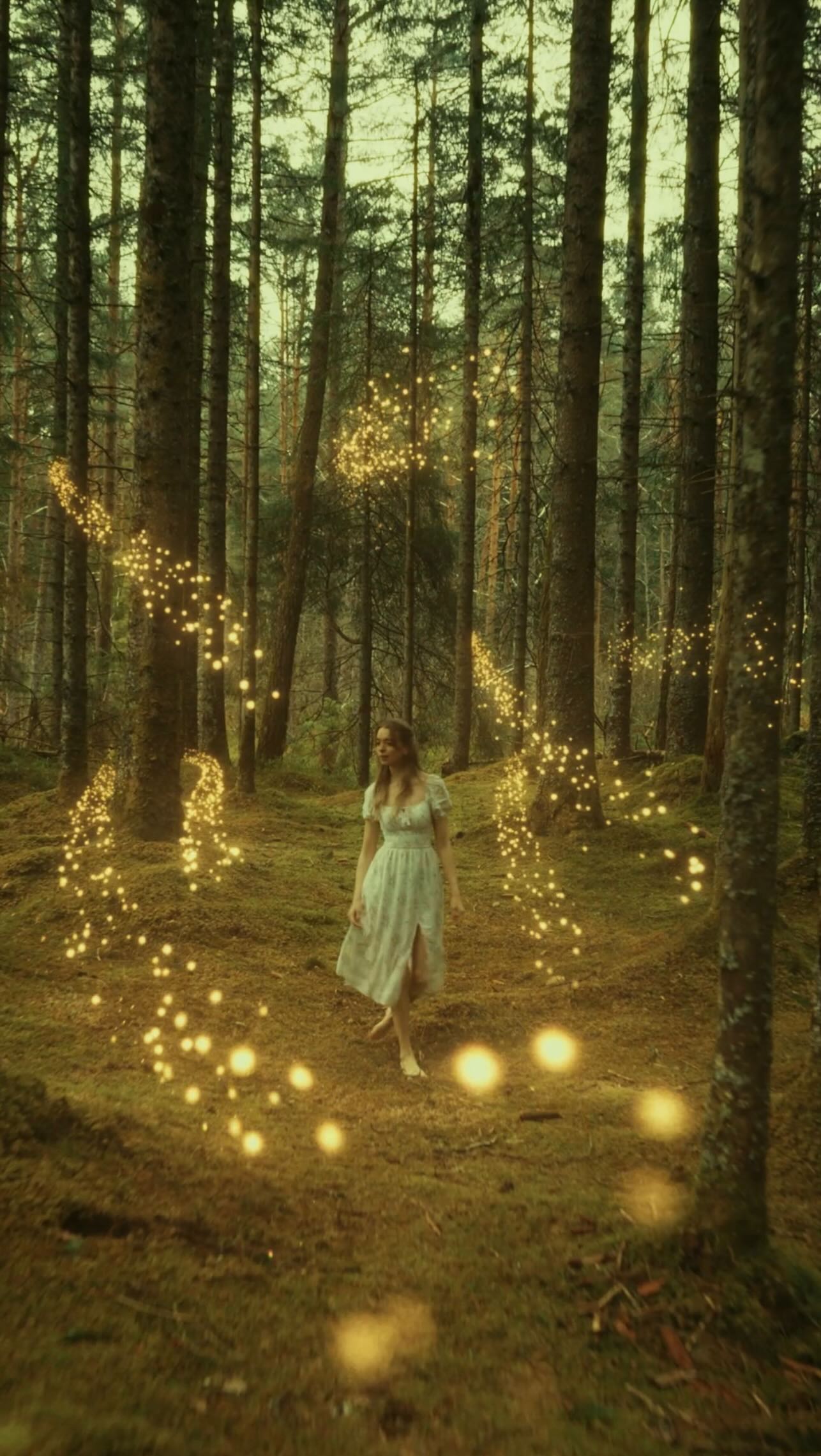
This image works because it understands that enchantment can be directional. The glowing particles are not scattered randomly across the forest. They move. They form pathways, arcs, and ribbons that guide the eye from foreground to background and from ground level into the trunks. That movement is what transforms the scene from a simple woodland portrait into a magical journey image. The lights do not decorate the forest. They animate it.
The strongest choice is the scale relationship between the woman and the trees. She is present, but she does not dominate. That matters because wonder depends on proportion. If the figure were too large, the image would become a dress portrait with some fantasy garnish. By keeping her relatively small and allowing the forest to remain architecturally powerful, the image preserves the sensation that she is passing through a world larger and older than herself.
| Signal | Evidence (from this image) | Mechanism | Replication Action |
|---|---|---|---|
| Guided eye flow | The golden lights curve from the foreground into the deep forest | Motion lines create visual narrative and help the viewer travel through the frame | Use magical particles as directional pathways, not as random decorative noise |
| Wonder through scale | The woman is small relative to the vertical tree trunks | Environmental dominance makes the setting feel enchanted and immersive | Keep the human subject smaller when the world itself is part of the story |
| Warm-cool tension | The forest is muted and cool while the lights glow warmly | Limited accent warmth gives magic more impact | Build the base scene in restrained natural tones, then let one magical color carry the emphasis |
| Quiet fantasy tone | There are no props, creatures, or dramatic effects beyond the light trails | Restraint keeps the image lyrical instead of noisy | Limit magical scenes to one core phenomenon when aiming for dreamlike elegance |
The vertical trunks are also doing compositional labor. They act almost like columns in a cathedral, giving the woods a sense of order and solemnity. That order is important because it makes the gold light trails feel even more alive by contrast. Straight trunks and drifting arcs are a productive visual tension. One side is rigid and ancient; the other is fluid and magical.
| Observed Style Choice | What It Does | Why It Matters |
|---|---|---|
| Muted forest grading | Keeps the natural setting subdued and believable | Allows the magical lights to become the unmistakable focal event |
| Golden particle ribbons | Turn static space into a visible path of wonder | Creates both mood and compositional direction at once |
| Simple pale dress | Keeps the human figure soft and unobtrusive | Supports the fairytale mood without demanding attention from the environment |
| Soft-focus atmosphere | Removes harsh realism and adds storybook softness | Makes the image feel remembered or dreamt rather than merely photographed |
From a prompt-engineering perspective, the key is to describe the lights as flowing structures rather than isolated sparks. Many weak fantasy prompts ask for “fireflies” or “glowing particles,” which often results in undirected glitter. Here, the power comes from choreography. The lights create curves, routes, and visual invitation. The forest is not simply illuminated; it is being traversed by magic.
| Prompt Technique | Use In This Image | Practical Benefit |
|---|---|---|
| Motion-shape prompting | The golden lights are described as trails and ribbons, not dots | Produces a more legible and poetic magical effect |
| Environment-first framing | The forest remains architecturally important, not just a backdrop | Preserves immersion and scale |
| Restraint in fantasy elements | No extra magical props or creatures compete with the light phenomenon | Keeps the scene elegant and emotionally clear |
| Subject-scale control | The woman is protected as a small figure within a larger world | Maintains wonder and prevents the image from flattening into fashion portraiture |
If you iterate on this kind of image, preserve the relationship between path, particles, and trunks before changing anything else. You can experiment with stronger mist, warmer sunset, or a different dress silhouette later, but the enchanted guidance effect must remain intact. That is the scene’s core idea. Remove it, and the image becomes just another woman-in-forest fantasy frame.
The broader lesson is that magical realism often feels most convincing when the supernatural element behaves like part of the environment’s geometry. In this image, the fairy lights are not pasted on top of the woods. They move through the woods as if the forest itself is thinking. That is why the frame feels quietly transporting instead of merely decorative.