▶
In a creative mood lately... Here’s my brand new ballad Where I Begin — gentle, melancholic, and straight from the soul. What do you feel when you hear it? 💫🎵
In a creative mood lately... Here’s my brand new ballad Where I Begin — gentle, melancholic, and straight from the soul. What do you feel when you hear it? 💫🎵
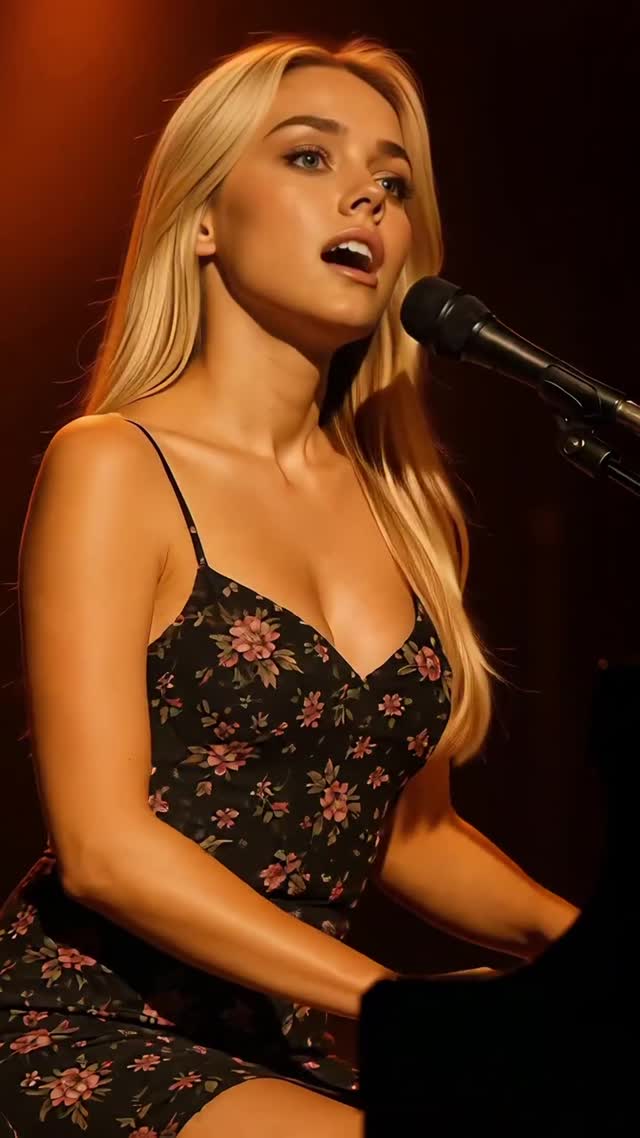
This is a 15-second, vertical (9:16) “live performance” micro-clip: one singer at a microphone, seated at a piano, shot in warm amber stage light against a dark, hazy background. The whole post is built around a single idea: let the voice be the hook, then make it instantly readable with bold lyric captions (ALL CAPS, white text with heavy black outline, with one keyword highlighted in yellow as the emotional punch). The camera language is simple and premium: telephoto portrait framing, shallow depth of field, stable tripod, and a subtle push-in that makes the viewer feel closer without distracting from the performance.
The caption context (“new ballad… gentle, melancholic… what do you feel?”) matches what you see: a clean, intimate stage moment with minimal visual noise. That alignment matters for Instagram Reels discovery because viewers can understand the “genre” in under one second: singer-songwriter ballad, emotional, authentic. For small creators, this is a high-leverage format because you don’t need fast cuts or complicated scenes. You need (1) a believable performance moment, (2) consistent lighting, and (3) subtitles that reduce listening effort and reward replays. Keywords you can naturally target: AI singer video prompt, lyric captions, warm stage lighting, piano performance reel, ballad reel, UGC music clip.
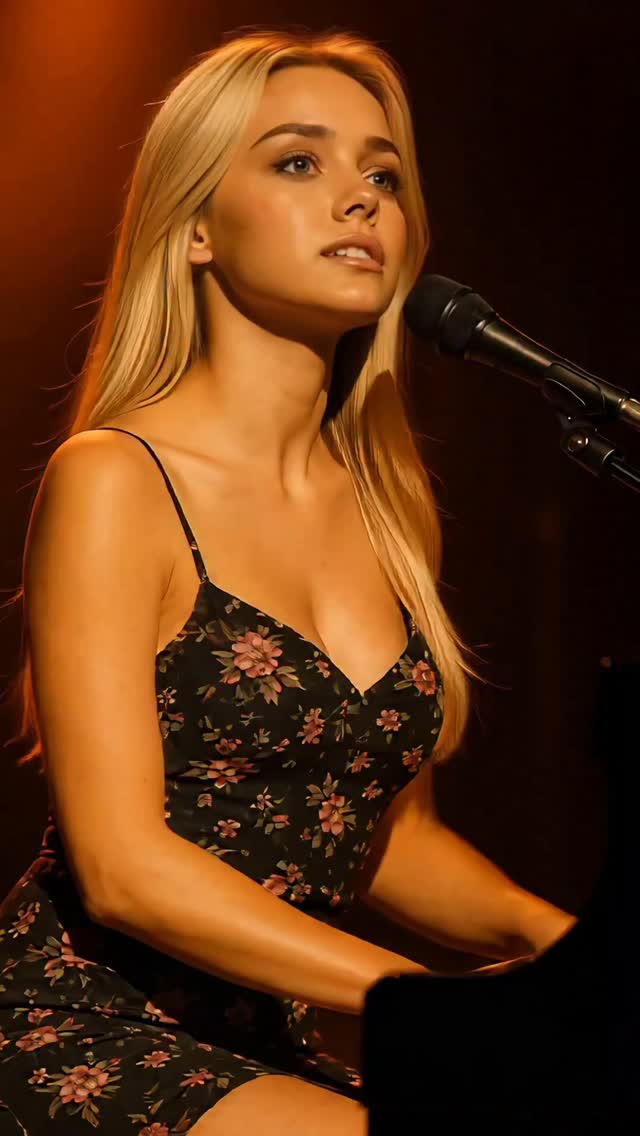
One performer fills most of the frame. She sings into a side-address microphone on the right, with the piano edge visible in the lower-right. The background is intentionally empty and dark, with light haze that makes the spotlight feel soft and cinematic.
A black spaghetti-strap dress with a small floral pattern keeps the look “date-night elegant” without pulling attention away from the face. Hair is long and straight, center-parted; makeup is clean glam (defined brows, soft highlight, natural lip).
The framing is a medium-close to close-up with a telephoto portrait feel (roughly 70–100mm). It stays stable, with only a gentle push-in and tiny reframes as the singer turns her head. Shallow depth of field isolates the performer and keeps the stage “expensive.”
Everything is driven by warm amber/orange stage light from upper-left, with a soft rim on hair and shoulder. Highlights roll off smoothly; shadows stay clean. The grade reads like “warm stage film look” rather than harsh LED.
The captions are bold, centered low, and extremely readable: ALL CAPS white with a thick black outline. One keyword turns yellow as the emotional emphasis lands. This design turns a music clip into a “watch + read” loop, which helps watch time even for viewers who can’t play audio.
| Time range | Visual content | Shot language (framing / focal-length feel / movement) | Lighting & color tone | Viewer intent |
|---|---|---|---|---|
| 00:00–00:03 | Singer begins the ballad at the mic; intimate facial expression, minimal background. | MCU/CU, telephoto portrait feel, stable tripod, subtle push-in. | Warm amber key with soft haze; dark stage backdrop. | Instant genre recognition; “stop the scroll” with a human face + voice moment. |
| 00:03–00:06 | First bold lyric caption hits; one keyword highlighted in yellow. | Same angle, micro reframe as she sings; captions anchor attention low. | Same warm grade; smooth highlight rolloff on cheekbones. | Lower comprehension cost; reward viewers who keep watching. |
| 00:06–00:09 | Caption updates; slightly more side-profile as the microphone becomes more prominent. | CU, telephoto feel, no distracting camera shake. | Amber rim on hair; background stays near-black. | Create emotional “turn” and keep attention through change (new words). |
| 00:09–00:12 | Peak phrase; mouth opens wider on a stronger note; highlighted keyword lands. | CU, tiny push-in; emphasis synchronized to caption highlight. | Warm bloom on skin; controlled contrast. | Retention spike: viewers wait for the emphasized word/note. |
| 00:12–00:15 | Resolve phrase; final caption lands near the end; soft facial release. | Hold steady; let performance finish cleanly. | Consistent amber palette; no background distractions. | Loop-friendly ending; encourages rewatch to “feel it again.” |
Why this mix works: broad tags help discovery, mid-tier tags align to the viewer’s “music clip” intent, and long-tail tags match the exact visual mechanic (stage light + lyric captions), which is what people save as reference.
Use a model/workflow that supports consistent identity across frames, realistic skin texture, and stable text overlays without flicker.
Lock the camera angle and lens feel, then reuse a reference sheet for face angles and keep the mic position fixed in every keyframe.
“Warm amber spotlight,” “telephoto close-up,” and “bold lyric captions” are the three anchors that create the signature.
Captions should be added in post (or constrained with a stable overlay system) instead of being re-generated per frame by the video model.
Prioritize consistent skin texture, stable lighting direction, and remove “too perfect” background details by keeping the stage simple and dark.
Instagram often rewards “aesthetic + emotion” loops, while TikTok can reward longer payoff—test both with the same first-second hook and captions.
Disclose clearly in the caption or pinned comment, especially if you’re using an AI-generated face/voice, and avoid implying a real live recording.