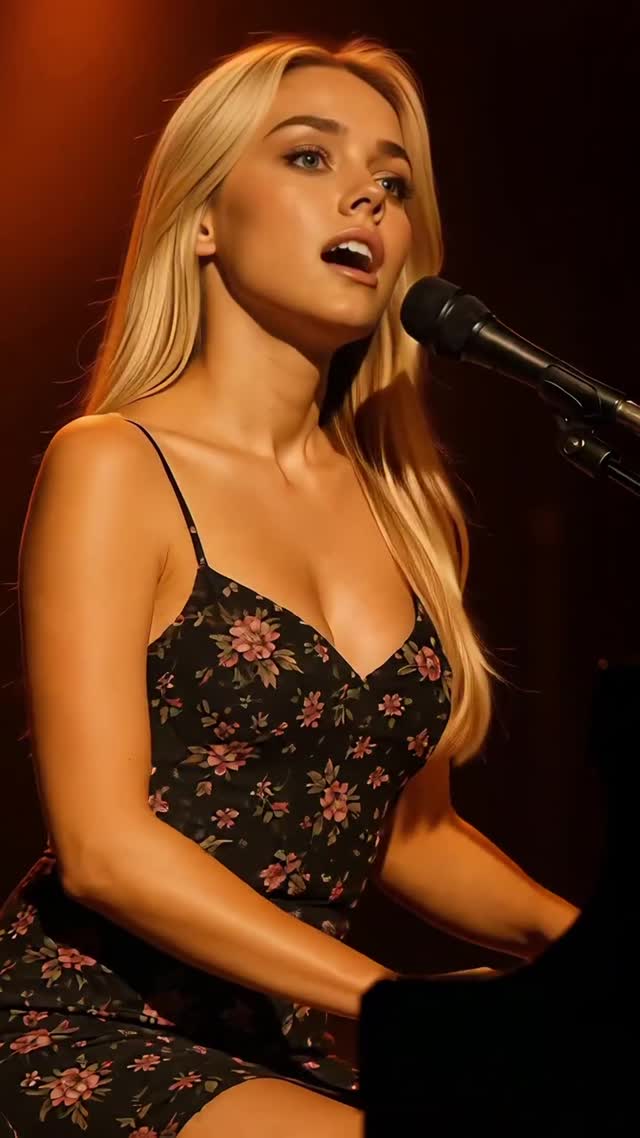
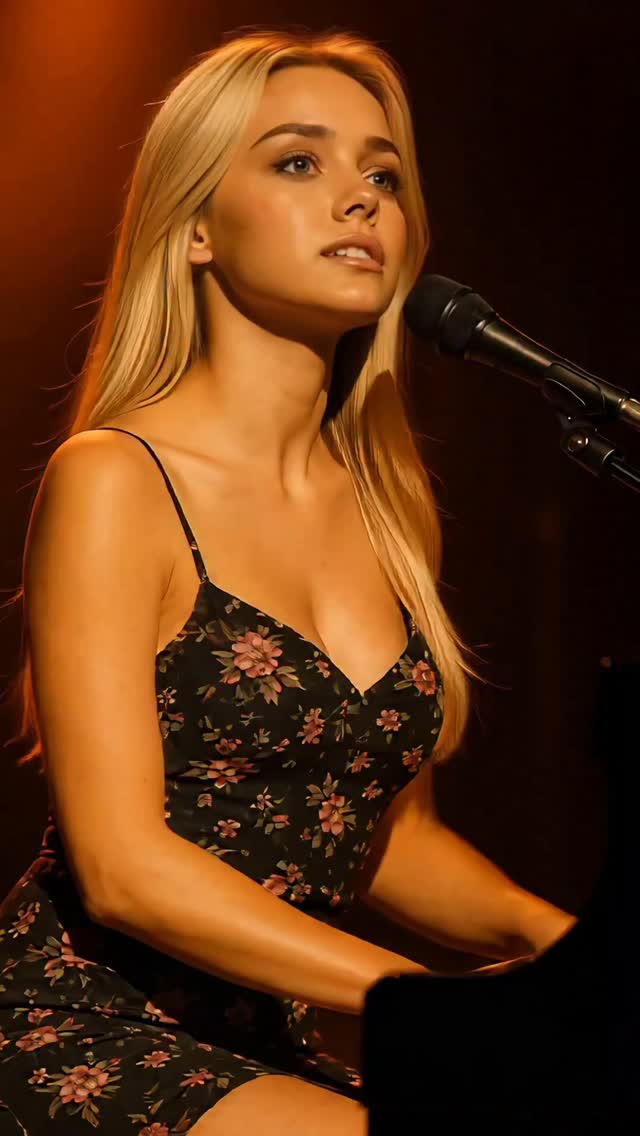
In a creative mood lately... Here’s my brand new ballad Where I Begin — gentle, melancholic, and straight from the soul. What do you feel when you hear it? 💫🎵
In a creative mood lately... Here’s my brand new ballad Where I Begin — gentle, melancholic, and straight from the soul. What do you feel when you hear it? 💫🎵
This image gains strength from instrument context. The piano in the foreground immediately signals musicianship depth, which often increases credibility compared with generic vocal-only portraits.
The styling stays elegant but understated: warm stage light, floral dress detail, and a compact composition. For creators, this is a reliable format for positioning yourself as both performer and songwriter.
| Signal | Evidence (from this image) | Mechanism | Replication Action |
|---|---|---|---|
| Instrument credibility cue | Piano body visible while singer performs into mic | Signals musical depth and authenticity | Include one clearly readable instrument edge in frame |
| Warm emotional stage tone | Amber lighting with dark background separation | Creates intimate concert mood | Use warm key and keep background one to two stops darker |
| Wardrobe personality detail | Subtle floral pattern on black dress | Adds character without visual overload | Use one restrained pattern rather than loud prints |
| Tight narrative framing | Face, mic, and piano fit in a compact vertical layout | Fast comprehension improves watch retention | Build a face-instrument-texture triangle in the composition |
Transfer 1: Midnight jazz variant
Keep: seated piano + vocal composition, warm-dark background structure.
Change: wardrobe to deep burgundy velvet and softer rim light.
Slot template (EN): {seated singer at piano} {warm low-key stage} {single microphone} {elegant patterned outfit}
Transfer 2: Daylight studio acoustic variant
Keep: face-mic-piano triangle composition.
Change: stage darkness to bright studio window light.
Slot template (EN): {pianist-singer close frame} {daylight studio} {minimal background} {clean wardrobe texture}
Transfer 3: Cinematic theater variant
Keep: instrument anchor and emotional open-mouth vocal moment.
Change: add subtle haze and deeper amber back practicals.
Slot template (EN): {vocal piano portrait} {theater amber haze} {focused expression} {vertical editorial crop}
This frame succeeds through tonal discipline. Warm skin highlights and hair tones are balanced against dark piano mass and low-key background, creating depth without clutter. The floral pattern adds a gentle narrative detail, making the look personal rather than generic stagewear. The microphone line and piano edge guide the eye toward the singer’s mouth, reinforcing the vocal moment. Because composition is tight, the viewer receives clear context quickly: this is a live musical performance, not a styled portrait alone. For creators, this structure is highly reusable: keep one instrument anchor, one warm light recipe, and one expressive vocal moment per shot.
| Prompt chunk | What it controls | Swap ideas (EN, 2-3 options) |
|---|---|---|
| "seated blonde singer-pianist, open-mouth vocal expression" | Narrative role and emotion | "eyes-closed soft note" / "smiling phrase" / "intense high note" |
| "black floral fitted dress" | Wardrobe personality and texture | "solid black satin" / "burgundy velvet" / "cream lace dress" |
| "black piano foreground" | Instrument context and frame structure | "grand piano edge" / "upright piano" / "keyboard stand" |
| "warm amber low-key background" | Mood and contrast | "cool blue lights" / "neutral studio gray" / "purple stage glow" |
| "right-side microphone alignment" | Performance clarity and directional focus | "left-side mic" / "center stand mic" / "handheld mic" |
Baseline Lock: lock seated piano composition, lock mic proximity, lock warm low-key lighting.
One-change rule: change one variable each iteration.
This creates a coherent performance series while maintaining visual freshness.