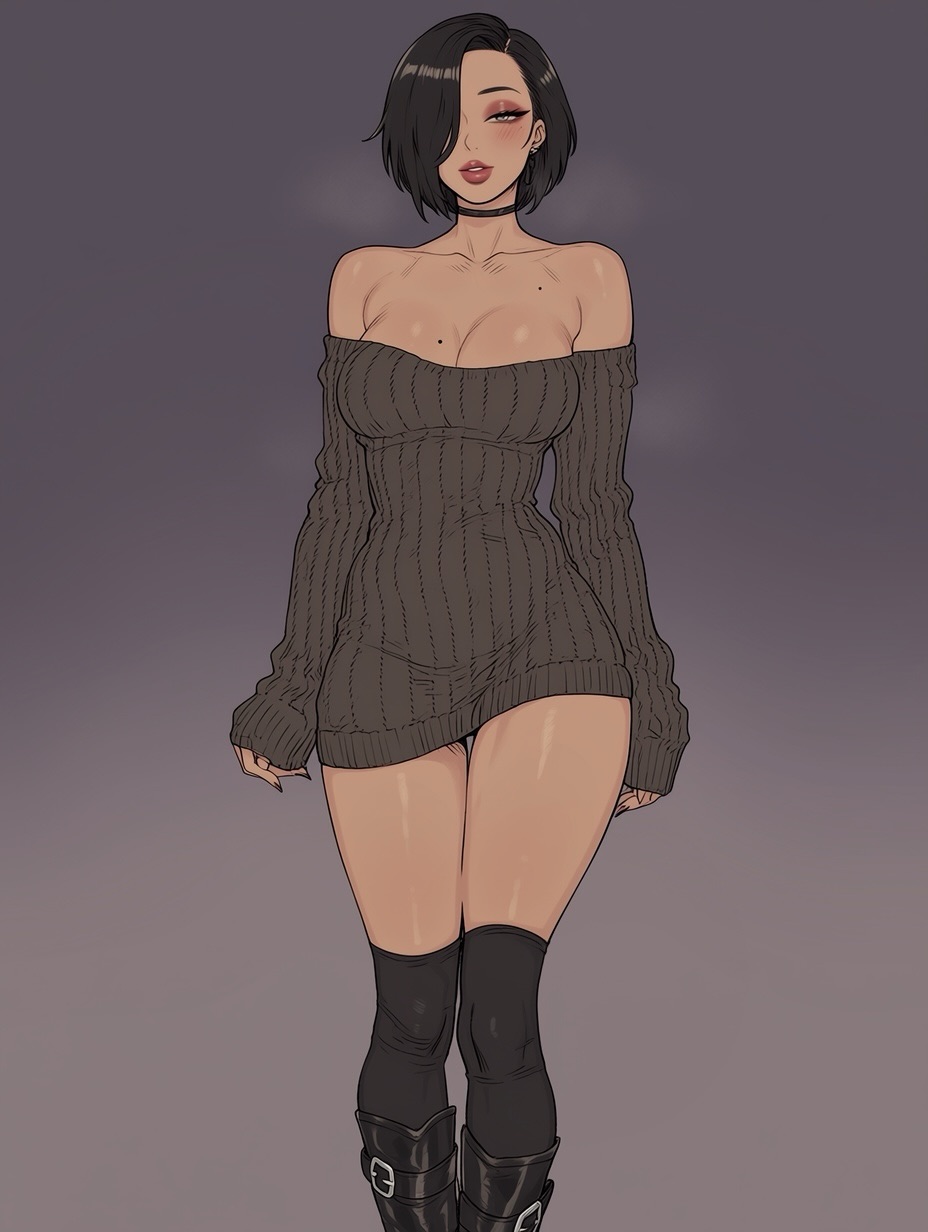
This image succeeds through understatement. There is no loud prop, no dramatic environment, and no aggressive styling twist demanding attention. Instead, it relies on proportion, texture, and color restraint. That can be harder to pull off than a louder concept because every small decision becomes more visible. When a simple portrait works, it is usually because the artist understands exactly which elements need to carry the frame.
Here, the main carriers are easy to spot: the short asymmetrical bob, the off-shoulder knit silhouette, the dark knee socks and boots, and the soft muted background. Each one adds structure without noise. Together they create a look that feels wearable, modern, and quietly stylized. For creators, this is a useful reminder that social-friendly fashion art does not always need a shock factor. Calm visual confidence can be its own hook.
The silhouette is doing most of the work. The exposed shoulder line widens the upper frame, the fitted dress narrows at the waist, and the dark socks plus boots anchor the lower half. That top-to-bottom rhythm helps the eye travel smoothly. It also makes the portrait feel taller and cleaner than it would with a busy pose or more accessories. In feed terms, it reads fast and it reads whole.
| Signal | Evidence (from this image) | Mechanism | Replication Action |
|---|---|---|---|
| Quiet silhouette control | The off-shoulder neckline, short bob, and fitted dress create a clean recognizable shape | Strong shape language lets a simple portrait stay memorable without extra props | Design the silhouette first before layering in accessories or scene detail |
| Muted palette consistency | Dress, background, and styling all stay inside a gray-taupe-black family | Palette restraint makes the portrait feel cohesive and mature | Choose a narrow tonal range and let contrast come from value, not color overload |
| Texture without clutter | The knit ribbing adds visual interest while the background remains soft and empty | One strong material texture can replace the need for a decorated environment | Use garment texture as the secondary focal point after the face |
It feels polished because nothing is trying too hard. The hair is short but not overstyled. The dress is sexy but not overloaded. The boots are present but not bulky. Even the background understands its role. It creates atmosphere without becoming a location. This kind of restraint is often what separates a good fashion illustration from a merely competent one. The artist knows when to stop adding.
The side-part bob is especially important. Long hair would have made the look softer and more generic. The short cut adds shape and attitude while still keeping the portrait approachable. It also opens more shoulder space, which helps the neckline become a stronger part of the composition.
| Observed | Why it matters for the look |
|---|---|
| Short black bob with one side covering part of the face | Adds modern edge and gives the portrait a sharper silhouette |
| Off-shoulder ribbed sweater dress | Builds clear upper-body shape while letting knit texture carry interest |
| Dark socks and buckle boots | Anchor the lower frame and keep the full-body composition visually balanced |
| Dusty mauve-gray gradient backdrop | Creates atmosphere without distracting from the styling |
| Low-contrast lighting | Supports the calm, understated fashion mood |
This style is less ideal for maximal streetwear, hyper-pop Y2K chaos, or dramatic story scenes. The image wins through restraint. Overloading it with props or loud color would break the balance that makes it effective.
Three transfer recipes are easy to build from this structure. Keep the clean full-body pose, the simple background, and the textured outfit logic. Change hairstyle, neckline, or footwear. Template one: {short hairstyle} + {textured mini dress} + {dark legwear} + {muted gradient backdrop}. Template two: calm fashion anime portrait, understated palette, full-body standing pose, knit texture focus. Template three: {modern casual archetype} lookbook portrait, plain atmospheric background, restrained rendering, clear silhouette.
To recreate this image well, write the prompt like a fashion lookbook page, not like a mood collage. The structure matters more than the adjectives. If silhouette, knit texture, and palette are not locked, the image will drift into something much more generic.
| Prompt chunk | What it controls | Swap ideas (EN, 2–3 options) |
|---|---|---|
| off-shoulder ribbed knit mini dress | Main silhouette and garment texture | turtleneck knit dress; fitted cardigan dress; off-shoulder sweater top and skirt |
| short side-parted black bob | Face framing and modern edge | dark brown bob; silver pixie cut; shoulder-length blunt cut |
| muted mauve-gray gradient background | Atmosphere without environmental clutter | soft beige gradient; cool gray studio fade; taupe seamless wall |
| dark knee-high socks and buckle boots | Lower-frame balance and outfit grounding | opaque tights and loafers; ankle boots; knee boots with soft socks |
| soft low-contrast studio lighting | Mood, skin softness, and understated finish | cloudy daylight style; diffused softbox lighting; even fashion studio light |
| clean anime fashion illustration | Medium identity and final polish | editorial manga lookbook art; soft cel-shaded outfit study; polished digital character render |
Lock three things first: the bob silhouette, the off-shoulder knit shape, and the muted background palette. Those controls define the entire image. After that, only change one or two knobs per run so the quiet balance stays intact.
The practical takeaway is that simple fashion portraits perform best when every visible choice supports one clean idea. Keep the silhouette strong, let one texture lead, and avoid clutter that adds complexity without adding value.