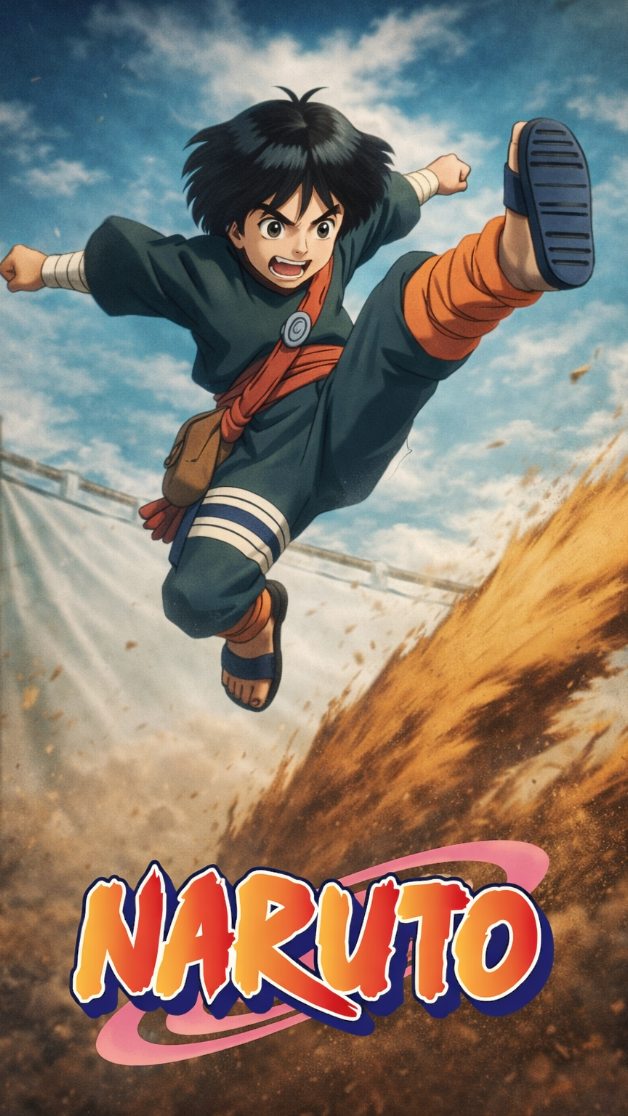
This image works because it understands one of the oldest action-poster truths: if the pose is strong enough, almost everything else can simplify. Rock Lee is not surrounded by complex effects, elaborate enemies, or a crowded battlefield. Instead, the image gives us one decisive act: a flying kick aimed almost straight through the frame. That single decision is enough to create excitement because the perspective does the heavy lifting. We do not just see the move. We feel like we are in the path of it.
The strongest viral mechanism here is extreme foreshortening. The sole of the foot pushes toward the viewer, and that instantly creates speed, youth, and impact. It also makes the image readable in a feed because the geometry is simple and bold. Even if someone only glances at the poster, they register motion immediately. For creators, this is a very useful lesson: strong action images often depend less on how many effects are present and more on whether one body part breaks toward the camera in a clear, dominant way.
The next thing that makes the image effective is that Rock Lee is the perfect character for this kind of poster. His entire identity is tied to physical effort, taijutsu, discipline, and velocity. So the image is not fighting against the character. It is amplifying his core trait. That matters. When you choose an action angle for fan art or promo-style work, it should match the character's inner logic. This low-angle kick feels inevitable for Rock Lee in a way it would not for every character in the same franchise.
| Signal | Evidence (from this image) | Mechanism | Replication Action |
|---|---|---|---|
| Impact perspective | The extended foot fills the foreground while the body hangs behind it | Foreshortening creates instant kinetic force and viewer engagement | Push one limb strongly toward the lens whenever the action needs to read at a glance |
| Character-match action | Rock Lee is shown in a pure physical kick with no extra powers | The move reinforces his identity rather than distracting from it | Choose an action that expresses the character's signature way of winning |
| Supportive environment | Blue sky and diagonal dirt burst frame the motion without clutter | Simple background elements reinforce direction and speed | Use one sky plane and one debris line instead of an overloaded combat setting |
| Readable shonen energy | Bright palette, open expression, clear silhouette, logo placement | The poster reads as youthful and promotional instead of chaotic | Keep action posters bright and legible when the target mood is classic shonen momentum |
Another reason the image succeeds is that the dirt burst on the right side is doing exactly enough and no more. It adds force, direction, and heat to the lower half of the frame, but it does not compete with the kick. This is an important action-illustration principle. Effects should echo the body, not overshadow it. The best motion support is the kind that makes the viewer believe the movement while still remembering the pose first.
How rioaigc Made This Naruto Rock Lee Air Kick Poster AI Art -- and How to Recreate It
- Character-specific action posters, because the pose can be built around one signature move.
- Anime promo thumbnails, because the silhouette and foot perspective remain readable at small sizes.
- Sports and martial-arts remixes, because the composition teaches impact and momentum clearly.
- Prompt studies on foreshortening, because the image is almost entirely powered by camera-body relationship.
This approach is less ideal for emotionally subtle character studies, ensemble scenes, or intricate magic battles where the main hook is environmental complexity. Its strength is focus. It wants one move, one body, one motion line.
Three Transfer Recipes
- Soccer-strike adaptation
Keep: low-angle foot dominance, airborne body, diagonal debris support.
Change: ninja kick to a bicycle kick or volley, dirt burst to turf spray.{athlete} launching {kick motion} toward camera under {bright sky} with {debris line} - Fantasy monk remake
Keep: pure physical attack, open sky, one main body action.
Change: green jumpsuit to monk wraps, dust burst to temple stone debris.{martial character} in {airborne kick pose} with {impact debris} and {heroic low angle} - Superhero jump poster
Keep: foreshortened limb, youthful momentum, bright poster clarity.
Change: kick to flying punch or knee strike, sky to city rooftop horizon.{hero} leaping toward viewer with {dominant foreground limb} in {clean action poster layout}
Aesthetically, the image is disciplined in exactly the right places. The background is mostly sky, which keeps the character isolated. The dirt spray gives warmth and force to the lower right, preventing the frame from feeling too empty. The costume colors are simple and recognizable. Even the logo placement at the bottom is useful: it closes the poster and gives the whole image the feel of a promotional still rather than a random fan crop. This is what good pop-anime design often does. It keeps the message extremely clear.
| Observed Style Choice | Why It Works Here | How To Recreate It |
|---|---|---|
| Foreground foot emphasis | Makes the kick physically felt by the viewer | Use extreme perspective on the leading limb, not the face |
| Blue-sky backdrop | Gives clean contrast and keeps the frame energetic | Choose a simple bright sky when the action pose should dominate |
| Diagonal earth burst | Supports movement direction and visual rhythm | Add one directional debris element that echoes the attack line |
| Classic outfit fidelity | Keeps the character instantly recognizable | Preserve the most iconic costume blocks even in dynamic perspective |
| Bright logo lockup | Pushes the image toward official-poster readability | Anchor the bottom with one branded or typographic element |
From a prompt-engineering perspective, this image proves that “Rock Lee kicking” is too general. To get this kind of result, you need to specify the kick direction, the camera height, the dust line, the lack of chakra effects, and the bright sky-backed readability. These are the real control points. Without them, the model may produce generic action instead of a clear shonen-impact pose.
| Prompt chunk | What it controls | Swap ideas (EN, 2–3 options) |
|---|---|---|
| Rock Lee flying kick toward camera | Core action identity and kinetic hook | midair side kick, descending heel strike, aerial taijutsu attack |
| low-angle shonen poster framing | Viewer relationship and force amplification | worm's-eye sports angle, upward hero shot, low-action promo frame |
| blue sky and cloud field | Clarity and energy in the background | arena sky, open training field, bright rooftop horizon |
| diagonal dust burst | Movement reinforcement and directional rhythm | sweeping sand spray, stone-chip arc, speed debris trail |
| no chakra, pure taijutsu impact | Character fidelity and thematic focus | physical martial arts only, body-driven action, grounded athletic attack |
Execution Playbook
Lock three things first: the kick perspective, the low-angle camera, and the simple sky-versus-dust environment split. Those are the pillars. After that, follow a one-change rule so the pose stays clean.
- Run 1: lock the airborne kick with the front foot dominating the frame.
- Run 2: refine only facial intensity, hair shape, and eyebrow identity.
- Run 3: tune only the dirt burst angle and debris density.
- Run 4: adjust costume folds, logo placement, and sky brightness without changing the pose.
The larger lesson here is that high-energy anime imagery does not always need more effects. Often it needs better geometry. This poster works because the body, the camera, and the debris all agree on one direction. That unity is what creates impact. For creators, that is the real benchmark: if you remove every extra effect, does the pose still hit? In this image, absolutely yes.