0:00 / 0:00
▶
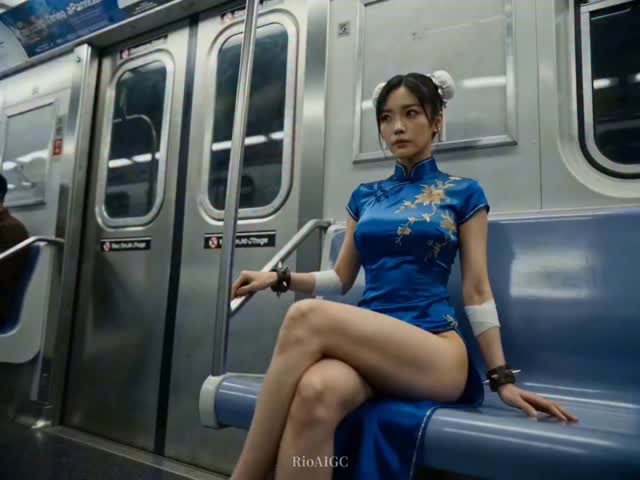
This viral sensation by @rioaigc is a masterclass in "Hyper-Realistic IP Reimagining." It features a cinematic, live-action-style brawl between two iconic Street Fighter characters—Chun-Li and Zangief—set within the gritty, mundane environment of a New York-style subway car. The video leverages high-fidelity AI generation to blend the fantastical elements of video game combat (glowing effects, superhuman strength) with the grounded textures of a real-world setting. With over 89,000 likes, it proves that high-production-value "fan fiction" created with AI is a massive growth lever for indie creators.
The video opens with a high-tension shot of Chun-Li seated on a blue subway bench. The lighting is cool and fluorescent, typical of public transit, which makes her vibrant blue silk cheongsam and gold embroidery pop. The texture of her outfit, the bandages on her arms, and the intricate "odango" buns are rendered with startling clarity. Zangief enters the frame as a massive, hyper-muscular force of nature, his skin showing realistic sweat, hair, and battle scars.
The action is fast-paced, utilizing a "shaky cam" handheld aesthetic to increase the sense of realism and urgency. You see sparks fly when Zangief strikes the metal poles, and the environment reacts—windows shatter, and the train wall eventually buckles under the force of the final blow. The color palette shifts from the sterile blue/grey of the train to warm, fiery oranges during Zangief's "glowing hand" attack, creating a dynamic visual contrast that keeps the viewer engaged.
| Time Range | Visual Content | Shot Language | Lighting & Tone | Viewer Intent |
|---|---|---|---|---|
| 00:00–00:02 | Chun-Li sitting calmly on a subway bench. | Medium Shot (MS), Static | Cool fluorescent, cinematic | Hook: Establish character and high-fidelity visuals. |
| 00:02–00:05 | Zangief bursts through the doors; passengers flee. | Wide Shot (WS), Dynamic | High contrast, shadows | Escalate: Introduce conflict and scale. |
| 00:05–00:12 | The fight begins; punches and blocks exchanged. | Close-ups (CU) & Medium Shots | Fast flickering lights | Engagement: Show choreography and detail. |
| 00:12–00:18 | Zangief performs a massive slam/pile-driver. | Low Angle, Tracking | Motion blur, grit | Peak Tension: The "hero in peril" moment. |
| 00:18–00:25 | Chun-Li recovers and delivers rapid-fire kicks. | Medium Shot, High Speed | Blue/Gold highlights | Payoff: Iconic character move execution. |
| 00:25–00:30 | Final kick sends Zangief through the train wall. | Wide Shot, Impact Frame | Debris, smoke, cool tone | Resolution: Satisfying conclusion and "wow" factor. |
The primary driver of this video's success is IP (Intellectual Property) Arbitrage. By taking characters that millions of people already love and placing them in a "forbidden" or "impossible" context (a hyper-realistic subway fight), the creator bypasses the need to build an audience from scratch. The "Uncanny Valley" effect works in favor here; the characters look just real enough to be shocking, but just stylized enough to remain recognizable as their game counterparts.
From a platform perspective, the video excels in Visual Retention. The first 3 seconds present a perfectly rendered Chun-Li, which acts as a "scroll stopper" for both gamers and fans of high-end digital art. The pacing is relentless—there is a major visual change or "hit" every 1.5 to 2 seconds, which is the gold standard for keeping watch time high on Instagram Reels and TikTok. The "loop effect" is also strong; the ending is so chaotic that viewers often re-watch to see the details of the environment destruction they missed the first time.
Choose two iconic characters with high contrast (e.g., small/fast vs. large/strong). This video suits "Concept Art" or "AI Cinematics" accounts. Focus on a "What if this was a movie?" angle.
To keep Chun-Li looking the same, use a Character Reference (Cref) in tools like Midjourney or a LoRA in Stable Diffusion. Note her specific traits: blue cheongsam, gold embroidery, white buns. For Zangief: mohawk, beard, red trunks, massive build.
Generate a base image of a subway car using prompts like: "Interior of a gritty New York subway car, blue plastic seats, stainless steel poles, cinematic fluorescent lighting, 8k resolution."
Generate 4-5 key moments as static images: 1. The Standoff, 2. The Grapple, 3. The Special Move, 4. The Impact. This ensures the AI video tool has a clear "map" to follow.
Use a tool like Runway Gen-3 Alpha or Kling AI. Upload your keyframes. Use motion brushes to define the movement of the kicks and the shattering glass. Use a prompt like: "Cinematic fight scene, fast camera movement, character performing rapid kicks, sparks flying, high motion."
The video's impact is 50% sound. Add "thud" sounds, "whoosh" for kicks, and the iconic subway "ding." Use an AI sound generator or a library like Epidemic Sound.
Cut the video to a fast-paced beat. Ensure the "impact" of a punch lands on a drum hit. Add a slight "camera shake" effect in CapCut to hide any AI warping artifacts.
Use the most realistic shot of Chun-Li as the cover. Title: "Street Fighter: The Subway Chronicles (AI Concept)."
Runway Gen-3 Alpha or Kling AI are currently the best for high-fidelity character movement and physics.
Use a consistent "Seed" number and a strong character description in every prompt segment.
This happens when the motion scale is too high; try lowering the "Motion" slider to 3-5 and using more descriptive action verbs.
Add film grain, motion blur, and realistic sound effects in post-production to ground the visuals.
Instagram is currently favoring high-aesthetic "cinematic" AI, while TikTok prefers "story-driven" or "weird" AI content.