AI art generator pages matter most when you care about style, not just speed. Artists and visual creators usually want outputs that feel intentional, whether that means oil-painting texture, watercolor softness, anime polish, or comic-book linework. This page helps you compare examples that lean into medium, mood, and aesthetic control so you can start from a stronger visual direction instead of a generic image result.

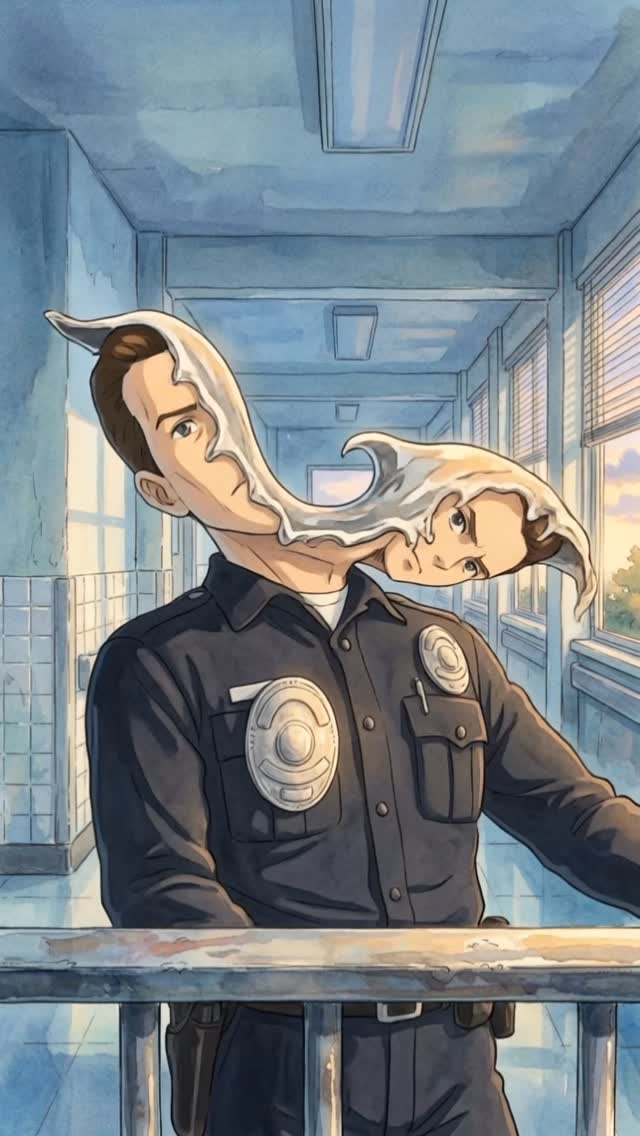
s1mple.ai: Surreal Liquid Head Police Officer AI Art
[Subject] A surreal uniformed officer standing in a sunlit institutional hallway, with a dark navy police-style shirt, metallic chest badges, and a calm body posture, while the head transforms into a flowing pale liquid ribbon that stretches sideways and resolves into two connected face forms. [Environment] A blue-toned corridor with tiled lower walls, long ceiling light fixtures, large windows on the right, warm daylight entering from outside, and a metal railing cutting across the foreground, evoking a school, hospital, or civic-building hallway. [Composition/Camera] Vertical mid-body portrait, camera positioned slightly below face level, subject centered but with the liquid head distortion extending dramatically to the right, foreground railing adding depth, corridor perspective lines guiding the eye toward the surreal deformation. [Lighting] Soft daylight mixed with cool interior ambient light, gentle reflections on the floor and badges, even illumination across the uniform, pale luminous highlights on the liquid face ribbon, warm window light balancing the cool hallway palette. [Style/Rendering] Surreal concept illustration with painterly anime-influenced realism, dreamlike institutional atmosphere, clean line structure, soft watercolor-like shading, uncanny visual metaphor, polished poster presentation. [Detail constraints] Preserve the officer uniform as grounded and readable, keep the liquid head transformation smooth and ribbon-like rather than gory, maintain the corridor perspective and windows as contextual anchors, ensure the surreal effect feels uncanny but elegant, and avoid horror clutter or excessive visual noise.

Negative prompt: gore, blood, horror splatter, zombie effect, messy distortion, extra limbs, broken anatomy, low detail hallway, cluttered background, harsh shadows, warped badges, muddy colors, low-resolution painterly blur, duplicated faces without flow connection

Suggested parameters: aspect ratio 2:3, stylize medium, high detail, surreal realism, painterly editorial mood, clean uncanny atmosphere

Delta prompt strategy:
1. If the surreal effect feels weak, increase the pale liquid ribbon stretching the head into two connected face forms.
2. If the image turns horror-heavy, remove gore and keep the transformation smooth, clean, and dreamlike.
3. If the hallway loses clarity, reinforce blue walls, windows, ceiling fixtures, and linear perspective.
4. If the uniform becomes generic, sharpen the police-style shirt, chest badges, and duty-belt details.
5. If the composition feels static, preserve the forward torso while letting the head distortion sweep laterally across the frame.
6. If colors become muddy, separate cool blue interior tones from warm daylight near the windows.
7. If the surreal ribbon lacks elegance, smooth the edges and create graceful flowing curvature between the faces.
8. If the image reads too realistic, add subtle painterly softness while preserving strong structural drawing.
9. If the foreground feels empty, keep the metal railing to anchor depth and realism.
10. If the mood becomes too literal, emphasize uncanny metaphor and poetic visual distortion over narrative explanation.
Video
GLOBAL LOCK: Retro sci-fi action-drama illustrated as painterly cinematic concept art with consistent late-20th-century dystopian thriller energy. Keep the main human lead as a white-presenting adult male in his 30s to early 40s with fair skin, strong jawline, short brown hair styled upward, athletic build, and a stern, protective posture. Keep the teenage boy slim, youthful, and slightly awkward, the red-haired mother tough and alert, the chrome humanoid machine perfectly metallic and expressionless, and the police officer as a surreal shape-shifting impostor whose face splits into a white liquid duplicate floating beside his head. Preserve the American Southwest setting with bars, alleys, concrete flood channels, desert highways, industrial firelight, institutional blue hallways, and motel-town streets. Maintain warm sunlit exterior tones, cool blue interior fluorescents, bright orange fire glow, silver chrome reflections, moderate painted texture, clean action readability, dramatic close-ups, and a mix of 35mm, 50mm, and 85mm cinematic framing. Speech style is sparse and trailer-like, with one or two short lines per beat, tense cadence, dry close-mic sound, and visible lip sync only where characters are front-facing in close-up.

[00:00-00:04] Night battlefield under a moonlit sky, a chrome endoskeleton warrior stands amid explosions and smoke, full-body wide shot with a low camera angle, burning debris behind it, hard orange backlight from fire, cold blue moon fill, drifting smoke and embers, no speech, only apocalyptic tension.

[00:04-00:08] Interior roadside bar or garage with warm practical lights and Pepsi signage, shirtless muscular man faces a woman at close conversational distance, medium close-up with shallow depth of field, tense eye contact, muted amber color grade, slight camera push-in, no speech or a low murmur that feels interrupted.

[00:08-00:12] Surprised close-up of the same male lead, 85mm portrait lens, eyes wide, a white liquid shape creeps into frame from the right edge, skin rendered with smooth painterly highlights, lips barely part as if about to say something, high lip-sync strictness if any whispered word is included.

[00:12-00:16] Wooden doorway confrontation, a heavy bearded man points a shotgun outward from inside a dim rustic room, reverse-shot structure from the visitor’s perspective, warm tungsten light inside, cooler dusk outside, angry expression, fast emotional escalation, cut sharply on the aiming gesture.

[00:16-00:20] Police officer stands behind a metal railing in a blue institutional corridor, daylight windows on the right, his face splits into a white liquid double that floats off to one side, medium shot and then close-up, uncanny identity distortion locked to the character description, dry fluorescent lighting, no comedy, pure body-horror unease.

[00:20-00:24] The police impostor faces a silver chrome humanoid in a workshop or station-like interior, alternating close two-shots and profile shots, the officer studies the machine while the machine remains unreadable, polished reflections on metal surfaces, low conversational tension, spoken line if used should be controlled, cold, and clipped.

[00:24-00:28] Exterior small-town alley with an ATM and pale morning sunlight, a teenage boy stands with another teen beside a red dirt bike, medium-wide framing, concrete walls and utility lines create depth, naturalistic golden daylight, hesitant body language, short casual dialogue possible with loose teenage cadence.

[00:28-00:32] The boy meets the red-haired mother, then they launch on the bike through a yard and into open road, camera alternates between side tracking and rear chase framing, dust and wind motion emphasized, warm sun, hopeful but urgent energy, no visible speech once the ride begins.

[00:32-00:36] Domestic kitchen interior with the red-haired mother alone, plaid sleeveless shirt, checking space around her with alert suspicion, then transition to a long concrete flood channel where a motorcycle races toward camera. Use medium shots indoors, wide vanishing-point exterior frames outside, bright noon light, pacing accelerates.

[00:36-00:40] A chrome humanoid emerges from a wall of fire in a blazing industrial doorway, centered heroic composition, flames licking around perfect metal anatomy, then cut to the main group lined up together like a defensive unit. Keep the contrast high, metal glossy, and fire glow intense, no speech, only mythic escalation.

[00:40-00:44] Return to the blue hallway where the police impostor’s face peels into a vertical white liquid split, then cut to a car interior crossing desert country with the teenage boy in the back seat and the stern protector driving. Tight close-up on the melting face, then side-profile car shots with golden late-afternoon light, minimal dialogue with deliberate pauses.

[00:44-00:48] Reveal a robotic hand behind glass, a Black male observer studies the mechanical fingers, then another man exposes his own cybernetic arm in a bright interior. Macro mechanical details, articulated joints, cables, metal knuckles, cool clinical light, slow deliberate hand motion, no speech or a single stunned reaction word.

[00:48-00:52] Mechanical hand flexes in close-up, then the police figure charges forward in front of fire, furious and no longer convincingly human. Close, aggressive framing, rapid motion, hot industrial glow, smoke, clenched teeth, voice if present should be forceful and urgent with hard consonants.

[00:52-00:56] Leather-jacketed hero loads a shotgun in a workshop, chest-up framing and insert shots of the weapon, then he appears in full figure, bandolier across his body, locked in battle stance. Use crisp action inserts, fiery orange backlight, metallic set dressing, and a hard determined facial expression.

[00:56-00:58] Final desert tag: a black-clad woman in sunglasses holds a rifle near a rugged vehicle and Joshua trees, medium-wide hero shot in harsh dry sunlight, wind moving clothes slightly, no speech, end on a survivalist future-war note.

NEGATIVE PROMPT: low-detail faces, inconsistent identities, duplicated limbs, broken fingers, warped firearms, unreadable props, incorrect police uniform details, cartoon slapstick tone, muddy chrome reflections, flicker between shots, temporal jitter, random text or logos, floating objects without narrative purpose, soft mushy anatomy, deformed motorcycles, broken perspective, accidental modern smartphones, robotic lip movement, off-timing mouth shapes, slurred dialogue, metallic synthetic voice, harsh sibilance, clipped peaks, pumping compression, over-denoised speech, and mismatched room tone between cuts.

SPEECH PACK:
[00:08-00:12] Speaker A, closest audible: "What the hell is that?" Safe paraphrase: "He sees something impossible entering frame." TAKE_A: shocked, breath catches before "hell". TAKE_B: lower, more controlled disbelief. TAKE_C: whispered panic. Lips visible: yes, high sync.
[00:20-00:24] Speaker B, closest audible: "You are not him." Safe paraphrase: "The officer realizes the machine is not human." TAKE_A: flat and clinical. TAKE_B: suspicious and tense. TAKE_C: almost whispered. Lips visible: partial, medium sync.
[00:24-00:28] Speaker C, closest audible: "Come on, let's go." Safe paraphrase: "The teens move toward the bike." TAKE_A: rushed. TAKE_B: nervous. TAKE_C: urgent whisper. Lips visible: partial, medium sync.
[00:32-00:36] Speaker D, closest audible: "Get inside." Safe paraphrase: "A protective instruction before the chase escalates." TAKE_A: firm. TAKE_B: louder warning. TAKE_C: clipped command. Lips visible: low to medium sync.
[00:40-00:44] Speaker A, closest audible: "He's still behind us." Safe paraphrase: "They realize the threat remains active during the drive." TAKE_A: tense low voice. TAKE_B: controlled urgency. TAKE_C: breathy fear. Lips visible: partial, medium sync.
[00:48-00:52] Speaker B, closest audible: "Run!" Safe paraphrase: "Immediate danger forces escape." TAKE_A: shouted. TAKE_B: raw panic. TAKE_C: hoarse command. Lips visible: yes, high sync.
Video
Create a vertical close-up video of a tarot card that looks entirely handmade from knitted yarn and soft textile stitching. The card should fill most of the frame and depict a pastel interpretation of The Hanged Man: a small skeleton figure hanging upside down from a horizontal branch, surrounded by a decorative stitched border. Use a gentle handmade aesthetic rather than horror. The entire image should appear woven or embroidered, with visible knit loops, soft thread texture, and slightly fuzzy yarn edges. Keep the palette muted and dreamy, using dusty pink, pale lavender, faded green, and cream tones.

Place the Roman numeral XII above the title area and include the words THE HANGED MAN in a stitched, readable all-caps style along the lower portion of the card. The composition should stay centered and symmetrical like a tarot illustration, with the branch near the top, leafy hanging vines on either side, and the upside-down skeleton occupying the middle. The motion should be minimal: just a slight camera hold or faint parallax that gives life to the card while preserving the feeling of a static textile artwork.

Avoid realistic gore, blood, decay, or any harsh horror cues. The skeleton should feel symbolic and stylized, more like folk art or whimsical fiber illustration than a graphic death image. Use soft, even lighting and a clean neutral background so the tactile knitted-card effect remains the star. The final result should read as a surreal handcrafted tarot card animation with cozy fabric texture and clear visual focus on the Hanged Man motif.
Video
GLOBAL LOCK: Vertical 9:16 surreal exterior video of an ornate cemetery mausoleum transformed into a blush-pink couture architecture object, viewed front-on in a real graveyard under cold overcast daylight. Keep the same chapel-like stone structure throughout, but cover it in layers of pastel pink drapery, bows, gathered fabric, lace, rosettes, scalloped trims, and bridal-lolita ornament so the building feels like a funerary monument wrapped in soft ceremonial fashion. The surrounding cemetery must remain realistic: weathered gravestones, stone pathways, bare winter trees, muted gray-blue sky, and damp subdued atmosphere. Preserve the emotional contradiction of mortality rendered gentle and decorative. No people, no speech, no text overlays, only slight camera drift and quiet stillness.

[00:00-00:01] Reveal the full front view of the pink couture mausoleum in the cemetery. The structure has pointed gothic-ecclesiastical lines, but almost every surface is softened by blush drapery, bows, and lace-like ornament. Gravestones in the foreground anchor the scene in a real burial setting.

[00:01-00:02] Hold the composition with minimal camera drift. The building’s fabric-wrapped surfaces, scalloped decorations, and gathered embellishments become clearer, while the cold gray environment makes the pink treatment feel more uncanny.

[00:02-00:03] Preserve the same solemn cemetery atmosphere. The mausoleum should remain readable as funerary architecture, even as its details drift into wedding-cake, bridal, and lolita visual language. Keep the surrounding stones and trees muted and naturalistic.

[00:03-00:04] Continue the calm study of the structure. The tension should come from mismatch, not action: a monument to death presented as soft ceremonial fantasy architecture. No people appear, reinforcing stillness and emotional distance.

[00:04-00:05] End on the clearest hero hold of the pink mausoleum, balancing graveyard realism with elaborate pastel ornament. Keep the building centered, the cemetery bleak, and the decorative surfaces rich enough to feel tactile and excessive.
Video
Create a vertical cinematic overhead shot of an ornate fantasy carriage traveling slowly through an old graveyard. The carriage and horses should be entirely styled in soft pastel pink, with the carriage looking richly embellished by knitted textures, floral appliques, tassels, and lace-like fabric details. It should feel like a fairy-tale coach reimagined in textile form, with a rounded canopy, decorative trim, and soft sculptural surfaces. Two matching pale pink horses pull the carriage at a slow steady pace along a dirt path between weathered gravestones.

The cemetery should be realistic but subdued: gray and black headstones, scattered leaves, muted brown earth, and a calm overcast atmosphere. Keep the camera elevated in a high-angle tracking view so the carriage remains the hero object while rows of tombstones frame the route. The mood should be surreal and poetic rather than frightening. Emphasize the contrast between the delicate dreamy carriage and the somber graveyard setting.

Use soft naturalistic lighting with restrained color grading so the pink carriage stands out clearly against the earthy background. Motion should remain smooth and slow, with subtle wheel movement and gentle horse steps. Avoid gore, horror creatures, fog-machine cliches, or aggressive haunted-house styling. The result should feel like a visually subversive fantasy tableau: a romantic pastel carriage procession moving through a cemetery in a calm, elegant, slightly uncanny way.
Video

GLOBAL LOCK: a short vertical surreal cemetery tableau showing a wide field of blush-pink ornate gravestones arranged across muted grass and pale stone paths, each memorial marker decorated with bows, pearls, lace, floral appliques, padded satin textures, and ruffled tulle bases; no people, no vehicles, no text; cool overcast outdoor light with a restrained dusty-pink palette against gray-beige earth tones; the scene should feel like gothic bridal installation art, quiet, elegant, and uncanny, with minimal to no motion, vertical 9:16.

[00:00-00:01] Open on a broad elevated view of the cemetery grid, revealing many pink embellished tombstones spread across the lawn with small white flower bundles at the edges.

[00:01-00:02] Hold the composition so the viewer can read the repeating decorative logic across heart-shaped stones, crosses, rounded headstones, and low rectangular forms, all restyled in blush textile ornament.

[00:02-00:03] Preserve the contrast between the soft bridal material language and the solemn burial-ground layout, with pale stepping stones cutting through the frame and overcast light flattening the shadows.

[00:03-00:04] Let the camera drift almost imperceptibly while the repeated pearls, bows, lace trim, and gathered fabric bases remain the visual focus.

[00:04-00:05] End on the same complete cemetery installation view, emphasizing atmosphere, repetition, and the dreamlike couture treatment of every memorial object.
Video
GLOBAL LOCK: Create a short vertical top-down installation-art video showing a perfectly arranged symmetrical field of pale blush, ivory, and soft pink rococo-gothic objects placed on rough gray concrete ground. The composition reads like a tiny dollhouse cemetery, miniature shrine, or pastel memorial installation rather than a standard interior room. At the center sits an ornate heart-backed rococo chair or throne with elaborate trim and scalloped base. Around it are mirrored rows of small sculptural objects resembling miniature tombstones, altars, cherub-like figures, memorial pedestals, carved plaques, and soft baroque decorative blocks. The whole layout must feel curated, ritualistic, collectible, and highly controlled. The camera is a fixed overhead view with almost no movement beyond a subtle stabilization drift or tiny push. Lighting is soft natural or diffuse overcast daylight, preserving surface detail and pale tonal subtlety. No humans, no dialogue, no text, no UI.

[00:00-00:02] Open on the full installation from a direct top-down view. The heart-backed central chair anchors the arrangement, while miniature pale objects form mirrored rows above, beside, and below it. The gray concrete floor should remain visible between objects, adding a stark industrial contrast against the delicate pink-ivory ornamentation. Keep the camera still and the symmetry immediately legible.

[00:02-00:05.04] Continue holding the same top-down composition while allowing only a barely perceptible drift or push that helps the viewer study the central throne, the surrounding tombstone-like forms, the little statuary pieces, and the pastel memorial arrangement as a whole. Preserve the uncanny tension between cute rococo softness and funerary symbolism. End without breaking the symmetry or introducing dramatic movement.

NEGATIVE PROMPT: ordinary living room, standard dollhouse furniture set, bright toy-store shelf display, colorful rainbow palette, black gothic horror scene, candles and flames, dramatic fog, humans entering frame, handheld wobble, side-angle camera, missing central heart throne, missing symmetrical arrangement, missing tombstone-like forms, crowded cluttered composition, text overlays, logos, UI graphics, violent action, dark cemetery night scene, realistic full-scale graveyard, ornate gold palace interior, narrative character performance.

SPEECH PACK:
[00:00-00:05.04]
TAKE_A: [silent] no dialogue, quiet ambient stillness only
TAKE_B: [silent] no spoken words, faint outdoor hush if any
TAKE_C: [silent] static installation presentation, no voice, no lip-sync
Video
GLOBAL LOCK: Vertical 9:16 surreal exterior video showing a hearse transformed into an extravagant pastel-pink lolita object, parked in a quiet cemetery under an overcast sky. Keep the same full-vehicle side view throughout: a white hearse base almost completely covered in layers of blush pink ruffles, lace, bows, rosettes, scalloped fabric drapery, and ornamental frills, turning the vehicle into something between a funeral car, wedding carriage, and gothic dollhouse confection. The setting must remain a real cemetery with gravestones, bare winter trees, muted grass, and gray cold daylight. Preserve the emotional contradiction: death rendered soft, cute, decorative, and disarming. No people, no speech, no text overlays, no dramatic motion; only subtle camera drift and a still observational tone.

[00:00-00:01] Reveal the full pastel hearse parked on a cemetery road, framed from the side. The vehicle is densely wrapped in blush pink lace, bows, gathered fabric, and layered ruffles. Gravestones and bare trees in the background establish a sober real-world setting.

[00:01-00:02] Hold the same composition with a slight camera drift. The decorative surface details become clearer: window drapery, rosettes, scalloped trims, and plush textile volume covering nearly every contour of the hearse. Lighting remains flat and wintry, making the pink embellishment feel even stranger.

[00:02-00:03] Preserve the quiet cemetery atmosphere. The hearse should read as immediately recognizable in function yet visually softened into a lolita fantasy object. Keep the background muted and realistic so the contradiction remains the main event.

[00:03-00:04] Continue the calm exterior study. The lace and ruffle density should feel tactile and excessive, while the hearse silhouette remains legible underneath. No people appear, reinforcing the stillness and unease of the scene.

[00:04-00:05] End on the clearest hero hold of the pink lolita hearse in the graveyard, balancing softness and mortality in one image. Keep the pastel texture rich, the cemetery naturalistic, and the overall mood unsettling through mismatch rather than horror.
Video
GLOBAL LOCK: A vertical editorial video set in a real cemetery, focused on a cluster of ornate pastel-pink funerary sculptures and tombstone-like monuments staged against gray stone graves and dry earth. The objects must feel highly decorative and rococo-inspired, with shell motifs, bows, ribbon carvings, flourishes, and soft candy-colored surface treatment that contrasts with the sober graveyard surroundings. Keep the composition as a frontal-to-slightly elevated view, with muted daylight under overcast or flat natural sky, desaturated gray-brown cemetery tones in the background, and the pink monuments as the dominant visual subject. Preserve a surreal-but-gentle mood, no people, no spoken audio, and include a bold magazine-style text overlay block at the bottom reading like an editorial feature tease.

[00:00–00:01]
Open on a static or barely drifting vertical frame of a cemetery plot where several elaborate pastel-pink tomb monuments sit clustered together. The center structure is the largest, flanked by shell-like and ribboned decorative pieces. The background shows ordinary gray stone headstones, bare ground, and sparse wintery branches, making the candy-pink funerary objects feel uncanny by contrast. A lower-third editorial text overlay is already present near the bottom of the frame.

[00:01–00:02]
The camera holds or drifts forward only minimally, allowing the carved bows, shell ridges, scalloped edges, and ornamental relief work to become easier to read. The cemetery remains plainly real: dirt paths, dark stone, and weathered markers sit behind the soft pink structures. Keep the lighting flat and documentary-natural, not theatrical, so the surrealism comes from the object design rather than dramatic cinematography.

[00:02–00:03]
The frame continues to emphasize the contradiction between softness and mortality. The pink monuments look almost confectionary or dollhouse-like, while the environment remains a practical graveyard. The lower overlay text should stay legible and magazine-like, with a small brand tag and a main line about visual subversion, plus a swipe prompt. No subject movement occurs beyond tiny camera stabilization drift.

[00:03–00:04]
Maintain the same composition and mood, letting the eye move between the central pink memorial, the side shell-shaped pieces, and the gray headstones behind. The color treatment should preserve low-saturation earth tones in the background while keeping the pink objects softly luminous. The contrast must feel conceptual, not cartoonish.

[00:04–00:05]
End on the same eerie but gentle tableau: rococo pastel death imagery placed calmly inside an ordinary cemetery. The text overlay remains in place until the end. No cuts, no character entrance, no weather effects, and no audio-driven events. The clip should read like a short magazine feature intro on visual subversion through stylized symbols of death.

NEGATIVE PROMPT: gothic black cemetery styling, horror monsters, fog machines, dramatic blue moonlight, blood, gore, zombies, people entering frame, moving animals, neon colors, candy shop setting, text glitches, broken lettering, camera shake, warped grave geometry, low-detail carvings, extra monuments appearing, sunny golden hour, lush green grass, interior mausoleum, speech, narration, screaming, subtitles beyond the designed editorial overlay, melted rococo details, cartoon rendering.

SHOT PROMPTS:
Shot 1: vertical cemetery editorial frame with a cluster of ornate pastel-pink rococo tomb monuments against gray graves and dry earth, bold magazine-style lower-third text overlay present.
Shot 2: subtle drift or micro push-in revealing shell motifs, bows, scalloped edges, and decorative reliefs while the realistic cemetery background stays muted.
Shot 3: hold on the contrast between gentle pink memorial sculpture and the ordinary graveyard setting, keeping the bottom editorial text readable.
Shot 4: steady conceptual tableau with desaturated background and softly luminous pink funerary forms, no people and no action.
Shot 5: final still hold on the surreal cemetery composition with the overlay intact.

SPEECH PACK:
Speaker count: 0.
On-camera speech: none.
Transcript: none.
Lip-sync requirement: none.
Audio intention: no dialogue or narration; if any sound exists, keep it to neutral outdoor ambience only.
Delivery takes: not applicable because the reference is speech-free.
Overlay note: preserve a designed editorial lower-third text treatment as part of the visual reference, but do not generate additional captions beyond that intended magazine teaser block.
Video
GLOBAL LOCK: A short vertical surreal fashion-art video showing a colossal blush-pink and ivory ruffled gown-like structure standing alone on cracked gray urban ground, viewed from a slightly elevated angle. The central subject must remain a monumental dress-shaped sculpture with no visible wearer: layered tulle, organza, rosette-like ruffles, gathered fabric volume, and a chapel-train silhouette compressed into a towering architectural mass. The environment stays stark and empty, with rough concrete or weathered pavement creating a harsh contrast against the softness of the couture form. Keep the scale uncanny, as if a bridal monument has been dropped into a ruined city surface. Lighting is diffuse daylight with soft shadows, muted highlights, and a dusty editorial grade. Camera language is restrained and observational, using a slow overhead drift that studies the silhouette and texture rather than dramatic action. The mood is uncanny, romantic, abandoned, and sculptural. No humans, no dialogue, no on-screen text, no visible installation supports.

[00:00-00:01.6] Open on the full monumental gown sculpture from a high three-quarter overhead view. The viewer should immediately register the impossible scale, dense ruffle layering, and the contrast between delicate couture softness and cracked ground.

[00:01.6-00:03.2] Continue with a subtle slow drift that reveals more of the upper crown-like folds and the cascading side layers. Emphasize pale blush and ivory fabric textures, rosette clusters, and the sense that the object is both dress and building.

[00:03.2-00:05.04] Hold on the same surreal installation with minimal environmental movement. Preserve the empty urban surface, elevated camera angle, dusty cinematic palette, and the eerie absence of any wearer or surrounding crowd.

NEGATIVE PROMPT: visible human body, mannequin torso, runway event, bright saturated colors, modern traffic, bystanders, text overlays, logos, watermarks, glossy CGI shine, plastic fabric, low-detail folds, collapsing anatomy, fluttering chaotic cloth, camera shake, fast drone orbit, heavy wind, dark horror lighting, blue cast, rain, fantasy castle background, extra props, duplicated ruffles, unstable scale, temporal flicker, low-resolution texture.

SHOT PROMPTS:
SHOT 1: Elevated reveal of a giant blush-and-ivory couture gown sculpture standing alone on cracked urban ground.
SHOT 2: Slow observational drift over dense rosette and tulle layers, preserving monumental dress architecture.
SHOT 3: Final held portrait of the abandoned bridal monument in a muted editorial ruin setting.

SPEECH PACK: No spoken dialogue. Audio should remain minimal, with optional faint outdoor air and distant city hush only, keeping the scene silent and sculptural.
Video
GLOBAL LOCK:
Subject: A Caucasian woman in her late 20s, blonde hair tied in a neat ponytail, wearing a leopard-print (cheetah pattern) blouse.
Environment: A cozy home studio/office background with dark grey walls, wooden bookshelves filled with books, green indoor plants, and soft dual-tone lighting (warm orange light from one side, cool blue light from the other).
Camera: MCU (Medium Close-Up) framing, eye-level, 35mm lens feel with shallow depth of field.
Style: Professional UGC creator aesthetic, high-quality video, crisp audio.
Speech: Direct-to-camera delivery, energetic and authoritative tone.

[00:00–00:05]
Visual: Rapid montage of extreme macro close-ups (ECU). First, a human eye with visible iris patterns and eyelashes. Second, an ear with a gold hoop earring showing skin texture. Third, a wrist with a simple black line tattoo showing skin pores and fine hairs.
Action: Static macro shots.
Lighting: Bright, natural daylight feel for the macros.
Text Overlay: "most AI" -> "look fake" -> "because" -> "is trained".
Speech: "Most AI images look fake for one reason. Because AI is trained to remove flaws."

[00:05–00:11]
Visual: The woman (Subject) in the MCU studio setting, gesturing with her hands. Floating icons of AI tools (ChatGPT, Freepik, Ideogram, Nano Banana) appear around her.
Action: Subject talks directly to the camera, moving hands to emphasize points.
Lighting: Studio setup (Orange/Blue).
Text Overlay: "need" -> "AI tools" -> "to prompt".
Speech: "But we don't need better AI tools. We just need to prompt the model to create images that actually look real."

[00:11–00:21]
Visual: Transition to a black screen with white text titled "Master Prompt". The text scrolls or highlights specific sections. Then, a split screen showing the woman talking in a small window and the prompt text in a larger window.
Action: Subject continues talking while the prompt text is displayed.
Lighting: Studio setup for the talking head.
Text Overlay: "to create" -> "that actually" -> "look real".
Speech: "The key to realistic AI images is using a prompt with a specific structure. This prompt should force skin detail, including visible pores, uneven tone, and natural imperfections."

[00:21–00:30]
Visual: Montage of AI-generated faces with high realism. A man's face with stubble and pores, a woman's face with freckles and slight redness. Then, a screen recording of the Freepik interface showing a gallery of realistic portraits.
Action: Fast cuts between the portraits and the UI.
Lighting: Varied, matching the generated images.
Text Overlay: "most people start" -> "make" -> "image".
Speech: "Most people start their prompt with 'make a realistic image of'. I start by telling the model how the camera behaves."

[00:30–00:42]
Visual: Screen recording of a prompt being typed into a text box. Keywords like "iPhone 14 Pro", "handheld framing", and "imperfect composition" are highlighted in yellow.
Action: Scrolling through the prompt text.
Lighting: Digital UI.
Text Overlay: "model that" -> "camera behaves" -> "casual hand" -> "imperfect composition".
Speech: "Casual handheld framing, slightly imperfect composition, and a smartphone camera perspective. This alone already breaks the AI look."

[00:42–00:52]
Visual: The woman back in the MCU studio setting. She gestures toward floating app icons for "Enhancor" and "Higsfield". A screen recording shows a "Skin Enhancer" tool being used on a photo of a woman with goggles.
Action: Subject explains the final step.
Lighting: Studio setup.
Text Overlay: "But Most People Stop There" -> "Final Step" -> "Most Creators Are Gatekeeping".
Speech: "But most people stop there. I use a final step that most creators are gatekeeping. I run each image through a final skin enhancement step using Enhancor or Higsfield."

[00:52–01:00]
Visual: The woman in MCU, pointing down toward a text box that says "Comment GUIDE". A final zoom-out effect or a slight blur transition.
Action: Subject smiles and points.
Lighting: Studio setup.
Text Overlay: "Prompt Structure" -> "Workflow" -> "Comment GUIDE".
Speech: "If you want my exact prompt structure and the full workflow, just comment GUIDE and I'll send it over."

NEGATIVE PROMPT:
Smooth skin, plastic texture, perfect symmetry, airbrushed look, 6 fingers, distorted eyes, watermark, logo, blurry background (unless specified), robotic voice, lip-sync lag, harsh sibilance, flickering lights, low resolution.

SPEECH PACK:
[00:00-00:05] "Most AI images look fake for one reason. Because AI is trained to remove flaws."
[00:05-00:11] "But we don't need better AI tools. We just need to prompt the model to create images that actually look real."
[00:11-00:21] "The key to realistic AI images is using a prompt with a specific structure. This prompt should force skin detail, including visible pores, uneven tone, and natural imperfections."
[00:21-00:30] "Most people start their prompt with 'make a realistic image of'. I start by telling the model how the camera behaves."
[00:30-00:42] "Casual handheld framing, slightly imperfect composition, and a smartphone camera perspective. This alone already breaks the AI look."
[00:42-00:52] "But most people stop there. I use a final step that most creators are gatekeeping. I run each image through a final skin enhancement step."
[00:52-01:00] "If you want my exact prompt structure and the full workflow, just comment GUIDE and I'll send it over."
Video
GLOBAL LOCK: A vertical cinematic-teaching reel, approximately 47 seconds, designed as a visually rich prompt-and-framing tutorial for better AI-generated film stills. The video alternates between sample portrait or scene imagery and bold centered on-screen text that critiques low-quality AI aesthetics and then replaces them with concrete visual principles. The piece opens with a polished but generic blonde beauty portrait on a black background labeled as “low quality AI,” then pivots into stronger cinematic examples: moody urban night scenes under arches, distant silhouettes in fog, soft practical lighting, handheld-style portraits, and warm sunset close-ups of a short-haired woman. The overall color world leans teal-green shadows, warm amber highlights, subtle grain, and low-key cinematic contrast.

The structure is educational, not narrative. Text captions carry the teaching flow: first rejecting weak AI image habits, then introducing simple filmmaking rules such as better frames, one dominant camera perspective, warm sunset key light from one side, natural texture, contrast, and the idea that the work should visually prove itself. The imagery should feel like proof-of-concept boards or moving mood references rather than continuous story scenes. Most shots are carefully composed single moments: a woman framed in shallow light, two people under an urban arch, a hand-held close-up with soft night lighting, and other filmic fragments that demonstrate intentional cinematography.

The tone should feel confident, minimalist, and opinionated, like a creator explaining how to stop making generic AI portraits and start making cinematic images with stronger visual grammar. Visual priorities: centered all-caps instructional text, black separators or negative space, elegant comparison between generic beauty render and moodier cinematic frames, teal-and-amber grading, shallow depth of field, strong directional light, tasteful grain, and compact tutorial pacing. Avoid busy graphics, loud meme styling, or heavy voice-dependent explanation. The point is that the lesson is readable through image-plus-caption alone.
Video
GLOBAL LOCK: A vertical cinematic fashion tutorial video that begins with a direct hook and transitions into a moody nighttime beach portrait sequence. The subject is an East Asian young woman with short black hair and light skin, wearing a white satin slip dress, with visible tattoo sleeves and shoulder tattoos on one arm. The visual identity combines raw direct-flash photography, grainy night texture, dark ocean horizon, bright moonlight in the sky, wet sand reflections, and a dreamy editorial tone. Keep the same woman, dress, tattoos, beach-at-night setting, flash-lit skin highlights, and minimalist sensual styling throughout. The audio style is creator-led tutorial / prompt-sharing narration with concise social-video pacing, dry close mic sound, and an intimate but confident tone.

[00:00–00:04] Extreme close-up of the woman’s eye and cheek under hard direct flash, with a metallic star sticker on her face and strands of black hair crossing the frame. Large bold text appears in sequence: “STEAL,” “STEAL MY,” “STEAL MY AI,” “STEAL MY AI PROMPTS.” The camera is nearly static, intimate, and confrontational, using a macro beauty framing with shallow focus and stark flash highlights against deep shadow.

[00:00–00:04] The hook is spoken or implied as a fast creator-style opening line inviting viewers to take the prompts. Speech cadence is clipped and attention-grabbing, landing in sync with each text change. Lips are only partially visible, so sync matters less than timing and mood.

[00:04–00:09] Cut to a full-body night beach portrait. The woman stands barefoot at the shoreline in the white slip dress, lit by harsh on-camera flash while the moon glows above the horizon. Yellow subtitle-style text begins presenting prompt-writing advice across the lower portion of the frame. The camera alternates between profile and back views as she faces the sea, then touches her hair and turns slightly toward camera. Keep the wet sand glistening and the sky nearly black-blue.

[00:09–00:14] Continue the beach sequence with slower editorial posing. The woman steps through shallow water, then faces away from camera so the back of the dress and her damp hair are visible. Use a mix of medium full-body and lower-body shots that emphasize bare feet in the surf, dress hem in water, and direct-flash specular highlights on skin and fabric. The voiceover/tutorial text explains how the prompt should describe camera treatment and mood, while the images function as the visual result.

[00:14–00:19] The woman sits or kneels near the shoreline and opens her arms outward, then shifts into seated portrait poses looking toward the horizon and back to camera. The composition becomes softer and more romantic while still retaining the raw flash look. Yellow caption blocks continue in the lower frame with practical prompt tips. Motion is minimal, with small posture changes and gentle ocean movement carrying the scene.

[00:19–00:23] Move into medium close-up portraits of the seated woman in the surf. Her tattoos, shoulder line, cheekbones, and the satin texture of the dress become more prominent. She glances downward, then sideways, then leans toward the camera. Maintain the tension between harsh direct flash and soft emotional expression. The tutorial text suggests concrete structure for recreating the look rather than vague aesthetic language.

[00:23–00:25] End on standing and close-up beach portraits with the woman facing camera head-on and then slightly off-axis. The dress clings softly with dampness, the tattooed arm remains a clear identity anchor, and the flash creates a glossy editorial finish. The final beat feels like a complete visual example of the prompt style being taught: raw, romantic, direct-flash night photography translated into AI-video form.
Video
Create a vertical 9:16 premium AI model promo visual featuring an ultra-realistic close-up portrait of a young woman facing directly into camera against a dark teal background. She has fair skin, dark hair pulled back, subtle natural makeup, and translucent amber-orange eyeglasses catching a precise highlight across the frame. The lighting should be soft but dramatic, sculpting the face with studio precision and emphasizing realistic skin texture, calm eyes, and balanced symmetry. In the composition, glowing yellow ImagineArt 1.0 text appears in the upper right, while Most Realistic AI Model is set large at the bottom like bold creator-marketing typography. The overall feeling should be a polished product ad announcing a highly realistic character-generation model for creators and brands. No clutter, no subtitles, no cartoon styling.
Video
Kallaway
GLOBAL LOCK: One single male creator remains consistent across the full video: a light-skinned man in his late 20s to early 30s with a slim build, wearing a black baseball cap and black hoodie, speaking directly to camera from a dark creator studio with subtle blue and warm accent lighting. The video is a vertical 9:16 tutorial about an “ultimate AI cheat code” for recreating image styles using visual analysis, reference images, style reference codes, prompt breakdowns, and image-generation workflows. On-screen visuals include cinematic image grids, red and black graphic compositions, moodboard-like galleries, prompt boxes, style reference code text, ChatGPT or AI assistant windows, and image-generator interfaces. The editing style alternates between talking-head explanation and crisp screen recordings, with bold subtitle emphasis and rapid creator-education pacing. Speech is single-speaker, clear, energetic, and instructional, with high lip-sync importance whenever the creator is on screen.

[00:00-00:06] Open with a strong hook calling this the ultimate AI cheat code. Flash multiple stylized image examples on screen, including cinematic portraits, surreal visuals, and polished art-directed compositions. The creator speaks directly to camera in a medium close-up, hands raised to stress the promise.

[00:06-00:14] Show how the method starts from any image or visual example. Alternate between the creator and moodboard grids of different aesthetics, including pink sunset scenes, red graphic posters, and cinematic portraits. The creator explains that the system can analyze style rather than just copy random prompts.

[00:14-00:22] Move into the reference and analysis stage. Display image-library interfaces, style examples, and tools that inspect visual characteristics. The creator explains that visual style is hidden inside references, not just in obvious prompt text. Screen recordings should be crisp and legible.

[00:22-00:31] Introduce style reference codes and code-like descriptors. Show a clean screen with “Style Reference Codes” or similar text, followed by example outputs generated from these references. The creator describes how the code or extracted pattern can be applied to other images to keep a consistent visual language.

[00:31-00:40] Bring in AI assistant windows or chat interfaces where the creator asks for word-based breakdowns of the visual style. Display prompt boxes, short analytical responses, and extracted descriptors that summarize lighting, palette, mood, composition, and texture. He explains that words plus references create stronger reproduction.

[00:40-00:49] Show comparison grids and more style examples across different subjects. The creator explains how you can take one visual system and reuse it on other scenes, people, or concepts. The interfaces display image sets, generated outputs, and moodboard transitions to demonstrate consistency.

[00:49-00:55] End on the creator in close-up with a concise final takeaway that the easiest way to recreate strong visuals is to combine references, extracted words, and style codes rather than guessing prompts from scratch. Finish with confident tutorial energy and a direct promise of better outputs.

NEGATIVE PROMPT: multiple presenters, podcast microphones, bright casual room, unrelated stock footage, blurry UI, no image grids, no reference code text, no AI assistant windows, generic filler b-roll, identity drift, unsynced lips, cartoon overlays, or slow low-energy pacing.

SPEECH PACK: Single male tutorial speaker only. Fast creator-educator cadence, crisp articulation, close-mic dry sound, emphasis on terms like style, references, words, codes, and images, high lip-sync importance in all talking-head segments, no second voice.
Video
GLOBAL LOCK: A young man in his early 20s, Mediterranean/Southern European appearance, olive skin tone, curly dark brown hair, well-groomed mustache and goatee. He wears a black cotton t-shirt with a vintage-style graphic print. The environment is a modern home office with soft, natural indoor lighting and a blurred background containing shelves and posters. Cinematic color grading with high dynamic range and soft highlight rolloff. Speech is energetic, clear, and direct-to-camera.

[00:00–00:02]
Subject: The man in a maroon and navy blue soccer jersey with "PEOPLESTYLE 07" on the front.
Environment: A grey asphalt street with white crosswalk markings.
Action: Standing still, looking directly at the camera with a neutral expression.
Framing: Medium shot, eye level.
Lighting: Warm, sepia-toned, mimicking the aged oil painting texture of the Mona Lisa shown in the top half of the split screen.
Motion: Subtle handheld camera micro-shake.
Speech: No speech, upbeat background music starts.

[00:02–00:03]
Subject: The man in a dark charcoal suit, white shirt, and striped tie.
Environment: A high-rise office with a large window overlooking a city skyline.
Action: Holding a vintage black desk phone to his ear, looking slightly off-camera.
Framing: Medium shot, eye level.
Lighting: High contrast, deep blues and vibrant yellows, mimicking Van Gogh's "Starry Night" shown in the top half.
Motion: Static camera.

[00:03–00:05]
Subject: The man in a plain black t-shirt.
Environment: An outdoor desert landscape at dusk.
Action: Profile view, looking over his shoulder toward the camera.
Framing: Medium close-up, side angle.
Lighting: Monochromatic warm orange glow, soft backlighting, mimicking the geometric 3D art above.
Motion: Slow camera pan around the subject.

[00:05–00:11]
Subject: The man in the global lock black graphic tee.
Environment: Home office desk with a laptop in the foreground.
Action: Talking to the camera, using expressive hand gestures (palms up, moving outward).
Framing: Medium close-up, eye level.
Lighting: Natural window light from the side, shallow depth of field.
Speech: "to your... with absolutely no prompts... that's why I started using..." (Energetic, persuasive tone).
Sync: High lip-sync strictness; cuts land on phrase endings.

[00:11–00:20]
Visual: Screen recording of the Higgsfield Hex interface. A dark mode dashboard. A cursor moves to click a "Color transfer" button. An abstract red, black, and white painting is uploaded. The UI extracts a color palette (red, pink, tan).
Action: Digital UI interaction.
Lighting: Clean digital screen glow.
Speech: Narrating the process (implied).

[00:20–00:37]
Subject: Back to the man in the home office.
Environment: Same as [00:05-00:11].
Action: Continuing to talk and gesture. Floating UI cards appear in front of him showing various images (a white goat, a vintage car, a blonde woman) all styled with the same color palette.
Framing: Medium close-up.
Text Overlays: "ARTISTIC VISION NOW DECODED", "#hex", "Comment 'SOUL'".
Speech: "and that's it... choose... artistic vision now decoded... if you want to try this out, comment 'SOUL' and I'll send you..."
Sync: High lip-sync strictness. Final cut on the CTA.

NEGATIVE PROMPT: Robotic speech, flat delivery, blurry face, inconsistent facial hair, flickering lighting, distorted UI text, messy background, unnatural hand movements, low-resolution textures, over-saturated colors, lip-sync lag.

SPEECH PACK:
[00:05–00:11]
Transcript: "...to your videos with absolutely no prompts. That's why I started using..."
TAKE_A: (Fast, excited) "...to your videos with absolutely NO prompts! That's why I started using..."
TAKE_B: (Confident, steady) "...to your videos with absolutely no prompts. [pause] That's why I started using..."

[00:20–00:37]
Transcript: "And that's it. Choose... artistic vision now decoded. If you want to try this out, comment 'SOUL' and I'll send you the link."
TAKE_A: (Inviting) "And that's it! Just choose... artistic vision now decoded. If you want to try this out, comment 'SOUL' [emphasis] and I'll send you the link!"
TAKE_B: (Direct) "And that's it. Choose your style. Artistic vision decoded. Comment 'SOUL' now and I'll send it over."

AI Art Generator

AI art generator content only becomes useful when it goes past the broad promise of making an image. Most creators who search this topic already know that part. What they want is a clearer path to a specific look: a hand-painted portrait, a watercolor scene, a moody fantasy frame, or a comic-panel style that feels deliberate instead of random. The best examples on this page should help you judge style fidelity first, because that is usually the difference between a throwaway render and an image worth building on.

That is also why medium language matters. A creator chasing baroque lighting, ink texture, or anime cel shading is not asking for the same thing as someone who wants a polished product shot. If you use the examples and prompts here well, you can narrow your aesthetic much faster and spend less time cleaning up outputs that never matched the look you wanted in the first place.

FAQ

What is an AI art generator best at?

It works best when you have a clear visual direction. The strongest results usually come from style-specific prompts that mention medium, mood, color treatment, and composition instead of vague one-line requests.

Can AI art generators mimic painting styles?

Yes. They are especially useful for oil-painting, watercolor, ink, anime, and comic-inspired looks when your prompt pushes the style language hard enough from the start.

How do I get less generic AI art?

Use references to medium, era, texture, and framing. Creators usually get better results when they describe the artwork like an art director instead of asking for a generic beautiful image.

Are AI art generators good for collectible or portfolio pieces?

They can be a strong starting point, especially when you care about concept exploration and visual range. The most useful examples on this page are the ones that already show a point of view rather than filler output.

AI Art Generator: Style Ideas, Prompts & Creator Examples | Alici.AI